
Nvidia’s DSX POD Puts an AI Data Center in a Shipping Container — and Cuts Setup to 14 Days
Key takeaway: Nvidia’s DSX POD, unveiled on October 21, 2026 at GTC Berlin, packs seven Vera Rubin AI racks into a factory-built, container-sized module, cutting on-site AI data center deployment from around six months to as little as 14 days — but only where power, cooling, and networking are already ready.
Nvidia is no longer just selling the chips inside AI data centers. It now wants to sell the data center itself — pre-assembled, pre-tested, and shipped in a container.
The company unveiled the DSX POD at its GTC conference in Berlin on October 21, 2026. The pitch is simple: instead of assembling thousands of parts on a construction site, most of the work happens in a factory, and the finished module arrives ready to plug in. Nvidia says partner deliveries will begin worldwide in early 2027.
What Nvidia actually announced
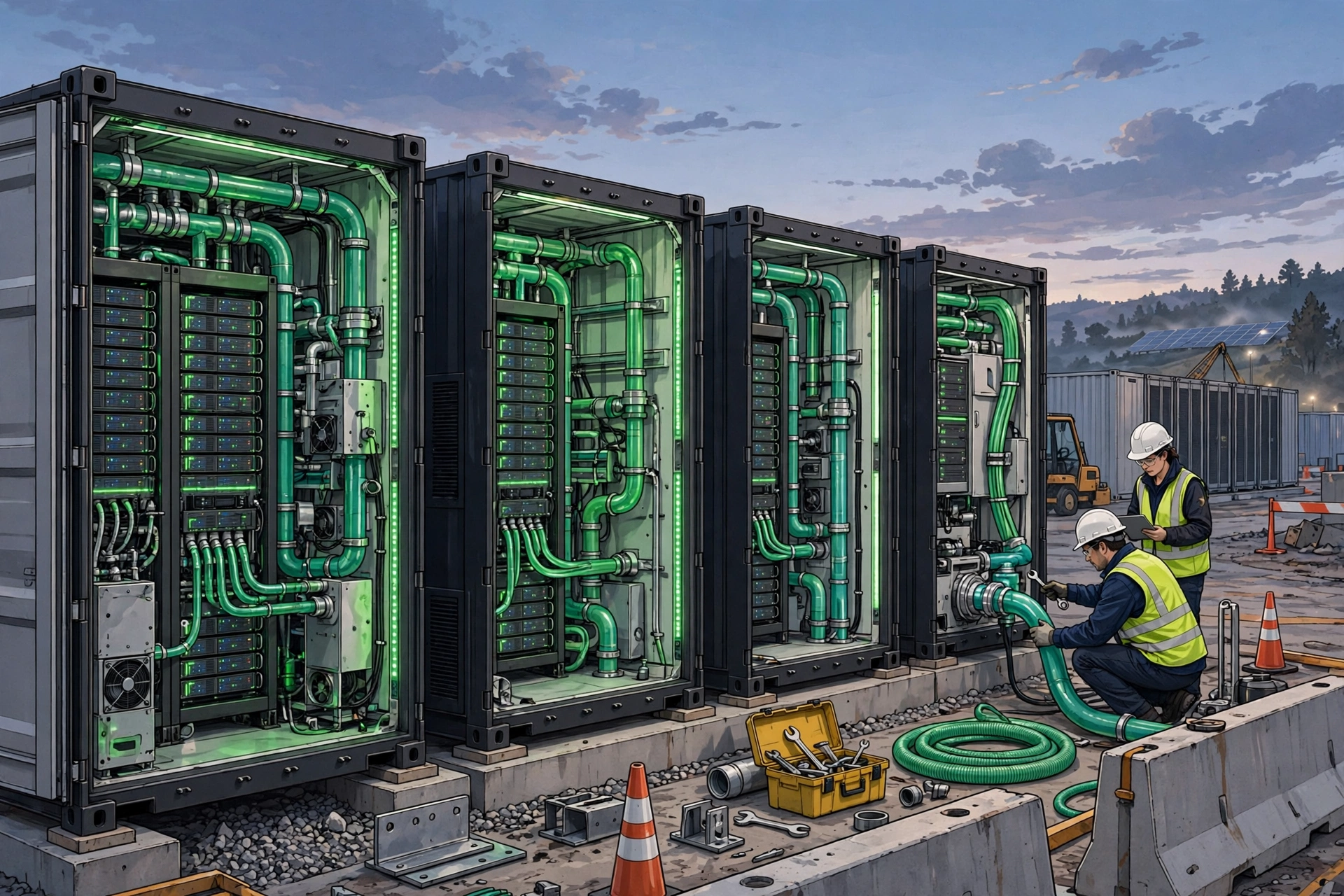
The DSX POD is a reference design for a complete Vera Rubin AI factory in modular containers. Each pod centers on seven liquid-cooled Vera Rubin NVL72 racks, linked by 17 kilometres of Spectrum-X networking cabling — 504 Rubin GPUs in total, according to Nvidia executives quoted in trade coverage of the launch.
The module is roughly the size of a standard shipping container and weighs about 28 metric tonnes, making it transportable by truck on conventional roads. Racks, networking, cabling, power distribution, and liquid cooling are integrated and tested before the unit leaves the factory.
“This is a fully assembled, fully tested, fully pre-plumbed, prebuilt, pre-validated container that is the building block for AI factories,” Ian Buck, Nvidia’s vice president of hyperscale and high-performance computing, said in a media briefing reported by Data Center Knowledge.
Seventeen partners — including Dell Technologies, HPE, Lenovo, Eaton, Schneider Electric, and Vertiv — plan to deliver DSX POD units worldwide from early 2027.
Why 14 days matters — and what it does not fix
Nvidia founder and CEO Jensen Huang framed the announcement in financial terms at GTC Berlin. “An AI factory creates value when it starts producing tokens, not when construction is complete,” he said. Tokens are the units of text or other data that AI models process and generate — so every week a data center sits unfinished is a week it earns nothing.
Huang illustrated the point with a striking example: a data center expected to generate $40 billion in annual revenue would lose the equivalent of $10 billion if delayed by three months. That figure was an illustrative estimate from Huang, not a loss reported at any specific facility.
The important caveat is in the fine print. The 14-day figure applies to deployment at a prepared site — one where utilities are already in place. As analysts noted in launch coverage, securing power supply, cooling infrastructure, and network connections can be the hardest part of building a data center, and none of that is solved by a container. The DSX POD compresses the integration stage, not the whole construction project.
Still, running site preparation and factory integration in parallel, rather than one after the other, is a real change in how AI capacity gets built. It also shifts the bottleneck: if deployment takes two weeks, manufacturing throughput — how fast chips, substrates, and optical components can be produced — becomes the limiting factor instead.
Traditional build vs. DSX POD
| Traditional on-site build | Nvidia DSX POD | |
|---|---|---|
| Where assembly happens | On the customer site, rack by rack | In a factory, before shipping |
| On-site deployment time | Around six months | As little as 14 days at a prepared site |
| Cabling and cooling | Installed and tested on site | Pre-installed, pre-plumbed, factory-tested |
| Compute per module | Varies by design | Seven Vera Rubin NVL72 racks, 504 GPUs |
| Availability | Project-dependent | Partner deliveries from early 2027 |
Why Nvidia is doing this now
The announcement lands in the middle of a scramble for AI computing capacity. Cloud providers are reporting sold-out capacity, and Nvidia’s own Vera Rubin platform is now in full production, with fully liquid-cooled racks designed for dense, high-power deployments.
The same GTC Berlin event saw Google Cloud’s first Vera Rubin-based A5X instances go live with an initial customer, with general availability planned for November 2026 and Google Cloud planning to scale Vera Rubin infrastructure to as many as 960,000 Rubin GPUs across multiple sites. That figure is a stated plan, not installed capacity — but it shows the scale of demand that containerized deployment is meant to serve. For context, see our coverage of OpenAI’s GPT models coming to Google Cloud, another sign of how cloud AI capacity is being stitched together.
The demand side is just as clear. Proactive AI agents such as Anthropic’s Claude Duet and giant open models like Moonshot AI’s Kimi K3.1 Pro both need enormous inference capacity — and that capacity has to be built somewhere, fast.
Knowns, unknowns, and what to watch
What is confirmed: the DSX POD design, its seven-rack Vera Rubin configuration, the 17-partner ecosystem, the early-2027 delivery window, and the 14-day deployment target at prepared sites.
What is still unknown: pricing, the exact container dimensions, how many pods a single site can practically chain together, and whether factory throughput can keep pace with orders once deliveries begin.
What to watch: the first partner shipments in early 2027, real-world deployment times at customer sites (as opposed to Nvidia’s target), and whether rivals or open standards such as the Open Compute Project’s MGX designs offer a competing modular path.
For businesses, the practical takeaway is narrower than the headline. If you are planning AI infrastructure, the DSX POD is worth watching — but judge it on the time from a fully prepared site to first token, not on the 14-day figure alone. And if you want USABite’s coverage to keep showing up in Google Search, add us as a preferred source in the Google app.
Frequently asked questions
What is Nvidia’s DSX POD?
Nvidia’s DSX POD is a factory-built, container-sized module containing a complete Vera Rubin AI factory: seven liquid-cooled NVL72 racks, networking, cabling, power distribution, and cooling, all integrated and tested before shipping.
How fast can a DSX POD be deployed?
Nvidia says deployment at a prepared site can drop from around six months to as little as 14 days. The figure assumes the site already has power, cooling, and networking ready; it does not cover building those utilities from scratch.
How many GPUs are in one DSX POD?
One DSX POD contains seven Vera Rubin NVL72 racks with a total of 504 Rubin GPUs, connected by 17 kilometres of Spectrum-X networking cabling.
When will DSX POD units be available?
Nvidia says 17 partners, including Dell, HPE, Lenovo, Schneider Electric, and Vertiv, will deliver DSX POD units worldwide starting in early 2027.
Does the DSX POD solve the AI data center power problem?
No. The DSX POD speeds up on-site integration, but securing power, cooling, and network capacity remains a separate challenge that site owners must solve before the 14-day deployment clock can start.
Sources
- The Hindu — Nvidia targets 14-day AI data centre deployment with modular system
- Data Center Knowledge — Nvidia unveils DSX Pod for faster AI data center builds
- Technology.org — Nvidia DSX POD puts AI factories in containers
- Unite.AI — Google Cloud’s first Nvidia Vera Rubin A5X instances go live






One Comment
Comments are closed.