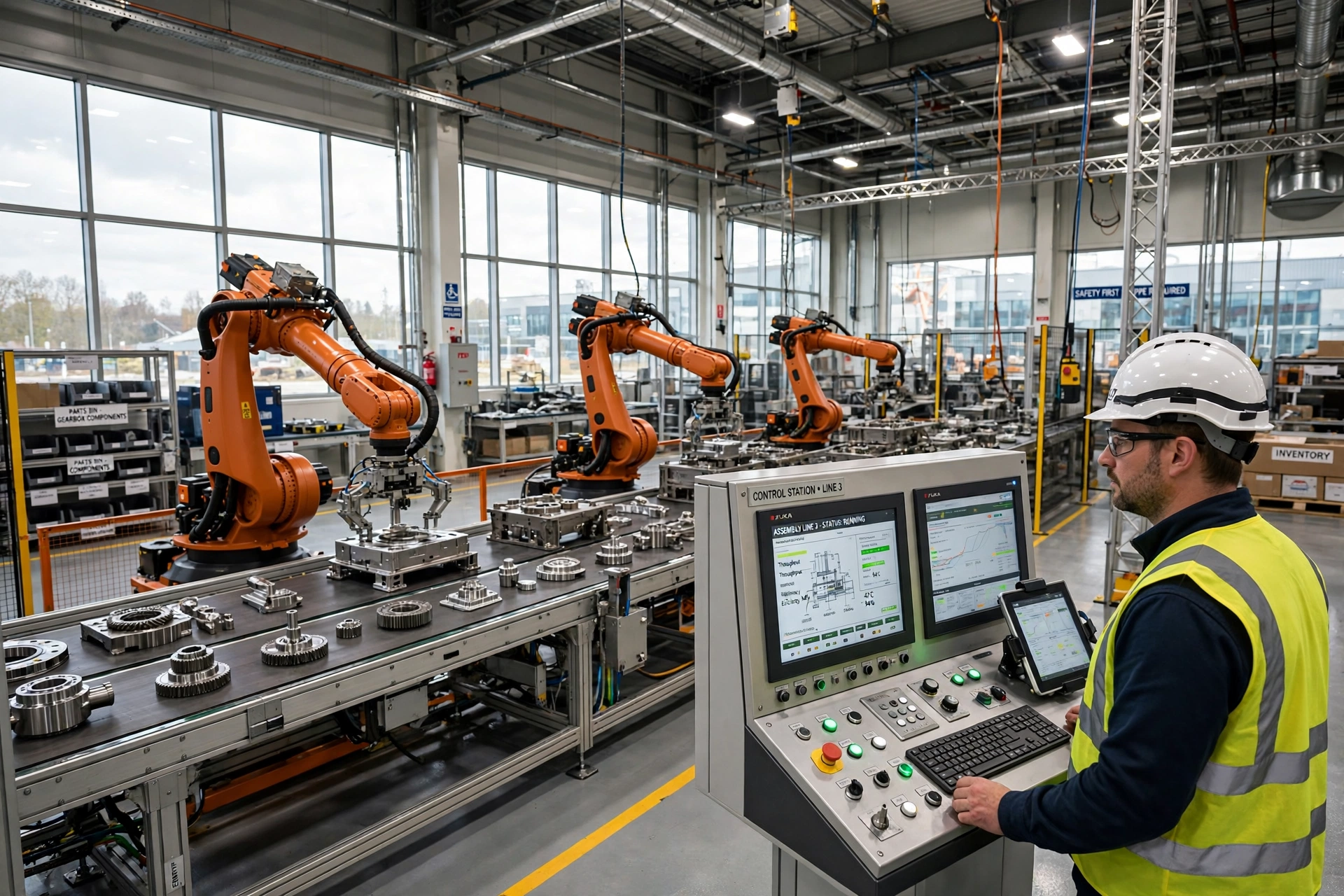
Automating Manufacturing Systems Explained: What They Are, How They Work, and Where They Pay Off
Key takeaway: Automating manufacturing systems means replacing manual control of production with connected machines and software — robots, programmable logic controllers (PLCs), SCADA systems and manufacturing execution systems (MES) — that run, monitor and adjust work on their own. The goal is removing repetitive, error-prone tasks so factories produce more, with fewer defects and less downtime.
What automating manufacturing systems means
Automating manufacturing systems is the process of using machines, control systems and software to run production with as little manual intervention as possible. Instead of an operator starting each machine, checking each part and recording each result by hand, the system does those jobs itself.
It is broader than buying a single robot. A fully automated setup connects several layers: the machines that do the physical work, the controllers that tell them what to do, and the software that schedules and tracks production. The market is large and still growing: Market Research Future valued global industrial automation at $234.72 billion in 2025 and projects $251.06 billion in 2026, reaching $459.97 billion by 2035.
The five layers of an automated factory
Every automated factory is built from the same basic layers, even though the equipment differs by industry:
| Layer | What it does | Examples |
|---|---|---|
| Physical equipment | Performs the production work | Industrial robots, cobots, CNC machines, conveyors |
| Control systems | Tell machines exactly what to do, in real time | PLCs, distributed control systems (DCS) |
| Monitoring | Watch the whole process and raise alarms | SCADA systems, human-machine interfaces (HMI) |
| Execution software | Schedule jobs, track orders and record quality data | MES, linked to ERP systems |
| Analytics and AI | Predict failures and optimise the schedule | Predictive maintenance, machine vision, digital twins |
The MES sits in the middle: it turns the production plan from the business system (ERP) into tasks for the shop floor, then reports back what happened.
How the systems work together
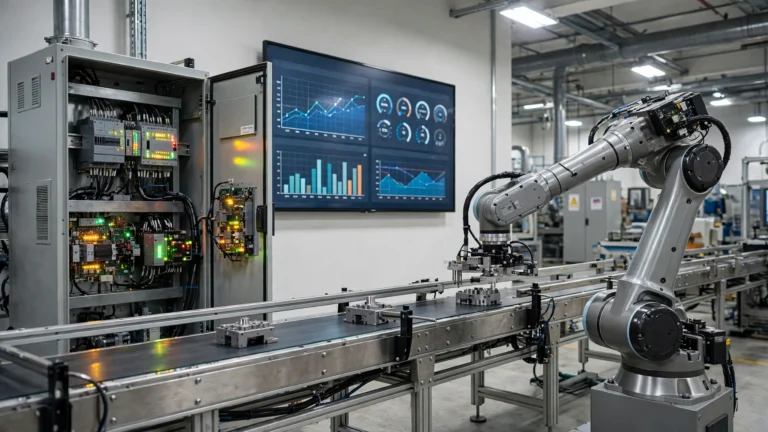
A typical flow looks like this. An order arrives in the ERP system, which passes it to the MES. The MES schedules the job and sends instructions to the PLCs. The PLCs drive the robots and CNC machines, while sensors feed live data to the SCADA system. If a sensor reports a temperature drifting out of range, the system can slow the line or alert an operator before parts are ruined.
Integration is the hard part: many factories run SCADA, MES and ERP systems from different vendors that were never designed to share data. The machines are ready, but the connections between them are not.
Automating manufacturing systems vs manual production
| Factor | Manual production | Automated manufacturing systems |
|---|---|---|
| Speed | Limited by operator pace and shift length | Runs around the clock at a steady rate |
| Consistency | Varies with fatigue and experience | Same result every cycle, with logged data |
| Quality checks | Sample-based, after the fact | Machine vision inspects every part in real time |
| Flexibility | Easy to change tasks on the fly | Reprogramming needed; modern systems switch faster |
| Upfront cost | Low | High — hardware, software, integration, training |
What automating manufacturing systems cost
There is no single price tag: a single cobot cell can cost tens of thousands of dollars, while a full line rebuild runs into the millions. The costs that catch buyers out are usually not the robots. Integration, safety fencing, software licences, and staff training often add as much as the hardware itself, and older machines may need new sensors or controllers first.
Payback comes from higher throughput, less scrap and rework, and less unplanned downtime. Predictive maintenance — fixing a machine before it breaks, using sensor data — is the most cited quick win. But a system only pays back at high utilisation; an expensive cell idle half the week is a loss.
What you need before you automate, and the risks
Automation works best on processes that are already stable. If a manual process produces inconsistent results, automating it usually produces inconsistent results faster. The usual prerequisites are: a documented, repeatable process; clean data on cycle times, scrap rates and downtime; reliable power and network infrastructure on the shop floor; and staff who can maintain the new equipment. Start with a single pilot cell — one robot or one automated inspection station — measured against clear numbers for a few months before rolling it out to other lines.
The risks are real. Connected machines expand the attack surface: a ransomware incident can now stop production, not just office computers. And automation changes jobs rather than simply removing them: operators become supervisors and technicians, which requires training that many small manufacturers underestimate.
Analysis: where automation actually pays off
The honest answer is that automation pays off where volume is high, quality is measurable, and the process is stable — and it disappoints where it is bought as a shortcut around a broken process. The numbers support that caution: the International Federation of Robotics reported 542,000 industrial robots installed worldwide in 2024, with 4.66 million robots operating in factories, yet the global average robot density is still only 162 robots per 10,000 manufacturing workers.
Our take: treat automation as a systems project, not an equipment purchase. The factories that win are the ones that fix the process first, connect the data second, and buy the robots third.
Frequently asked questions
What is an automated manufacturing system?
An automated manufacturing system is a connected set of machines, controllers and software that runs production with minimal manual intervention. It typically combines robots or CNC machines, PLCs for control, SCADA for monitoring, and MES software for scheduling and tracking, all sharing data so the factory can adjust itself in real time.
What is the difference between MES and SCADA?
SCADA monitors and controls equipment in real time — what machines are doing right now — and raises alarms. MES works one level up: it manages production orders, schedules jobs, tracks materials and records quality data.
How much does it cost to automate a manufacturing system?
Costs range from tens of thousands of dollars for a single cobot cell to millions for a full production line. Integration, safety systems, software licences and staff training often cost as much as the machines themselves, and payback is judged on higher throughput, less scrap and fewer stoppages.
Does automating manufacturing systems replace workers?
It replaces specific manual tasks, not whole workforces. Operators typically move into supervising, programming and maintaining the automated systems — which is why successful factories invest in retraining at the same time.
Sources
- Market Research Future — Industrial Automation Market report (market size: $234.72B in 2025, $251.06B in 2026, $459.97B by 2035)
- GCN — IFR World Robotics 2025 figures (542,000 robots installed in 2024; 4.66 million operating worldwide)
- STG Consulting — Industrial Technology in 2026 (automation layers, integration and scaling risks)
- Eclipse Automation — Systems Integration in Manufacturing Automation (SCADA, MES and ERP silos)
- USABite — Manufacturing Automation Integration Explained
- USABite — AI for Manufacturing Changeovers
- USABite — Custom Factory Automation
- USABite — Industrial Automation Project Management