Claude Dreams Between Sessions: How Anthropic Teaches AI Agents to Remember
Key takeaway: Anthropic has explained how it gives Claude a memory that lasts between sessions. In a November 6, 2026 engineering post, the company describes “dreaming” — offline time in which Claude re-reads its own logs, corrects notes that turned out to be wrong, and builds linked wiki pages it can draw on later. In Anthropic’s tests, agents that dreamed learned from experience instead of starting every session from zero.
What Anthropic announced
On November 6, 2026, Anthropic published The components of agent memory, an engineering post about how Claude keeps knowledge between sessions. Anthropic defines agent memory as knowledge Claude gains from experience — interactions with users and tasks it has been assigned — and retains as context it can read later. It is not a change to the model’s weights, and it is not the same as remembering within a single conversation.
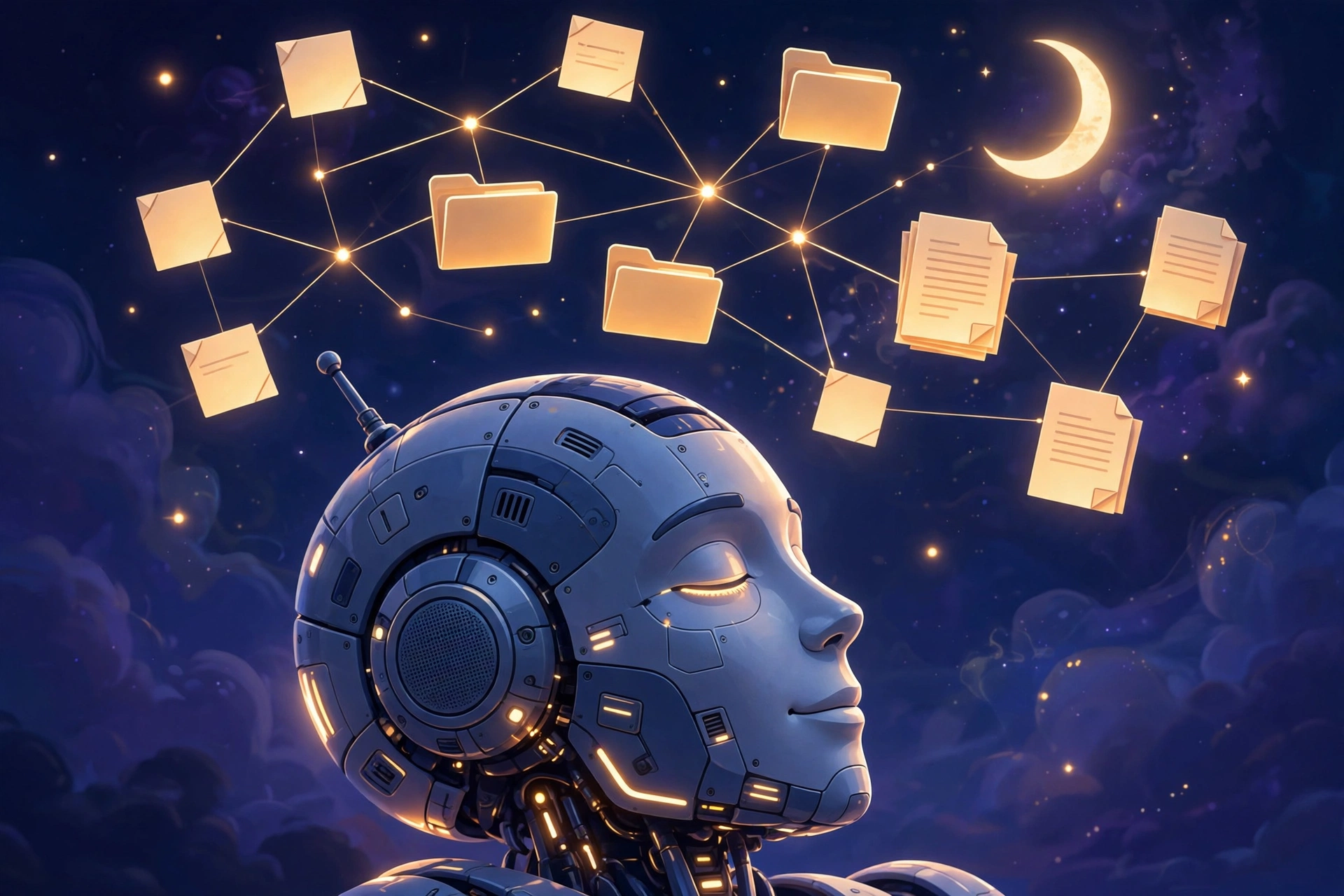
The idea borrows from sleep-time compute, a concept proposed by researchers at Letta and UC Berkeley: models use idle time between interactions to reorganize what they already know, much as the human brain consolidates memories during sleep. Anthropic calls this offline process “dreaming.”
How Claude’s memory is organized
Anthropic breaks agent memory into four layers: transcripts (the raw record of conversations), memory notes (short lessons, rules, and plans Claude writes for itself), memory representations such as wikis (linked pages Claude maintains about a subject), and injected context (a small set of memories loaded into every new session). The top layer must stay small — Claude Code’s auto memory loads only the first 200 lines or 25 KB of a MEMORY.md file as an index.
The Pokémon test: less memory, better play
To test what Claude chooses to remember, Anthropic had its models play Pokémon Red. Each model got a folder of memory files it could read and write while playing:
| Model | Memory files written | Badges earned (~10,000 steps) |
|---|---|---|
| Claude Sonnet 3.7 | 413 files across 225 folders | 1 |
| Claude Fable 5 | 9 files in 2 folders, plus one global.md | 4 |
| Claude Opus 5.5 | Small folder of goal and next-step notes | Beat the game |
Sonnet 3.7 wrote down everything — a separate file for each battle, item, and character — and its notes kept going out of date as the game state changed. Around step 10,000 it spent 17 steps creating and deleting memory files without taking a single action in the game. Fable 5 saved only what the game did not already show on screen: strategy, plans, and tested rules, tracked in a single global.md dashboard.
Dreaming can correct a wrong memory
A note that is wrong from the start can mislead Claude in a later session — and dreaming is Anthropic’s way to catch it. In one Pokémon run, Claude wrongly wrote down that the PokéCenter was on the east side of Mt. Moon. Trusting that note, it walked off a one-way ledge and eventually wrote “Mt Moon DONE” in its notes. It had not finished the mountain at all.
When Anthropic ran dreaming on that memory folder, Claude checked the note against the session transcript, caught the error, and rewrote it. With the corrected note, it went straight back into Mt. Moon and eventually reached Cerulean City. In the run with the uncorrected note, Claude fell off the ledge three times and ended the run back in Pewter City, never reaching Cerulean City.
What the wiki tests showed
Dreaming can also build new representations. Anthropic tested wiki-building on about 350,000 internal documents from Stainless, a software company it acquired in May — roughly 420 million tokens. Over 128 dreaming sessions, performance on a 25-question test grew from 13% to 48% of graded criteria. On 24 questions about a company merger, Claude scored 87% when it consulted the wiki, compared with 73% using search alone. And when dreaming was tuned to build the wiki around contract terms, the resulting legal brief covered 100% of the facts, up from 72%. Using search and the wiki together also saved about 20,000 tokens per question.
What this is not — and what to watch
Known: Anthropic has published the research, the results, and cookbooks for developers who want to try dreaming and knowledge wikis. The techniques are described as research setups on Managed Agents and Claude Code’s auto memory.
Unknown: This is not a product launch. The post does not announce dreaming as a general feature for all Claude users, and there is no date for wider availability. Anthropic also notes open questions: when Claude should create memory, how often dreaming should run, and how to keep representations from accumulating errors.
What to watch: whether dreaming-style memory shows up in Claude’s products, how it handles privacy and control over what gets remembered, and whether other labs publish comparable memory systems. For users of AI agents for business automation, the practical question is the one Anthropic tested: can an agent pick up where it left off, without drowning in its own notes?
Analysis: memory is the bottleneck for useful agents
Analysis — our take, based on the evidence above. The striking finding is not that Claude can remember things; it is that remembering less, but better, wins. Sonnet 3.7’s 413 files were a liability, not an asset — a warning against giving agents ever-bigger memories. The Mt. Moon example is the one to remember: an agent that trusts a wrong note is worse than an agent with no note at all. Dreaming matters because it gives the agent a way to check its own homework. But it costs compute, and Anthropic is candid that checking every memory continuously is not practical. Until the product questions — which memories get checked, how often, and who decides — are answered, this remains a research result: an important one, but a research result. For the bigger picture, see our explainer on what the main goal of generative AI is.
Frequently asked questions
What is Claude’s “dreaming”?
Dreaming is Anthropic’s name for offline compute between sessions. Claude re-reads its own session logs, checks its memory notes against the original transcripts, corrects mistakes, writes new notes, and builds linked wiki pages it can use later. It changes no model weights — memory here means stored context, not retraining.
How does dreaming fix wrong memories?
Claude compares a memory note against the session transcript it came from, which acts as ground truth. In Anthropic’s Pokémon test, dreaming caught a note that wrongly placed the PokéCenter on the east side of Mt. Moon, corrected it, and the next run reached Cerulean City instead of looping back to Pewter City.
Does Claude remember everything between sessions?
No. Anthropic’s tests show that remembering everything hurts: one model wrote 413 memory files and earned one badge, while a model that saved only nine focused files earned four. Claude’s memory works best as a small set of tested rules, plans, and facts — with the rest retrievable on demand.
Is dreaming available in Claude today?
Not as a general product feature. Anthropic describes dreaming as a research setup used with Managed Agents and Claude Code’s auto memory, and has published cookbooks for developers who want to try it. No wider rollout date has been announced.
Why does agent memory matter for users?
Because useful agents work on tasks that span days and weeks, not single chats. Memory that survives between sessions lets an agent pick up where it left off and avoid repeating mistakes — but only if the memory is accurate, which is exactly the problem dreaming is designed to solve.
Sources
- Anthropic — The components of agent memory (November 6, 2026)
- Let’s Data Science — Anthropic details how Claude uses dreaming to organize agent memory
- AI Weekly — Anthropic research unveils agent memory architecture