How to Make Pasta from Scratch: Easy Homemade Dough Guide
How to Make Pasta from Scratch: The Complete Step-by-Step Guide to Fresh Homemade Dough
Key takeaway: To make pasta from scratch, mix 100 grams of flour with 1 egg per serving, knead for 8 to 10 minutes until smooth, rest the dough for 30 to 60 minutes, roll it paper-thin, and boil fresh ribbons for 2 to 3 minutes. Tipo 00 flour gives the silkiest dough, but all-purpose flour works well too.
Learning how to make pasta at home turns two everyday pantry staples—flour and eggs—into silky, tender ribbons that commercial boxed noodles cannot match. Unlike extruded dried noodles, fresh egg pasta cooks in two to four minutes and absorbs sauces into its porous surface (Fond Kitchen). Mastering the baker’s ratio and dough rest makes rolling fettuccine, tagliatelle, or lasagna sheets effortless.
Following our practical format on USABite’s step-by-step guides hub, this guide covers flour science, mixing, rolling, and troubleshooting.
The Golden Ratio & Flour Science Behind Great Pasta Dough
Traditional northern Italian egg pasta follows a simple, scalable formula: 100 grams of flour (about ¾ cup plus 1 tablespoon) to 1 large whole egg per serving (Fond Kitchen). Weighing flour ensures consistent hydration, while half a teaspoon of olive oil and a pinch of sea salt per egg tenderize and strengthen the dough (The Science of Food).
Your flour choice dictates both rolling ease and cooked al dente bite. Italian millers grade wheat flour from Tipo 00 (the finest powder grind) up to Tipo 2 (the coarsest grind) (Chowhound). Two wheat proteins—glutenin (elasticity) and gliadin (extensibility)—make protein level as important as grind size (The Science of Food).
| Flour Type | Protein Content | Milling Grind & Texture | Best Homemade Pasta Shapes |
|---|---|---|---|
| Italian Tipo 00 Pasta Flour | 12% – 13% (Fabulous Pasta) | Ultra-fine powder; rolls paper-thin with zero grit (Pasta Evangelists) | Ravioli, tortellini, silky tagliatelle, lasagna sheets |
| Semolina (Semola di Grano Duro) | 12% – 13% (Fabulous Pasta) | Coarse amber durum wheat; high plasticity and firm bite (Pasta Evangelists) | Pappardelle, orecchiette, cavatelli, and dusting cut strands |
| Standard All-Purpose Flour | 10% – 12% (Fabulous Pasta) | Medium grind; everyday staple needing 8–10 min kneading | Homemade fettuccine, linguine, and hand-cut ribbons |
| 50/50 Tipo 00 + Semolina Blend | 12.5% – 13% (Fabulous Pasta) | Smooth rolling with micro-ridges that grip heavy ragù sauces | Spaghetti alla chitarra, garganelli, and hearty noodles |
Avoid low-protein cake flour (which tears) and strong bread flour (which turns rubbery) (Fabulous Pasta).
Ingredients for a 4-Serving Batch
For four main-course portions (600g fresh pasta), gather these ingredients (Fond Kitchen):
- Flour: 400 grams (about 3⅓ cups) Italian Tipo 00 flour, all-purpose flour, or a 75/25 blend of Tipo 00 and semolina (Fabulous Pasta).
- Eggs: 4 large whole eggs at room temperature so the yolks emulsify evenly with the starch.
- Olive Oil & Salt: 1 tablespoon (15 ml) extra-virgin olive oil and ½ teaspoon fine sea salt (Gimme Some Oven).
- Dusting Flour: ¼ cup coarse semolina flour to prevent cut ribbons from sticking (BBC Good Food).
Step-by-Step: How to Make Homemade Pasta Dough
Step 1: Build the Flour Well and Incorporate the Eggs
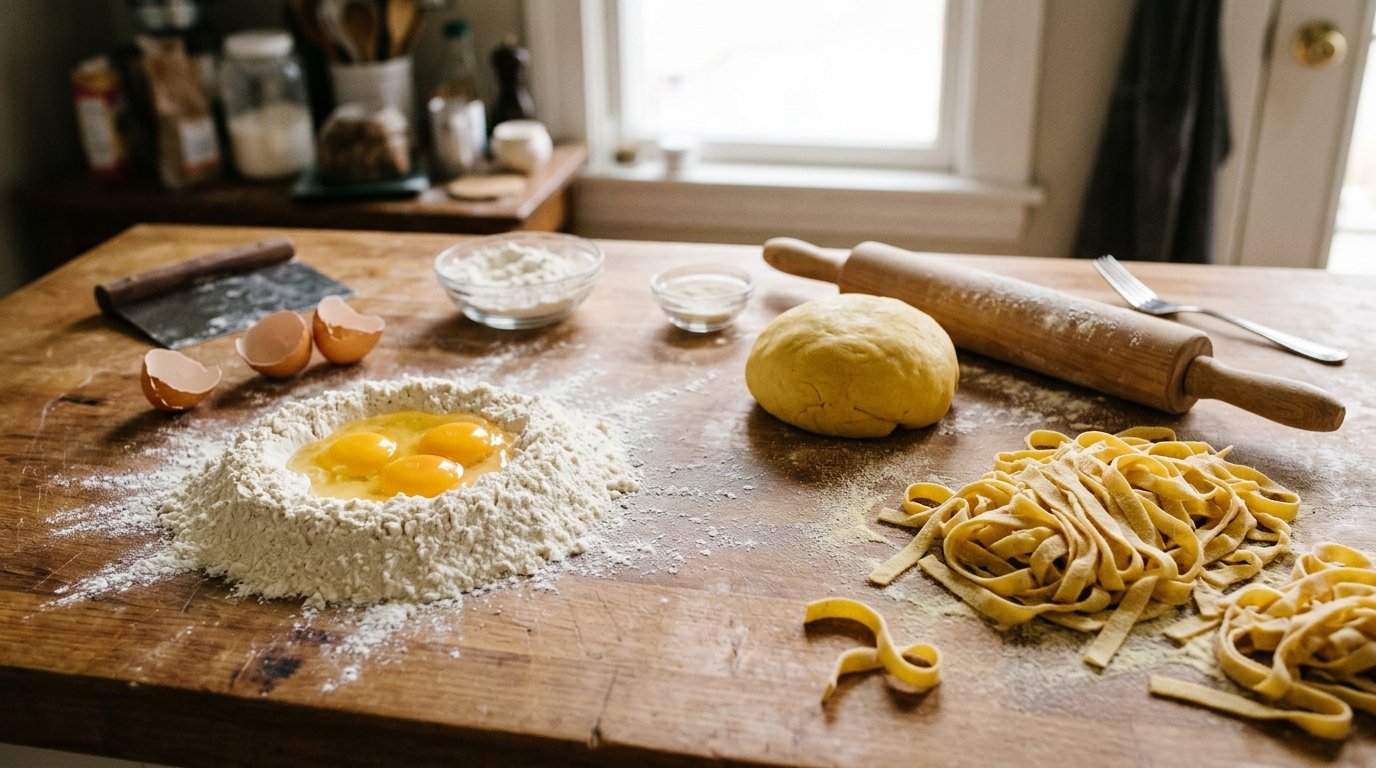
Mound 400g of flour on a board and carve a wide volcano well in the center (Fond Kitchen; The Burnt Butter Table). Crack the four eggs into the center, add the salt and olive oil, and whisk the yolks with a fork. Gradually whisk flour from the inner rim into the eggs for 3 to 4 minutes until thick (Fond Kitchen).
Appliance Shortcut: In a food processor, pulse flour, salt, and three-quarters of the egg mixture into coarse crumbs (BBC Good Food). Alternatively, knead everything in a stand mixer with a dough hook on low speed for 8 to 10 minutes (Gimme Some Oven).
Step 2: Knead to Build an Elastic Gluten Network
Fold the remaining flour in with a bench scraper to form a shaggy ball (The Burnt Butter Table). On a clean board, press forward with the heel of your palm, fold back, rotate a quarter turn, and knead for 8 to 10 minutes (Fond Kitchen). You can also use the double-rest method: knead for 3 minutes, wrap in cling film for 10 minutes to hydrate, and knead for 3 to 4 minutes more (The Burnt Butter Table). The dough is ready when satin-smooth and a finger poke springs back (Nina’s Pasta Project).
Step 3: Rest the Dough at Room Temperature
Wrap the dough ball tightly in plastic wrap and rest it at room temperature for 30 to 60 minutes (Fond Kitchen). Resting hydrates the starch and relaxes gluten chains so sheets do not shrink back (Happy on the Homestead). Dough refrigerated up to 18 hours should return to room temperature before rolling (Bigger Bolder Baking).
Step 4: Roll by Pasta Machine or Rolling Pin (No Machine Needed)
Divide the rested dough into four quarters, keeping three wrapped tightly (BBC Good Food). Flatten one piece into a disk:
- With a Pasta Machine: Pass the disk through the widest roller setting (`0` or `1`). Fold into thirds, rotate 90 degrees, and feed through the widest setting twice more to laminate the dough (BBC Good Food). Narrow the rollers one notch per pass until setting `5` or `6` for fettuccine, or `7` for ravioli.
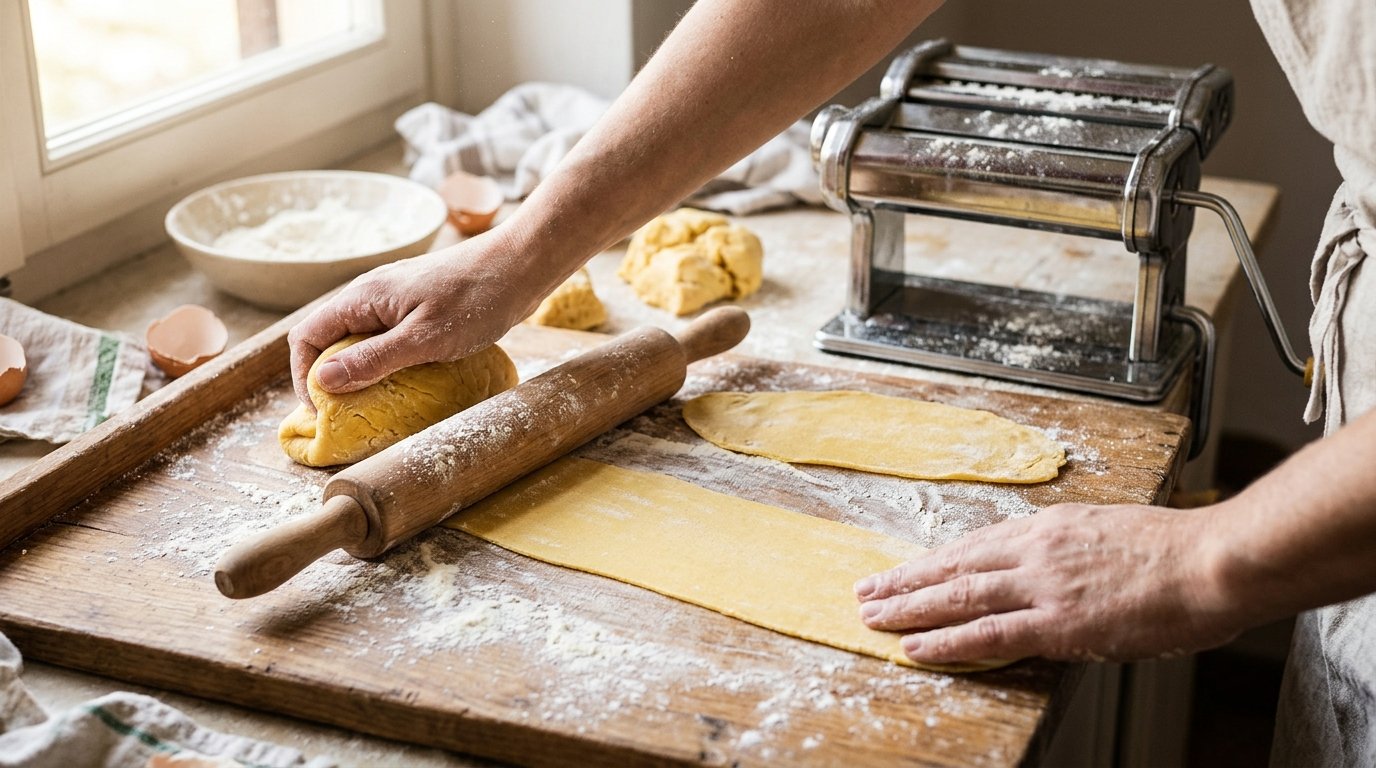
- With a Rolling Pin (No Machine): Dust your board with flour and roll from the center outward until paper-thin (Bigger Bolder Baking).
Step 5: Cut, Dust with Semolina, and Boil to Al Dente
Dust the rolled sheet with semolina flour, fold loosely into a flat roll, and slice across with a sharp knife into ¼-inch ribbons for fettuccine or ¾-inch ribbons for pappardelle (Bigger Bolder Baking; BBC Good Food). Unfurl the strands and coil into loose nests.
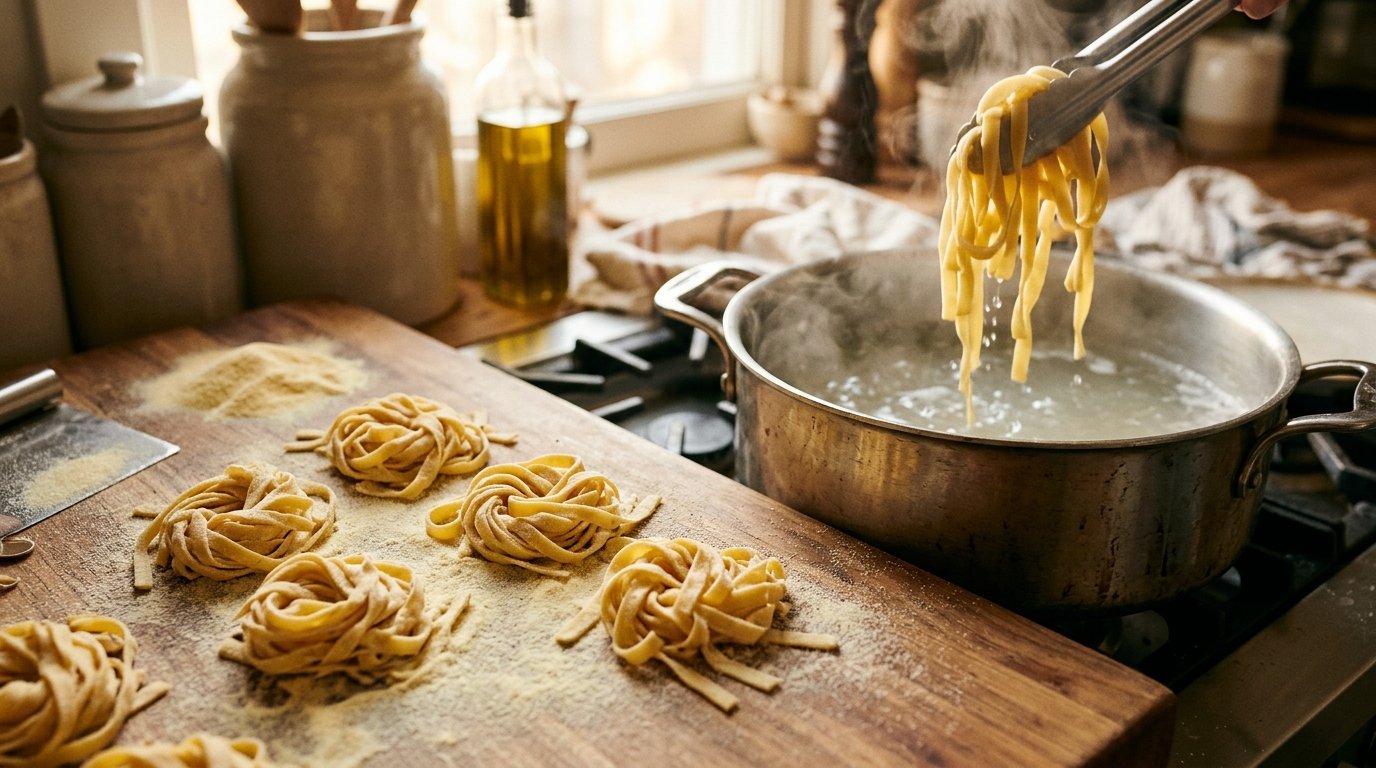
Boil in heavily salted water: thin cut ribbons cook in 2 to 3 minutes, while filled shapes like ravioli take 4 to 5 minutes (The Burnt Butter Table). Toss immediately into warm sauce with a splash of starchy cooking water.
Troubleshooting & Storage Tips
- Dry, crumbly dough: Mist your hands with water or knead in ½ teaspoon of water at a time until cohesive (The Burnt Butter Table).
- Sticky or tearing sheets: Dust lightly with Tipo 00 flour and fold through the widest roller setting once more (Jamie Oliver).
- Refrigerating & freezing: Always shape pasta before freezing. Freeze semolina-dusted nests on a tray for 20 to 30 minutes, then store in an airtight container for up to 2 days in the fridge or 1 month in the freezer (The Burnt Butter Table; BBC Good Food).
Have feedback or want to request our next kitchen guide? Send us a note through the USABite contact page.
Frequently Asked Questions
How long should you boil fresh pasta?
Thin cut ribbons need only 2 to 3 minutes in heavily salted boiling water, while filled shapes such as ravioli take 4 to 5 minutes. Toss the drained pasta into warm sauce right away with a splash of the starchy cooking water.
Can you freeze fresh pasta?
Yes. Shape the pasta first, then freeze semolina-dusted nests on a tray for 20 to 30 minutes before moving them to an airtight container. Fresh pasta keeps up to 2 days in the fridge or 1 month in the freezer.
Why is my pasta dough dry or sticky?
Dry, crumbly dough needs a little more water: mist your hands or knead in half a teaspoon at a time until it holds together. Sticky or tearing sheets need a light dusting of Tipo 00 flour and one more pass through the widest roller setting.
Can I make pasta without a machine?
Yes. After resting the dough, dust your board with flour and roll from the center outward with a rolling pin until the sheet is paper-thin, then cut it into ribbons with a sharp knife.