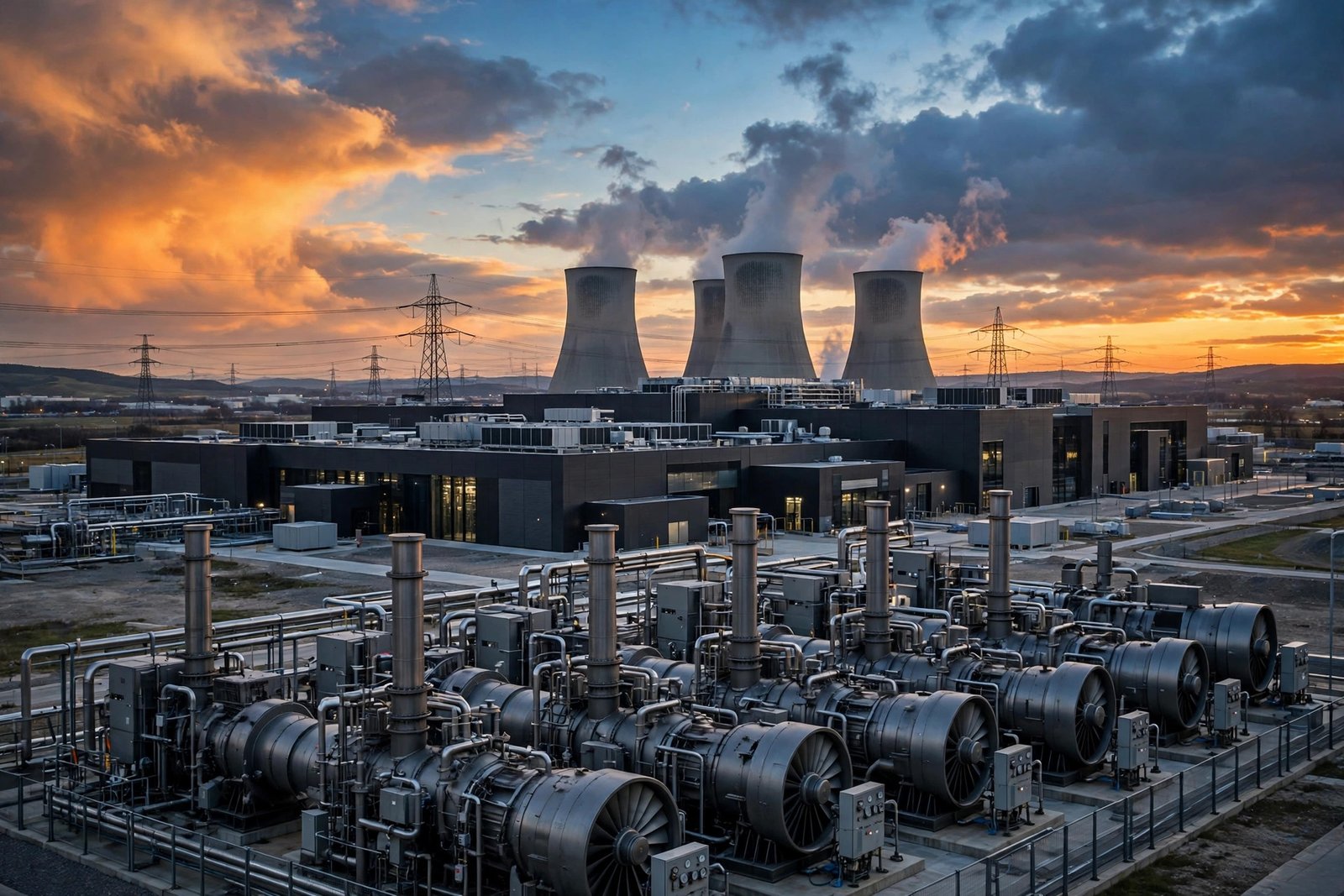
Anthropic Reportedly Spends $3.4 Billion on Gas Generators to Power Its AI Data Centers
Anthropic Reportedly Spends $3.4 Billion on Gas Generators to Power Its AI Data Centers
Key takeaway: Anthropic, the company behind the Claude AI models, has reportedly agreed to pay about $3.4 billion for 1.7 gigawatts of gas-fired generators to power its AI data centers. The Financial Times reported the deal on November 8 — but Anthropic has not confirmed it, and Reuters could not independently verify it.
According to the Financial Times report, Anthropic signed the agreement in late September. The deal would transfer commitments for 1.7 gigawatts of heavy-duty Caterpillar generators from OnePWR Solutions, a San Antonio, Texas power-equipment supplier. OnePWR had ordered the generators about two years ago but needed financing to complete the purchase — and Anthropic stepped in to take over the orders. For two years the AI industry’s constraint was chips. Now it is power.
What Anthropic actually bought
Anthropic did not buy a power company — it bought a place in a sold-out queue. The deal covers the generator orders OnePWR had already placed with Caterpillar, plus the engineering and construction capability needed to install the machines. It did not acquire OnePWR, and no employees transferred.
Anthropic originally planned to buy electricity from OnePWR as an ordinary customer, according to the Financial Times. Instead it took over the equipment orders outright — buying delivery slots it could not get by ordering new, rather than waiting years in line for grid power. Piper Sandler, which advised OnePWR, lists a $3.4 billion sale of its power generation platform to an unnamed AI lab in September: same price, timing, and seller, though it does not name Anthropic.
What the deal costs — and what it signals
At $3.4 billion for 1.7 gigawatts, Anthropic is paying roughly $2,000 per kilowatt of capacity, hardware and installation included — a capital outlay for equipment, not a recurring electricity bill, and only a small slice of what it has committed to spend.
An amended prospectus filed with the U.S. Securities and Exchange Commission on November 2 showed Anthropic intends to spend more than $895 billion in the coming years, mostly on computing capacity and infrastructure. Gartner has warned that as much as $3.5 trillion in AI infrastructure spending could be impaired by 2030 if the buildout outruns demand.
What is still unknown
Almost everything about where the power will actually go is still undisclosed. No deployment sites have been named, and no delivery schedule has been confirmed.
There is also an unexplained gap in the numbers. OnePWR’s own February announcement described about 1.2 gigawatts in total, but the reported 1.7 gigawatts runs roughly 500 megawatts above that count, and neither document explains the difference. Anthropic and OnePWR both declined to comment, so until one of them confirms it, the $3.4 billion figure remains a well-sourced report, not a fact.
The risks: gas power is fast, but contested
Gas generators are the fastest way to get power to a data center — and the most contested. Grid connections for large data centers can take years, hence on-site generation, but gas-fired power brings emissions questions and local opposition. Elon Musk’s xAI already faces a lawsuit over gas turbines at its Memphis data center site, a preview of the fights Anthropic could face wherever its generators land.
Anthropic tried to get ahead of this in February, promising to fund every grid improvement its data centers require and shoulder any resulting hikes in consumer power rates. Investors are watching the spending, too: three major IPO investors told The Wall Street Journal its expected $1.5 trillion valuation will likely need to come down.
Why it matters
When the company behind Claude starts buying power plants instead of power, it means the AI industry’s scarcest resource is no longer the chip — it is the electricity to run it. That shift is visible across the industry: NVIDIA’s sovereign AI deal in Korea, announced the same day, is also about who controls the infrastructure.
For readers, the practical effect is indirect but real: data center power costs feed into the price of AI services, and the siting of new generation feeds into local grid debates. If a generator site is announced near you, watch the air permits and utility filings.
Analysis
Analysis, not verified fact: the most revealing part of this story is the change of plan. Anthropic started out trying to buy electricity and ended up buying the generators — it concluded that waiting for grid power was the bigger risk than owning the hardware. If other AI labs agree, expect more of these deals, and more fights over where the generators go.
Frequently asked questions
Did Anthropic confirm the $3.4 billion generator deal?
No. The deal was reported by the Financial Times on November 8, 2026. Anthropic and OnePWR Solutions both declined to comment, and Reuters said it could not independently verify the report. The strongest corroboration is a Piper Sandler listing of a $3.4 billion sale of OnePWR’s power generation platform to an unnamed AI lab in September.
Why is an AI company buying gas generators instead of buying electricity?
Grid connections for large data centers can take years, and generator supply is sold out for years ahead. By taking over OnePWR’s existing Caterpillar orders, Anthropic bought delivery slots it could not get by ordering new equipment. Anthropic originally planned to buy electricity from OnePWR, but switched to owning the equipment itself.
How much power is 1.7 gigawatts?
About 1.7 billion watts — roughly enough electricity for more than a million average US homes. For an AI data center, it is the kind of capacity needed to run large-scale training and inference for frontier models like Claude, alongside the computing hardware itself.
Did Anthropic buy OnePWR Solutions?
No. Anthropic took over OnePWR’s generator orders and the engineering and construction capability to install them, but it did not acquire the company and none of OnePWR’s employees transferred. OnePWR remains an independent supplier.
When will the generators be running?
That is unknown. No deployment sites, delivery schedule, or operating timeline has been disclosed, and some of the generators may not arrive for two years. Watch for air permits, utility filings, and Anthropic’s SEC disclosures for the first concrete signs.
Sources
- Silicon Report — Anthropic strikes about $3.4B generator deal, FT reports
- The Neuron — Anthropic’s $3.4B Gas Generator Deal Explained
- MLQ.ai — Anthropic pays $3.4 billion for 1.7 GW of Caterpillar gas generators that OnePWR had on order, FT reports
- Anthropic, PBC — Form S-1 Registration Statement (SEC, November 2, 2026)