Complete Automation Solutions Explained: What They Are, the Main Types, and How to Choose One
Key takeaway: Complete automation solutions are end-to-end systems that cover design, installation, and support under one provider. They span factory robots, warehouse systems, and office software bots. The global industrial automation market is worth roughly $227–267 billion in 2026, and factories installed a record 603,000 robots in 2025 — but a “complete” label is only as good as the integration behind it.
What complete automation solutions are
A complete automation solution is a package that handles an entire automated process from start to finish, rather than one machine or one piece of software on its own. In industry, providers call this a “turnkey” solution: a single supplier manages design, engineering, PLC and SCADA programming, installation, testing, commissioning, and ongoing support, so the system arrives ready to run. That single point of responsibility is the whole point.
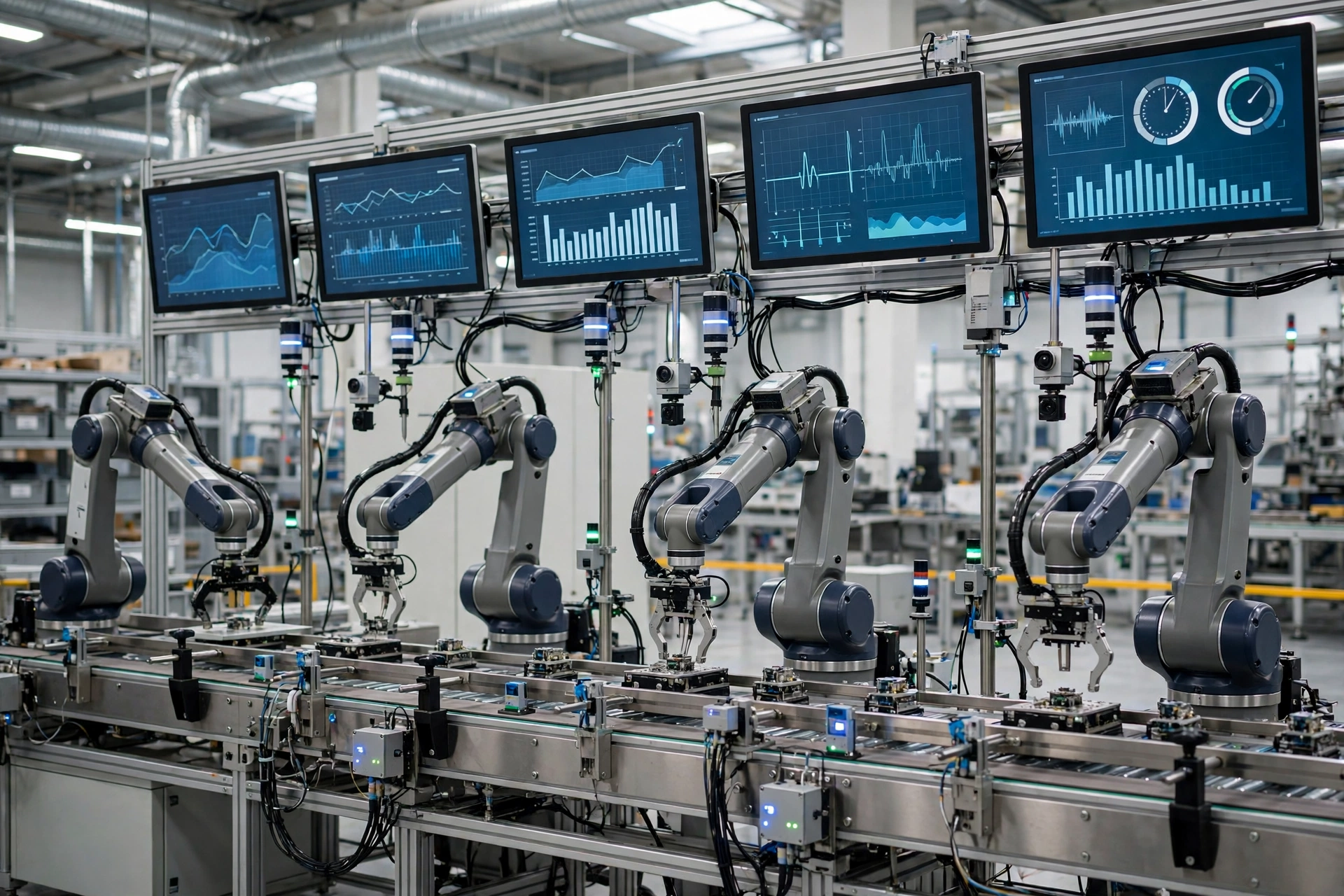
The phrase is used in two different worlds, and it helps to know which one a seller means. In factories and warehouses, complete automation solutions mean physical systems: robots, conveyors, sensors, and the control software that ties them together. In offices, it means software automation: robotic process automation (RPA) bots, workflow tools, and AI agents that carry a business process from trigger to completion without manual steps. For the official picture of how fast the physical side is growing, the International Federation of Robotics’ World Robotics 2026 report is the primary source.
The main types of complete automation solutions
Most complete automation solutions fall into four groups. The table below shows what each one covers and who it suits.
| Type | What it automates | Typical components | Best for |
|---|---|---|---|
| Industrial automation | Manufacturing and process lines | Robots, PLCs, SCADA, sensors, drives | Factories, food and drink, automotive, pharma |
| Warehouse and logistics automation | Storage, picking, and dispatch | ASRS, conveyors, AGVs/AMRs, warehouse management software | Distribution centres, e-commerce, retail |
| Business process automation (RPA) | Repetitive digital office work | Software bots, workflow engines, document AI | Banking, insurance, healthcare admin, shared services |
| Turnkey end-to-end projects | A whole line or facility, design to support | Everything above, delivered by one integrator | Companies that want one accountable supplier |
Warehouse systems show the pattern clearly: a complete warehouse platform combines automated storage and retrieval, guided vehicles, conveyors, and a warehouse management system that reports every move in real time and connects to the company’s ERP software, as warehouse specialist SIEGER Astor describes. Industrial integrators work the same way on factory floors, combining robots, vision systems, PLC controls, and material handling into standalone workcells or fully integrated production lines, according to Applied Manufacturing Technologies.
How big is the automation market?
The market is large and growing, but the headline number depends heavily on what the analyst counts. For industrial automation, Meticulous Research puts the 2026 market at $226.5 billion, rising to $503.4 billion by 2036, while Wissen Research estimates $266.7 billion in 2026. Other firms give lower figures by counting a narrower set of products. The honest reading is a market of roughly $200–270 billion in 2026, growing around 8–9% a year.
The physical evidence is less ambiguous. The International Federation of Robotics reports that factories installed a record 603,000 industrial robots in 2025, up 11% on the year before, taking the global operational stock to 5.079 million units, with installations forecast to rise another 9% in 2026. On the software side, the enterprise RPA market is estimated at $9.18 billion in 2026 by Emergen Research, growing to $28.02 billion by 2035 — though other firms’ estimates range from about $3 billion to $9 billion, so treat any single figure as approximate. The largest pure-play RPA vendor, UiPath, reported fiscal 2026 revenue of $1.611 billion, up 13%, in its SEC filings.
Complete automation vs point solutions
A point solution fixes one problem: a single robot cell, one palletiser, or a bot that processes invoices. A complete automation solution connects several of those pieces into one flow, with one control layer and one support contract. The trade-off is straightforward. Complete solutions cost more up front, take longer to install, and tie you to one supplier’s ecosystem. In return, you get fewer integration gaps, one accountable supplier when something breaks, and a system designed as a whole rather than bolted together over years.
Point solutions win when the problem is narrow and the budget is small — automating one bottleneck on an otherwise manual line, for example. Complete solutions win when the whole process needs to change, such as a new warehouse or a production line that must run with minimal staff. A common middle path is to buy a complete solution for one line or department, prove it, and then expand.
What does a complete automation solution cost?
There is no standard price, and any vendor quote without a site survey is a guess. Costs combine hardware (robots, conveyors, panels), software licences (often priced per bot, per user, or per line), integration and programming work, installation and commissioning, training, and ongoing maintenance — typically 10–20% of the system cost per year. Small RPA deployments can start in the low five figures; a turnkey factory line or automated warehouse can run into the millions. Vendors often quote paybacks of 12–24 months for high-volume, repetitive work, but that depends on utilisation — a robot running one shift a day pays back far more slowly than one running three.
What do you need before you start?
Three prerequisites decide whether a complete automation solution works. First, a stable, documented process: automating a messy, undocumented workflow just produces errors faster, so map the process and fix its worst steps before a vendor touches it. Second, data and connectivity: robots, sensors, and software bots all need clean inputs, reliable networks, and access to the systems they must talk to — ERP, warehouse management, or core banking. Third, people: someone in-house must own the system after handover, including trained operators and a maintenance plan. Skipping any of these is the most common reason automation projects stall after the pilot stage. For background on the factory side, see our explainers on automation engineering solutions and IoT and automation; for the office side, see robotic process automation and automating manufacturing systems.
Risks and limits to watch for
Complete automation solutions carry real risks. Vendor lock-in is the biggest: once a line is built around one supplier’s robots, controllers, and software, switching becomes expensive, so check how open the system is — standard protocols, documented interfaces, and spare-parts availability. Integration with legacy equipment is the second risk; older machines often lack the sensors or interfaces a modern system expects, and retrofitting them can add 20–30% to the budget. Third, change management: staff need training and new roles, and projects that ignore this routinely underperform. Finally, cybersecurity matters more as systems connect: a fully networked line is also a fully exposed one, so network segmentation and patching must be part of the design.
Analysis: “complete” is a promise to test, not a feature
Analysis: The word “complete” does useful work for sellers because it sounds like a guarantee — one supplier, one system, no gaps. In practice, the label is unregulated: a vendor can call a bundle of three products a complete solution. The test is in the contract, not the brochure. Ask who owns integration when two components fail to talk to each other, what the uptime guarantee covers, and whether the quoted price includes commissioning, training, and first-year support. With robot installations at record levels and AI moving into live industrial use, the buyers who benefit most are the ones who treat “complete” as a claim to verify — starting with one high-volume process, measuring the hours it returns, and expanding only when the numbers hold up.
Frequently asked questions
What is a complete automation solution?
A complete automation solution is an end-to-end system that covers design, installation, and support under one provider, instead of separate tools bought piecemeal. In factories it means robots, controls, and software delivered as a working line; in offices it means software bots and workflow tools that carry a process from trigger to completion.
What is the difference between a complete automation solution and a turnkey solution?
They are largely the same idea. Turnkey is the industrial term for a system delivered ready to run, with one supplier responsible for design, engineering, installation, commissioning, and support. Complete automation solution is the broader marketing term, also used for office and warehouse automation. If a vendor uses either phrase, check the contract to see exactly what is included.
How much does a complete automation solution cost?
There is no standard price. Small RPA deployments can start in the low five figures, while a turnkey factory line or automated warehouse can cost millions. Total cost includes hardware, software licences, integration work, commissioning, training, and annual maintenance of roughly 10–20% of the system cost. Judge any quote by payback time against your own volumes.
Which industries use complete automation solutions the most?
Automotive, food and drink, pharmaceuticals, and electronics lead on the factory side; banking, insurance, and healthcare lead on the office side through RPA. Warehousing and logistics are the fastest-growing segment as e-commerce drives demand for automated storage, picking, and dispatch.
Is a complete automation solution worth it for a small business?
Usually not as a first step. Small businesses normally get better returns from a single point solution — one bot or one automated cell — aimed at their most repetitive, high-volume task. A complete solution makes sense once that pilot has proved its payback and the business is ready to automate a whole process rather than one step.
Sources
- Meticulous Research — Industrial Automation Market Size & Forecast to 2036
- Wissen Research via PR Newswire — Global Industrial Automation Market to Hit US$ 410.3 Billion by 2031
- Emergen Research — Enterprise Robotic Process Automation Market, 2035
- Dataintelo — Robotic Process Automation Market Size, Share & Forecast 2025 to 2034
- Optimized Solutions — Turnkey Automation Solutions
- Applied Manufacturing Technologies — Industrial Automation Solutions
- SIEGER Astor — Warehouse Automation Systems