DeepSeek and MiniMax Get China’s Green Light for Overseas AI Use — Days After a $15B Raise and a US Ban
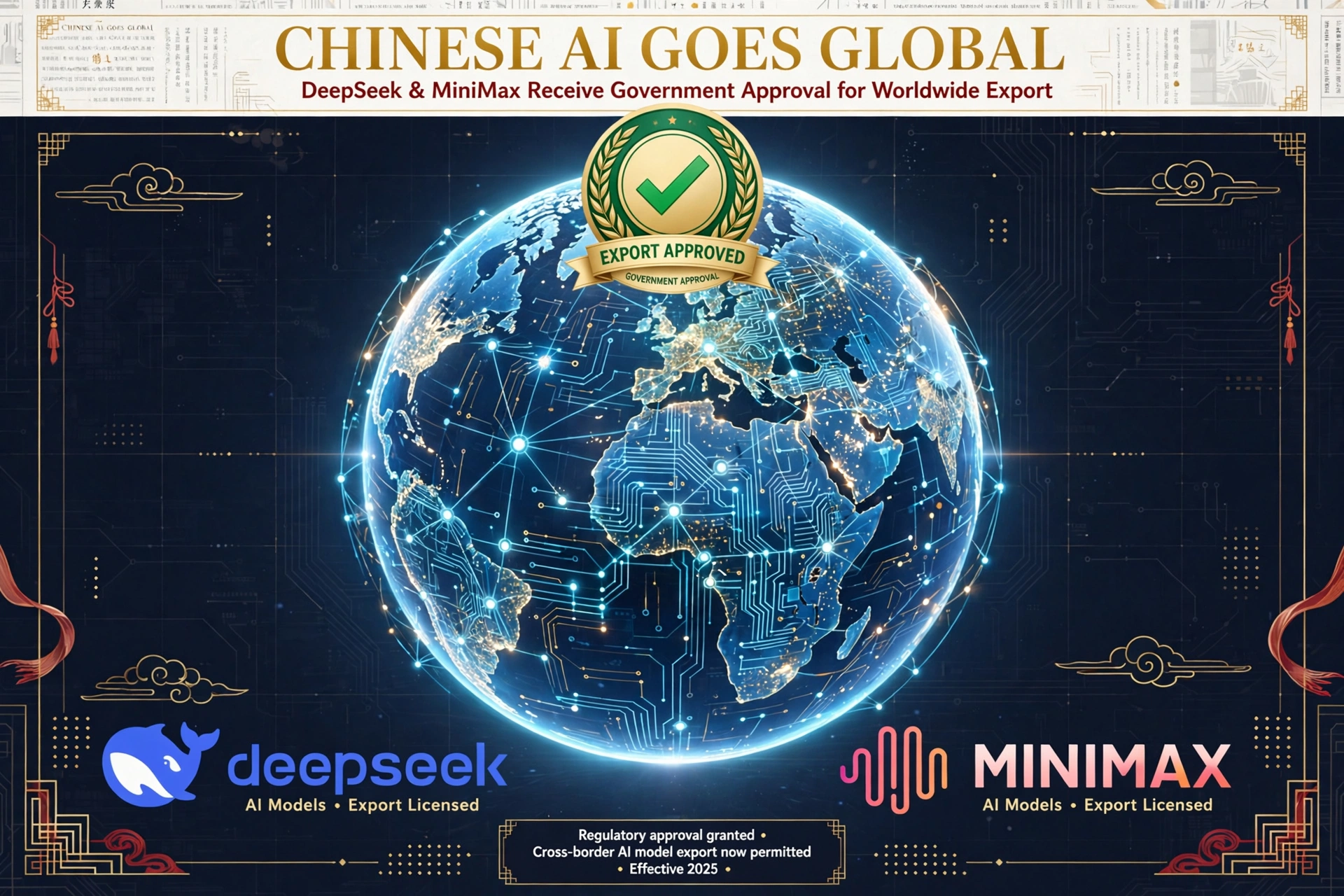
Key takeaway: China has approved DeepSeek and MiniMax to export their AI models for overseas use, state-affiliated media reported on October 23, 2026. The approval comes just days after DeepSeek reportedly raised $15 billion and the US ordered federal agencies to purge its technology. It signals Beijing wants its open-source models competing globally.
Two of China’s most prominent AI developers, DeepSeek and MiniMax, have won state approval for global use of their AI models, according to a post on Thursday by Yuyuan Tantian, a social media account affiliated with state broadcaster CCTV, as reported by Reuters. Neither company immediately replied to requests for comment.
What we know
- The approval is real but thinly sourced so far: the news comes from Yuyuan Tantian, a CCTV-affiliated social media account, not yet from the commerce ministry itself. In a follow-up post on Friday, the account said overseas internet users had urged other Chinese open-source large language models to follow suit.
- Timing is everything: the approval lands one week after China proposed export controls on 23 AI technologies — covering models, agents, and computing clusters — on October 16. But as Reuters notes, the commerce ministry said most AI technologies would remain exportable, with simplified licensing for open-source technology exports and Chinese companies running their own overseas computing centers.
- DeepSeek just raised $15 billion: TechCrunch reported on October 22, citing Bloomberg, that the Hangzhou-based lab raised about $15 billion (~100 billion yuan) in one of China’s biggest funding rounds ever, with investors including battery maker CATL and Tencent. That followed a June round of more than $7 billion at a $50 billion valuation.
- The US just banned it from federal systems: two days before the raise was reported, the US Department of Homeland Security ordered federal civilian agencies to remove DeepSeek’s AI technology from their systems over security concerns, per TechCrunch. The New York Post adds that the Commerce Department, the US Navy, and New York state have enacted similar crackdowns.
- MiniMax is now public: MiniMax went public in Hong Kong in January 2026, and holds a market capitalization of roughly $7.2 billion, according to TechCrunch. DeepSeek itself is reportedly eyeing an IPO in China.
What we don’t know
- The exact terms and scope of the approval — which models are covered, whether restrictions apply, and whether other labs like Zhipu AI or Moonshot AI will get the same treatment.
- How the approval squares, in practice, with the October 16 export-control proposal. The ministry’s “most technology stays exportable” line is reassuring, but the proposal still needs to be finalized.
- Whether DeepSeek will comment publicly. The company did not respond to Reuters, which is typical but leaves room for the details to change.
Why it matters
This is the clearest signal yet that Beijing does not intend to pull its AI labs off the world stage — even as Washington moves the other way. The US–China AI rivalry is increasingly playing out in policy: US federal agencies must purge DeepSeek, while Chinese regulators are green-lighting it for global use.
For the open-source AI ecosystem, the approval is significant. DeepSeek’s models have been downloaded and deployed worldwide since the lab rose to global attention in early 2025 with its R1 reasoning model. Formal export authorization removes the biggest regulatory question hanging over developers and businesses outside China who build on them — as explored in our earlier piece on DeepSeek’s latest model upgrade.
The $15 billion raise underscores how investors read the geopolitical fight: as a buying signal, not a red flag. Chinese capital is betting DeepSeek can outspend restrictions and compete directly with OpenAI and Anthropic on the global market.
What to watch
Watch whether Zhipu AI, Moonshot AI, and other Chinese labs get matching approvals — and how the October 16 export-control proposal gets finalized. If the final rules really do simplify open-source licensing as the commerce ministry suggested, China’s open-weight models could become even more accessible abroad. On the US side, watch whether the DHS removal order expands to other Chinese labs, and how federal agencies implement the purge.
Analysis: The honest read is that neither side is backing down, and the world is getting two AI stacks. For developers and businesses, the practical takeaway is simple: know which stack you’re building on, because export rules, federal procurement bans, and data-sovereignty questions are now part of model selection. Understand it. Then use it.
Frequently asked questions
What did China approve for DeepSeek and MiniMax?
China approved both companies for global use of their AI models, meaning they can export their AI technology for overseas deployment, according to an October 23 report citing a CCTV-affiliated social media account. The exact scope — which models are covered and under what conditions — has not been detailed by the commerce ministry yet.
Does this approval cancel China’s AI export controls?
No. On October 16, China proposed export controls on 23 AI technologies including models, agents, and computing clusters. The commerce ministry said most AI technologies would remain exportable, with simplified licensing for open-source exports. The DeepSeek/MiniMax approvals appear to operate within that framework, not against it.
Why did the US ban DeepSeek from federal systems?
The Department of Homeland Security ordered federal civilian agencies to remove DeepSeek’s AI technology from their systems over security concerns, citing “multiple threat vectors” and the risk of sensitive data reaching China. The Commerce Department, the US Navy, and New York state have taken similar steps. The ban applies to federal agencies, not private companies or the public.
Can developers still use DeepSeek’s models outside China?
Yes. DeepSeek’s models are open-weight and remain widely available to developers and businesses outside China. The new Chinese export approval actually reduces regulatory uncertainty for international users. What is restricted is procurement and use by US federal civilian agencies, not private-sector use.
Why did DeepSeek raise $15 billion right after the US ban?
The timing was coincidental — the round, reported by Bloomberg via TechCrunch on October 22, was already in motion. But investors including CATL and Tencent were clearly unbothered by the US restrictions. The round followed a June raise of over $7 billion at a $50 billion valuation, with DeepSeek reportedly eyeing a China IPO.
Sources
- Reuters, “China’s DeepSeek, MiniMax win approval for AI global use, state media-affiliated entity says” (October 23, 2026)
- TechCrunch, “DeepSeek reportedly raises $15B days after US restrictions” (October 22, 2026), citing Bloomberg
- Seeking Alpha / New York Post coverage of the October 16 Chinese AI export-control proposal and the DHS removal order