Embodied AI Unveils AIR: A Humanoid Robot That Learns Factory Jobs From Workers
Key takeaway
Swiss robotics startup Embodied AI unveiled AIR on November 6, 2026, at Humanoid Europe 2026 in Munich: a wheeled humanoid robot that learns factory tasks by watching human workers do them. AIR starts each job under human control, records the work, and typically takes over on its own within about a month, with lightweight tendon-driven arms designed to yield on contact so it can share the factory floor safely.
What Embodied AI announced
Embodied AI unveiled AIR at Humanoid Europe 2026 in Munich on November 6, 2026, nine months after beginning development. The EPFL spin-out, headquartered in Lausanne with an office in Rome, said AIR is already being tested with global manufacturers, that it has signed contracts with major manufacturers, and that it is preparing for larger-scale production.
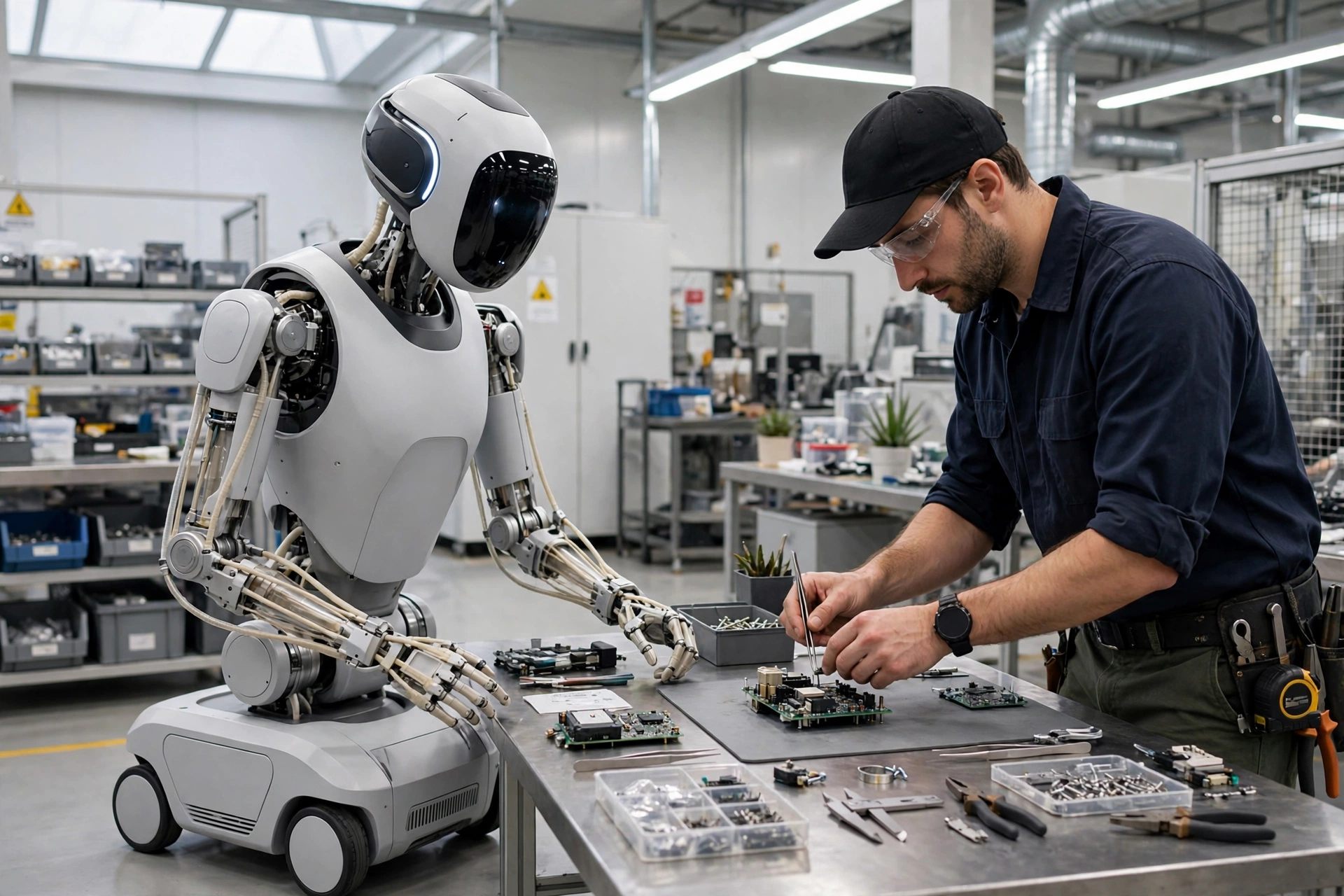
AIR is built for the repetitive manual tasks that change too often for conventional industrial robots: precise hand movements on jobs that still need a person today. Rather than working behind safety cages, AIR is designed to stand on the factory floor next to the team already doing the work.
How AIR learns a job
AIR does not arrive knowing a task. It starts every job under the control of a human operator, so it is productive from its first shift. Every run is recorded, and Embodied AI’s AI software learns the movements from those demonstrations until the robot can perform the task independently — typically within about a month, depending on the task. The human operator then stays on hand to cover anything the robot has not seen before, and a skill learned by one robot can be transferred to others.
The same AI software is already running in paid factory deployments on Embodied AI’s separate two-armed industrial robot system. In one evaluation by a major consumer electronics manufacturer, the system reached 98% reliability on a cable-handling task against the customer’s 90% target, while four other startups in the same evaluation failed to meet the requirements, according to the company.
Why AIR is built differently
Most humanoid robots today are still demonstrations, and most industrial robots are built for heavy-duty work behind cages. AIR takes a different route: safety comes from how it is built, not from software holding it back.
Its arms are light and moved by tendons, with the motors, gearboxes and electronics housed in the torso, so the arms carry almost no mass and give way on contact. It moves on wheels rather than legs, because factory floors are flat and wheels are more stable. AIR was designed under ISO/TS 15066:2016, the technical specification for collaborative industrial robot safety, with CE marking planned for 2027.
| AIR (Embodied AI) | Conventional industrial robot | |
|---|---|---|
| Where it works | On the open factory floor, beside people | Usually behind safety cages |
| How it learns | From human demonstrations, on the job | Programmed in advance by engineers |
| Arms | Lightweight, tendon-driven, yield on contact | Heavy, rigid arms built for force and speed |
| Movement | Wheels, for stability on flat floors | Fixed base, or legs on experimental humanoids |
| Best for | Repetitive manual tasks that change often | Fixed, high-volume, heavy-duty tasks |
Why it matters
The timing is driven by a labour gap. As many as 1.9 million US manufacturing jobs could go unfilled by 2033, according to Deloitte and The Manufacturing Institute. Manufacturers are responding: 22% plan to use physical AI such as humanoid robots within two years, more than double today’s 9%, according to the Manufacturing Leadership Council. But Deloitte also found that more than 80% of factory task hours are expected to stay human-driven — so the opportunity is in helping those people, not replacing them. It is the latest step in the wider spread of factory automation USABite has covered in our guides to automating manufacturing systems and IoT and automation.
Knowns, unknowns, and what to watch
What is confirmed: AIR exists, was unveiled publicly on November 6, 2026, is being tested with global manufacturers, and the company’s AI stack has passed a real factory evaluation at 98% reliability. The company has signed contracts with major manufacturers and is planning scaled production.
What is still unknown: Embodied AI has not disclosed pricing, a commercial availability date, or the names of the manufacturers testing AIR. The one-month learning figure is the company’s own estimate and will vary by task.
What to watch: whether AIR moves from testing to paid deployments, whether the CE marking lands in 2027 as planned, and whether the tendon-driven safety design holds up in independent factory evaluations rather than vendor-reported ones.
Analysis: safety is the product, not a feature
The most important sentence in Embodied AI’s announcement is not about learning speed — it is co-founder and CEO Francesco Stella’s point that a hallucinated answer in software is harmless because a human reviews it, while a wrong physical action is immediate and irreversible. That is why AIR’s design starts with hardware that cannot hurt someone: light arms, tendons, wheels, and a torso that holds the heavy parts. AIR’s claim to be different rests on two things that can actually be checked: the 98% reliability result in a customer-run evaluation, and the ISO/TS 15066:2016 design basis. Until independent deployments confirm both, AIR is a promising, well-reasoned entry into physical AI — not yet a proven one.
Who is behind Embodied AI
Embodied AI was co-founded by CEO Francesco Stella, whose doctoral research at EPFL — the Swiss Federal Institute of Technology in Lausanne — produced AIR’s tendon-driven arm design; Stella previously researched at MIT’s Computer Science and Artificial Intelligence Laboratory. He co-founded the company with chief technology officer Kai Junge and chief operating officer Max Polzin, both robotics PhDs. The company is backed by Faber, which led its first funding round, along with TechShop, Look AI Ventures, Plug and Play and Vento.
If you find USABite useful, add us as a preferred source in Google Search so our explainers show up first when you search.
Frequently asked questions
What is Embodied AI’s AIR robot?
AIR is a wheeled humanoid robot unveiled by Swiss startup Embodied AI on November 6, 2026, at Humanoid Europe 2026 in Munich. It is designed to work alongside factory employees and learn repetitive manual tasks through human demonstrations, then perform them autonomously.
How does AIR learn a factory task?
AIR starts each job under human operator control while its AI software records the work. It learns the movements from those demonstrations and typically takes over the task on its own within about a month, with the operator staying available for unfamiliar situations. Skills learned by one robot can be transferred to others.
Is AIR safe to work next to people?
AIR was designed for close work with people. Its lightweight arms are tendon-driven and yield on contact, its motors and electronics sit in the torso, and it moves on wheels for stability. It was designed under ISO/TS 15066:2016, the technical specification for collaborative industrial robot safety, with CE marking planned for 2027.
Has AIR been tested in a real factory?
Yes, in the sense that Embodied AI’s AI software already runs in paid factory deployments on a separate two-armed industrial system. In a cable-handling evaluation by a major consumer electronics manufacturer, it reached 98% reliability against a 90% target, while four other startups failed to meet the requirements. AIR itself is now being tested with global manufacturers.
When will AIR be available to buy?
Embodied AI has not announced pricing or a commercial availability date. The company says it has signed contracts with major manufacturers globally, is testing AIR with them now, and is preparing for larger-scale production, with CE marking planned for 2027.
Sources
- The AI Insider — Switzerland’s Embodied AI Unveils Humanoid Robot Designed to Learn Factory Tasks From Workers (November 6, 2026)
- RoboticsTomorrow — Embodied AI Unveils AIR, a Physically Safe Humanoid Robot That Learns on the Job (November 6, 2026)