North Korea Tests AI-Guided Torpedo: What the Zam-2.0 Claim Means
Key takeaway: On October 17, 2026, North Korean state media said the country had tested a “new-type” precision-guided torpedo, the super-speed Zam-2.0, that uses artificial intelligence for target detection and guidance. If real, the system would let a torpedo distinguish warships from decoys and make in-flight evasive decisions — but independent analysts caution that hard technical limits, especially underwater noise, remain.
What North Korea announced
According to the Korean Central News Agency (KCNA), the underwater test-fire took place on Thursday to “confirm the successful technical updating” of the weapon. KCNA stated: “AI technology was applied to the target detection and the guidance function of the new-type super-speed precisely guided torpedo.”
The agency also claimed the test proved “the core technology for raising the efficiency of propulsion and the performance of rocket propulsion device,” and said the program had completed “more than 180 rounds of different tests over the past five years.”
The announcement followed days of escalation: Pyongyang said it had test-fired two types of cruise missiles from a submarine after weeks of friction with Seoul over a landmine explosion along their border. And this is not the country’s first AI-military claim this month — earlier in October, North Korea announced the AI-assisted launch of an intermediate-range hypersonic missile it said was “capable of changing its flight orbit at a low altitude” with “no way to avoid” it.
What AI actually changes in a torpedo
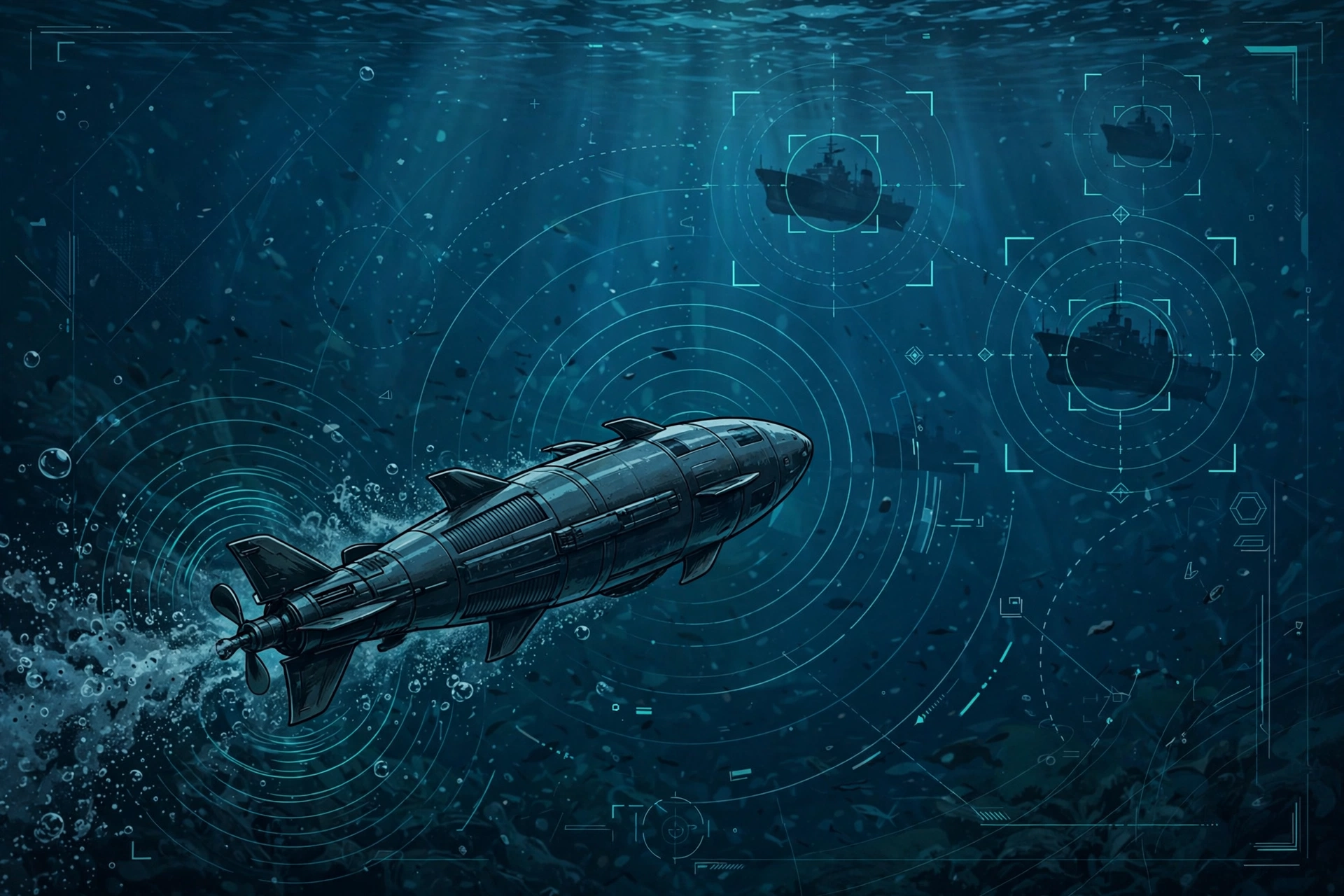
A conventional torpedo homes in on noise, magnetic signatures, or a wake trail — all of which can be spoofed. South Korea and the United States deploy decoy targets to divert torpedoes, as Lim Eul-chul, a professor at Kyungnam University, told AFP. The practical effect of adding AI would be better discrimination: learning to tell real warship signatures apart from decoys in real time, and adjusting course autonomously mid-run.
Analysts quoted by AFP noted that the stated introduction of AI could also allow North Korea to carry out evasive manoeuvres and make autonomous decisions to confuse an adversary. In short, the claim is about making the weapon harder to fool, not just faster.
Why this test happened now
The timing looks deliberate. The two Koreas appear to be intensifying an arms race over hypersonic missiles: days after North Korea announced its AI-assisted hypersonic missile, Seoul test-fired its own hypersonic glide vehicle, which it called a “key strategic asset capable of changing the course of the battlefield.” North Korea this week cast doubt on Seoul’s test, saying it may have “failed to achieve hypersonic flight” — a claim South Korea rejected.
There is a diplomatic layer too. With world leaders set to gather for November’s APEC summit in China, and US President Donald Trump saying this week he “may” meet North Korean leader Kim Jong Un during his Asia tour next month, Pyongyang has a familiar incentive to look strong ahead of talks. Yang Moo-jin, former president of the University of North Korean Studies in Seoul, told AFP that ahead of a possible US-North Korea summit, Pyongyang appears to be “playing down South Korea’s hypersonic missile programme to portray itself as ahead of Seoul — Washington’s ally — in the arms race.”
Analysts also say North Korea could be advancing its weapons technology with support from Russia, received in exchange for sending troops to support its war against Ukraine.
Analysis: treat the capability claim with caution
This section is analysis, not verified fact. The headline claim — AI for target detection and guidance — is the most technically plausible part of the announcement. AI-based signal classification for sonar is a well-understood field, and even a modest implementation could improve decoy discrimination.
The “super-speed” claim is harder to credit without independent evidence. As Yang Moo-jin noted, high speeds underwater generate significant noise, making a torpedo easier to detect — and reducing that noise “is a major technical challenge requiring advanced technology,” which he said North Korea does not yet appear to have reached. North Korean weapons claims are also historically unverifiable: there is no independent confirmation of the test, the test count, or the AI performance.
Still, the strategic signal is worth noting regardless of the technical reality. Kim Jong Un emphasized in September the need to raise “the level of artificial intelligence” in the country’s weapons systems, and the pattern this month — hypersonic missile, submarine cruise missiles, now a torpedo — shows a program systematically applying AI terminology to its weapons portfolio. That fits a broader global pattern: AI is moving into every layer of military competition, which is exactly why governments are racing to set rules around it, from new AI oversight bodies in the US to export controls on AI technology.
Frequently Asked Questions
What exactly did North Korea claim to test?
North Korean state media KCNA said it tested a “new-type” precision-guided torpedo system, the super-speed Zam-2.0, on Thursday, October 15, 2026. The claim: AI technology was applied to the weapon’s target detection and guidance, and the test confirmed improvements to propulsion and a rocket propulsion device, completing “more than 180 rounds of different tests over the past five years.”
What would AI do in a torpedo?
Based on how AI is used in sonar and guidance systems generally, AI could help a torpedo classify underwater signals and distinguish real targets — like warships — from decoys deployed by South Korea and the US, then adjust its course autonomously. Analysts say this could also enable evasive manoeuvres that confuse defenses.
Has the test been independently verified?
No. The announcement comes only from North Korean state media, and there is no independent confirmation of the test, the claimed test count, or how well the AI system performs. Analysts caution that technical hurdles remain — particularly the underwater noise problem that makes fast torpedoes easier to detect.
What happens next?
Expect the rhetorical arms race to continue: North Korea is questioning South Korea’s hypersonic test while showcasing its own systems, and analysts link the timing to possible Trump-Kim talks around November’s APEC summit in China. The deeper trend is AI’s growing role in military systems worldwide — a development drawing new government oversight and export controls.
Sources
- The Japan Times — North Korea says tested AI-assisted torpedo system (Oct 17, 2026)
- The Economic Times / AFP — North Korea says tested AI-assisted torpedo system (Oct 17, 2026)