Opentrons Raises $40M to Put AI in Charge of the Lab Bench
Key takeaway
Opentrons Labworks has raised $40 million in Series E funding, led by healthcare investor Avego, to scale robots and software that let artificial intelligence design, run, and learn from laboratory experiments. The company says its Opentrons Flex platform closes the gap between AI that can plan science and labs that still test it by hand.
What Opentrons announced
On October 29, 2026, Opentrons Labworks Inc., based in Long Island City, New York, announced a $40 million Series E financing round led by healthcare investor Avego, with additional investment from BroadOak Capital Partners. Existing investors include SoftBank Vision Fund and Khosla Ventures, according to the company’s announcement carried by Business Wire.
Opentrons says it will use the capital to scale its robotics, software, and data infrastructure tools, invest in AI-driven experimental execution, extend its automation capabilities, and expand into new markets and geographies. Independent coverage by citybiz confirms the same round size, lead investor, and use of funds.
Founded in 2014, Opentrons has deployed more than 11,000 robots to laboratories in more than 80 countries, including at 90 percent of the top 20 global pharmaceutical companies, according to the announcement. Citybiz adds that its customers include all 20 of the top-ranked U.S. research universities and 14 of the 15 largest global biopharmaceutical companies.
Why the lab is the bottleneck
The pitch is simple: AI can now generate hypotheses and design experiments far faster than laboratories can test them. Frontier models can propose a drug candidate or a material in minutes, but proving it still needs pipettes, plates, incubators, and people.
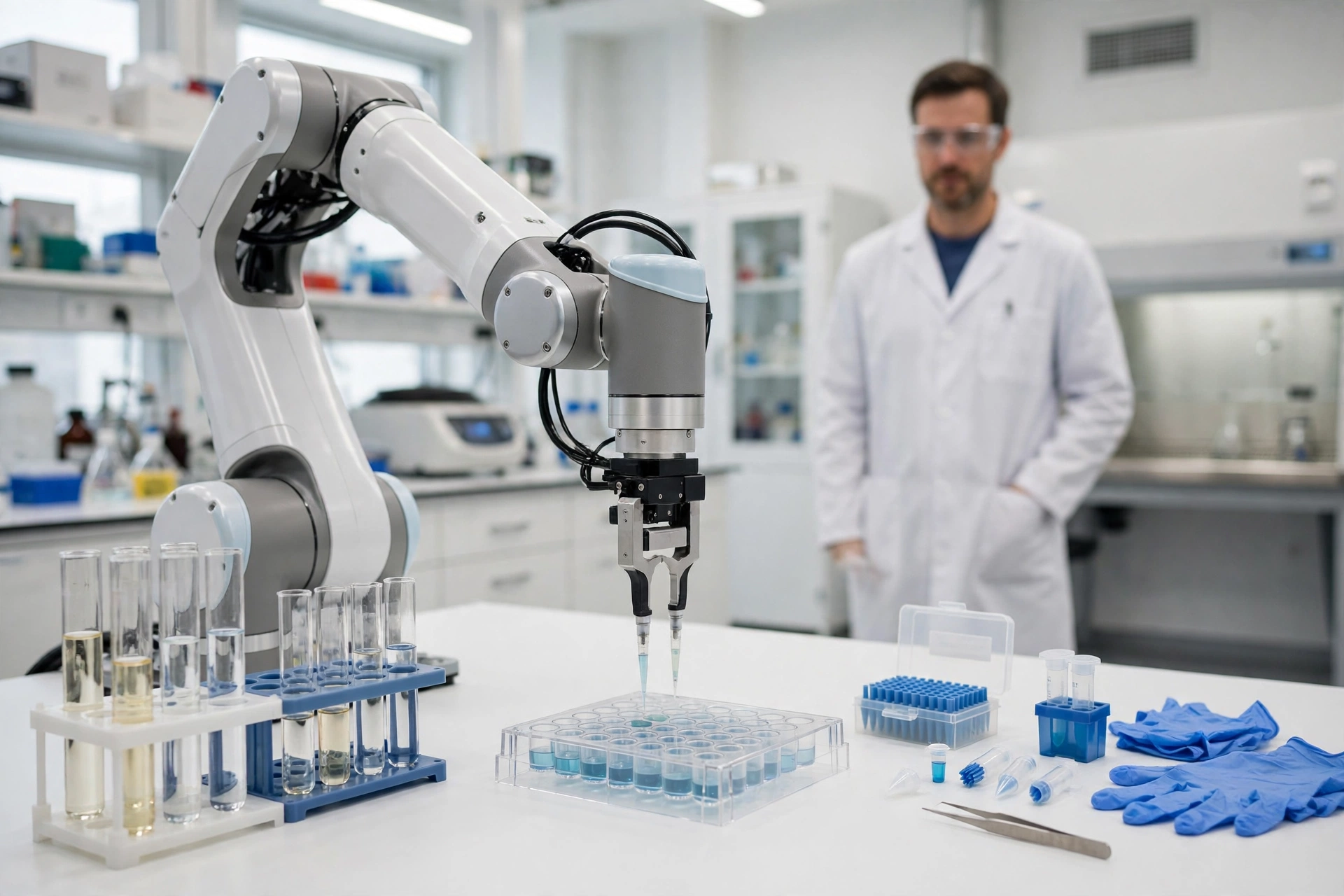
Opentrons’ answer is the Opentrons Flex platform: robots plus AI systems that design an experiment, run it, collect structured and reproducible data, and use the results to inform the next experiment. That loop — design, execute, learn — is what the company means by “autonomous science.”
“Millions of scientists spend much of their day on manual work a robot can do. Giving that time back to discovery is the biggest opportunity in science,” said James Atwood, PhD, CEO of Opentrons, in the announcement. “We made lab automation accessible for any lab, and our systems are built for AI to run experiments directly.”
Manual labs vs. AI-driven labs
| Manual lab workflow | AI-driven lab workflow (Opentrons’ model) | |
|---|---|---|
| Experiment design | Researcher plans each step by hand | AI proposes and refines the plan from prior results |
| Execution | Technician pipettes and plates samples | Robot runs the protocol repeatably |
| Data | Notes vary by person and day | Every run produces structured, reproducible data |
| Next step | Researcher reviews, then redesigns | Results feed directly into the next experiment |
What this costs and what it takes
Cost: Opentrons has not disclosed the round’s valuation or pricing for its systems in this announcement, so treat any price claims elsewhere as unverified. The company’s historical pitch has been accessibility — lab automation for labs that could not afford traditional six-figure systems — but buyers should still request a quote for the Flex configuration, software, and support they actually need.
Prerequisites: An AI-driven lab still needs validated protocols, clean sample handling, and staff who can check the robot’s work. Automation removes manual pipetting; it does not remove the need for experimental design judgment, safety review, or quality control.
Risks and limits: A robot faithfully repeats whatever protocol it is given, including a flawed one, and AI-designed experiments still need human validation before results are trusted — especially in drug discovery, where most candidates fail. Data quality matters too: structured data only helps if the underlying measurements are sound.
Knowns, unknowns, and what to watch
Known: The $40 million round, its lead investor, the stated use of funds, and the deployment figures above are confirmed by the company announcement and independent coverage.
Unknown: The valuation, the exact product roadmap, and which new markets Opentrons will enter first have not been disclosed. It is also not yet clear how far its AI-driven execution goes beyond assisted protocols toward fully autonomous experiment design.
What to watch: Whether Opentrons publishes customer results showing faster discovery timelines, whether large pharma customers expand from pilots to fleet-wide deployments, and whether rivals in lab automation answer with their own AI-execution products. The robotics angle matters beyond biotech too: as with AGIBOT’s Worken framework, the industry is shifting from counting robots to measuring the useful work they actually do, and AI is already changing physical production floors in similar ways.
Why it matters for readers
For most readers, this is not a product to buy — it is a signal about where AI goes next. The first wave of AI changed screens: chatbots, code, and documents. The next wave has to change the physical world, and laboratories are one of the earliest places where that is happening, because experiments are already structured and measurable. If Opentrons’ bet pays off, discovery gets faster and cheaper; if it stalls, it will be a reminder that robots, like models, are only as good as the data behind them.
FAQ
What did Opentrons announce on October 29, 2026?
Opentrons Labworks announced a $40 million Series E financing round led by healthcare investor Avego, with participation from BroadOak Capital Partners. The company says the money will scale its robotics, software, and data infrastructure for AI-driven science.
What is autonomous science?
Autonomous science is Opentrons’ term for a loop in which AI systems design experiments, robots run them, and the resulting data informs the next experiment. The goal is to reduce manual lab work and speed up discovery, though human validation remains essential, especially in drug research.
What is the Opentrons Flex platform?
Opentrons Flex is the company’s laboratory automation platform combining robots with software and AI capabilities. It automates experimental workflows such as liquid handling, so experiments can be designed, run, and improved in a continuous loop rather than done entirely by hand.
How big is Opentrons already?
According to the company, it has deployed more than 11,000 robots to laboratories in over 80 countries, including at 90 percent of the top 20 global pharmaceutical companies. Citybiz also reports customers among all 20 top-ranked U.S. research universities.
Does this mean AI will replace lab scientists?
No. The announcement frames robots as taking over manual work, not scientific judgment. Researchers are still needed to design studies, validate results, and make safety and quality decisions — automation changes what their day looks like, not whether their expertise matters.
Sources
Opentrons’ announcement via Business Wire, and independent coverage by citybiz.