Smart Evo Explained: What Walther Werke’s smartEVO EV Wallbox Is and What It Costs
Key takeaway: Smart Evo is the smartEVO line of EV wallbox chargers from German manufacturer Walther Werke — models like the smartEVO 11 (11 kW), smartEVO 22 (22 kW) and PRO 22 deliver Mode 3 AC charging through a Type 2 socket, with RFID authentication, OCPP smart-grid connectivity and dynamic load management. If you searched for “smart evo,” this is almost certainly the product you mean.
If you typed “smart evo” into a search box, you probably saw a dark-grey metal box on a garage wall and specs full of acronyms — OCPP, RFID, PLC, ISO 15118. Here is what the name refers to, how the chargers work, and what they cost.
What Smart Evo is
Smart Evo is the search name for the smartEVO wallbox series from WALTHER-WERKE (Ferdinand Walther GmbH & Co. KG), a German electrical-infrastructure manufacturer. It is a line of wall-mounted EV charging stations that charge electric cars with AC power in Mode 3 (IEC 61851) through a standard Type 2 connector.
The range covers the smartEVO 11 (11 kW / 16 A), the smartEVO 22 (22 kW / 32 A), the fully equipped PRO 22, plus newer uno single-point and duo dual-point versions — aimed at private garages, company car parks and small semi-public installations.
One detail explains the premium positioning: WALTHER-WERKE developed the series with Bender GmbH, whose CC613 charge controller provides integrated DC 6 mA residual-current detection — a safety feature many basic wallboxes handle with a separate add-on.
How a smartEVO wallbox works
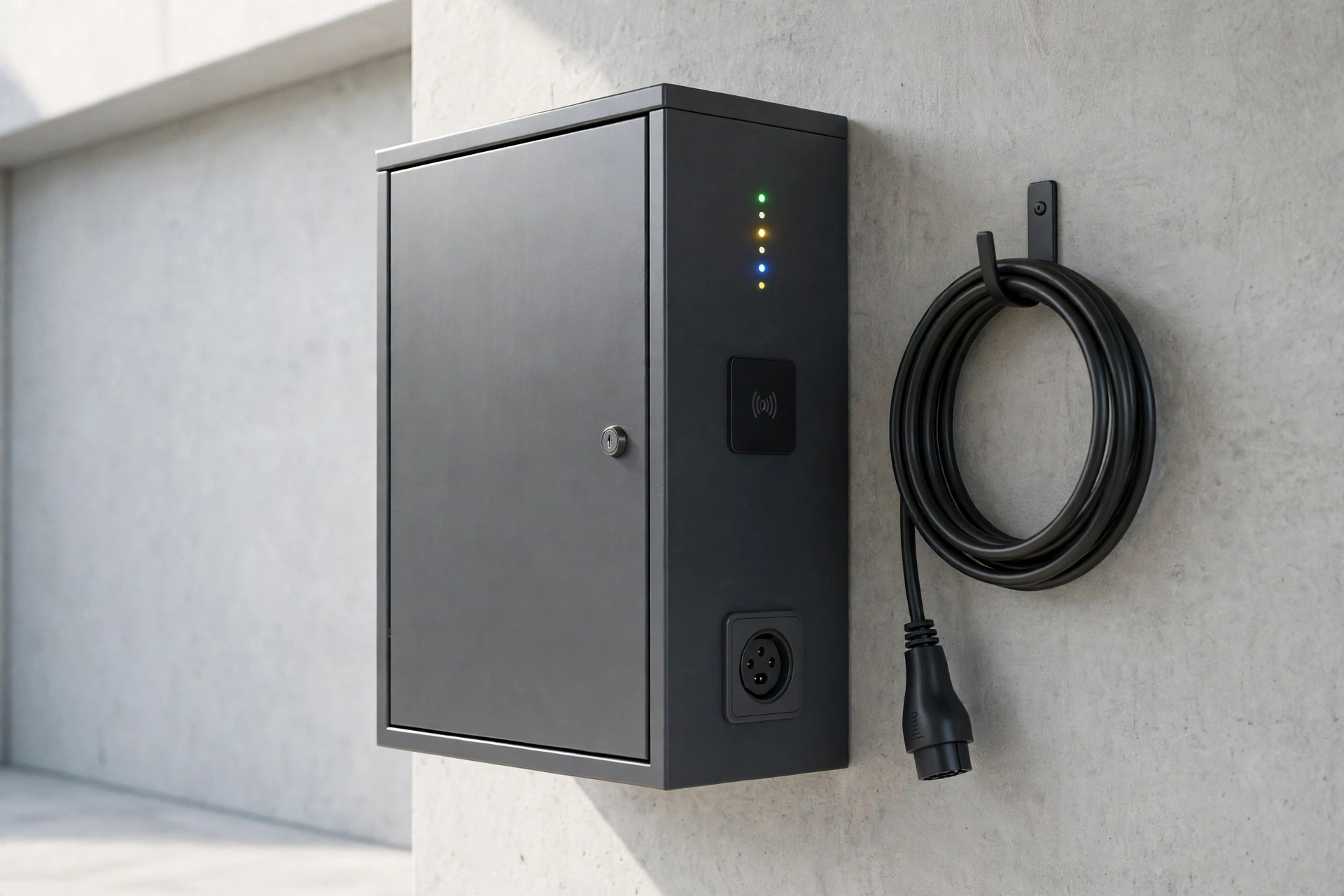
The hardware is deliberately industrial: a galvanized, powder-coated steel enclosure in iron-ore grey (DB703) with a lockable door, rated IP54, measuring 450 × 350 × 203 mm and weighing 17–20 kg. It mounts on a 3-point wall fastening.
The “smart” part is the communication stack:
- ISO 15118 Plug & Charge — the car authenticates itself automatically over powerline communication (PLC).
- RFID authentication — side-mounted panel with two Mifare cards in the box, plus three status LEDs.
- OCPP 1.6 (JSON) — smart-grid connectivity for remote monitoring and billing backends.
- Dynamic load management — phase-accurate load balancing across up to 250 charge points, so a row of chargers never trips the main breaker.
- Energy-system integration — Modbus TCP or EEBUS, plus SMA and TQ protocols, so charging can follow solar surplus or cheap-tariff windows.
Safety is layered: a MID-certified bidirectional energy meter, permanent PE monitoring, 6 mA DC fault-current detection plus a Type A RCD, an integrated circuit breaker, contactor monitoring, and two-stage temperature monitoring. An integrated web server handles firmware updates and remote maintenance over Ethernet (AMJ module included).
Why Smart Evo matters
As homes and fleets add more EVs, the grid connection becomes the bottleneck: one building may run a heat pump and two 22 kW chargers off a single main fuse. The smartEVO’s dynamic load management throttles charging to whatever the building can spare, second by second, instead of requiring a costly grid upgrade — while OCPP and energy-management hooks let it charge when rooftop solar is exporting or the overnight tariff kicks in. (Background: our explainers on AI energy optimization and automation abbreviations.)
The Smart Evo models compared
| Model | Max power | Points | Notes |
|---|---|---|---|
| smartEVO 11 | 11 kW (16 A) | 1 × Type 2 | Entry point; lighter supply requirements |
| smartEVO 22 / PRO 22 | 22 kW (32 A) | 1 × Type 2 | Core model; PRO is the fully equipped variant |
| smartEVO uno+ | 22 kW (32 A) | 1 × Type 2 | Visible MID meter with German eichrecht display |
| smartEVO duo+ | 2 × 22 kW | 2 × Type 2 | Per-point MID metering; small fleets |
Analysis: who should actually buy a Smart Evo
Analysis — not a verified fact: The smartEVO’s value proposition is industrial-grade reliability plus genuinely smart charging logic. If you want a wallbox that does one job for a decade in a weather-exposed location — steel housing, IP54, DC fault detection built in — this is that product. The trade-off is price: basic 22 kW wallboxes cost a fraction of the smartEVO 22. For a fleet operator or landlord billing drivers, the MID metering and OCPP backend justify it; for a single-car garage with an 11 kW car, a simpler box may be the better buy.
Frequently asked questions
What is Smart Evo?
Smart Evo is the search name for the smartEVO line of EV wallbox chargers from German manufacturer WALTHER-WERKE. Models like the smartEVO 11 (11 kW), smartEVO 22 (22 kW) and PRO 22 provide Mode 3 AC charging via a Type 2 socket, with RFID authentication, OCPP smart-grid connectivity, ISO 15118 Plug & Charge, and dynamic load management for up to 250 charge points.
How much does a smartEVO wallbox cost?
Retailer listings observed in 2026 show roughly CHF 2,240 for the smartEVO uno, EUR 2,969 for the smartEVO 22, and EUR 4,359 for the dual-point smartEVO duo+ — before professional installation, which is extra. Prices vary by dealer and change often.
Does the smartEVO work with solar or home energy management?
Yes. It connects via Modbus TCP or EEBUS, plus SMA and TQ protocols, and its local dynamic load management adjusts charging to available capacity — enabling solar-surplus or cheap-tariff charging. An Ethernet interface with an included AMJ module provides the data connection.
Can I install a smartEVO myself?
No — not realistically. The 22 kW models hardwire into a 3-phase supply (up to 32 A, with a 40 A preliminary fuse), which requires a licensed electrician, proper breaker and RCD coordination, and in many regions notification to the grid operator. It ships with mounting hardware, a drilling template and RFID cards, but not a plug-and-play setup.
Sources
- Galaxus — Walther Werke Wallbox smartEVO 22 product page (full specifications)
- smartEVO 11/22/PRO 22 technical documentation — electrical data and dimensions
- Bender Group — Walther Werke technology partnership (CC613 charge controller, 6 mA DC detection)
If you find USABite’s plain-English explainers useful, consider adding USABite as a preferred source in Google Search — it helps more readers find our coverage.