
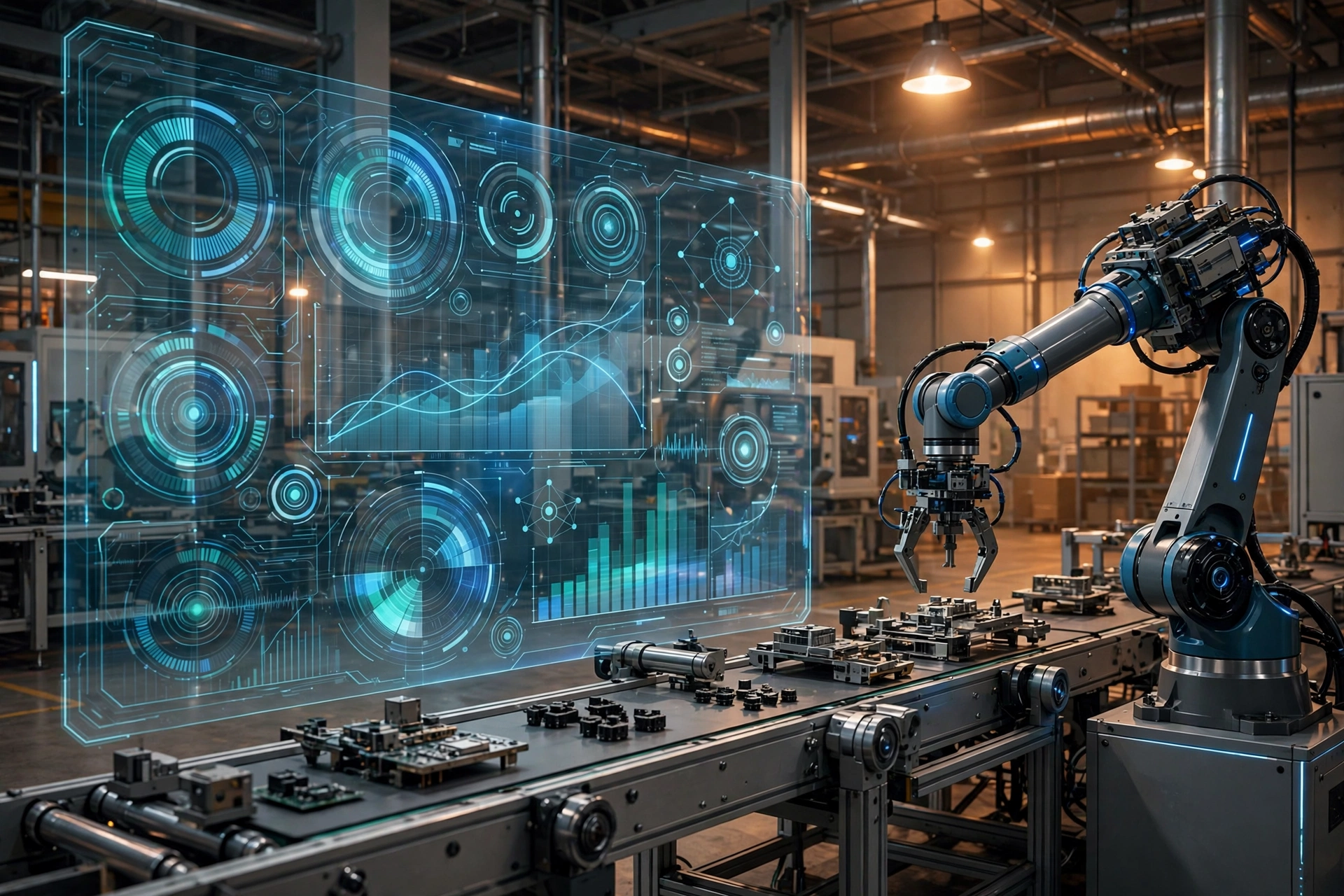
AI Consulting for Manufacturing: What It Is and How It Works
AI Consulting for Manufacturing: What It Is and How It Works
Key takeaway: AI consulting for manufacturing is outside expertise that helps factories decide where AI fits, confirm their data and systems can support it, and move from a pilot into production. A typical engagement runs through four stages — an AI readiness assessment, a prioritized use-case roadmap, pilot implementation, and change management — so the system keeps working after the consultants leave.
Factory owners keep hearing that artificial intelligence will transform manufacturing. The harder question is what to do on Monday morning: which machine gets the sensor, who builds the model, and how does it connect to the systems already running the plant? That gap — between knowing AI matters and getting a system into production — is what AI consulting for manufacturing exists to close.
What AI consulting for manufacturing actually covers
AI consultants are the paid outside experts a manufacturer hires to figure out where AI fits in its operations, check whether the data and infrastructure exist to support it, and either build the solution or guide an internal team through building it — as the GoodFirms guide to AI consulting services describes it. It is the layer between “we should probably do something with AI” and a system that runs in production without someone babysitting it.
Concretely, manufacturing AI consultants assess current processes, identify AI integration opportunities, and provide strategic guidance for industry-specific challenges. A typical service list includes AI strategy consulting, custom AI solution development, integration of AI into existing manufacturing systems, AI copilots and agents for the workforce, and governance controls for secure, transparent deployment at scale.
The typical stages of an AI consulting engagement
Most full-scope engagements move through four types of work, as GoodFirms outlines: strategic assessment (where AI creates measurable value versus where it is a distraction), data and infrastructure readiness (confirming the systems and data quality needed to actually support AI), model selection and implementation (choosing and building the right AI approach), and change management (getting the people who will use the system to actually use it).
Many engagements begin with a fixed-scope, fixed-price AI readiness assessment — a diagnosis of where AI creates real value in the operation and what it takes to get there, ending with a prioritized plan the leadership team can decide on. That assessment usually leads to a focused pilot on the highest-value use case first, with measurable ROI demonstrated before the scope expands.
Where manufacturing AI consultants add the most value
The use cases consultants recommend for factories are well established. Manufacturers commonly explore predictive maintenance, visual quality inspection, production forecasting, and supply chain planning. For example, a factory dealing with frequent equipment downtime would evaluate whether its maintenance records and machine sensor data are sufficient to predict failures, then run a pilot comparing the new approach with existing practices and measuring downtime, false alarms, maintenance costs, and production impact.
The numbers behind these use cases are striking. Research from McKinsey has reported predictive maintenance delivering up to 50% less downtime and 10–40% lower maintenance costs, and a 2025 peer-reviewed survey identified it as the most mature industrial AI application. U.S. Department of Energy data puts machinery downtime reductions at 35% to 45%, and McKinsey estimates AI could improve manufacturing productivity by 20–25% in the coming years.
Related reading: our explainers on AI energy optimization in manufacturing and batch process optimization with AI show how these same use cases play out on real production lines, and our piece on automating IT operations covers the systems-side work that usually has to happen first.
Analysis: why many AI pilots stall
Analysis — based on industry reporting, not verified client data. A common pattern runs: hire a consulting firm, define the strategy, identify opportunities, launch pilots — and watch results fail to materialize. Margins do not improve, throughput stays constrained, and operations do not fundamentally change. The technology is usually not the problem. The gap is between AI consulting and AI implementation: without integration into daily workflows and operational systems, the value never fully materializes.
The practical lesson is that the consulting engagement and the implementation are one project, not two. Assessments that design governance before deployment, and pilots that start with high-ROI use cases — predictive maintenance and quality inspection, where payback periods are shortest — are the ones that tend to survive contact with the factory floor.
When to hire an AI consultant
Bring in outside help when any of these are true: you cannot tell which AI use cases would pay back and which are distractions; your data is trapped in systems that do not talk to each other; a previous pilot stalled and nobody can say why; or you need governance and compliance controls — quality standards, safety rules, audit trails — that your internal team has not built before. The value of AI depends on the business problem, not the industry label, so a consultant’s first job is to help you define that problem precisely.
How to choose the right consulting partner
Match the vendor to your stage of work as well as your industry. Few consultancies are equally strong across assessment, readiness, implementation, and change management, so pick the one whose strengths match the gap you actually have. Ask how they move a pilot into production — a partner who delivers a working system, not just a roadmap and an invoice, is the one worth hiring. Ask for manufacturing references, fixed-scope assessment pricing, and a plan for handing the system over so your own people can run it without the consultants.
Frequently asked questions
What does an AI consultant for manufacturing do?
An AI consultant helps a manufacturer identify where AI creates measurable value, assesses whether data and infrastructure can support it, builds a prioritized roadmap, and either implements the solution or guides the internal team — covering strategy, data readiness, model selection, governance, and change management.
What are the most common AI use cases consultants recommend for factories?
The standbys are predictive maintenance, visual quality inspection, production forecasting, and supply chain planning. Energy and sustainability optimization — tuning consumption per unit produced — is increasingly common. These use cases run on data plants already generate, which is why they are usually the first recommendations.
How much does AI consulting for manufacturing cost?
There is no single price: it depends on scope, data readiness, and whether the firm also implements. Most engagements start with a fixed-scope, fixed-price AI readiness assessment that produces a prioritized plan. Larger engagements — pilot through production rollout plus change management — scale with the number of use cases and integrations involved.
How do I choose the right AI consulting partner for a factory?
Match the partner to your actual gap: assessment, data readiness, implementation, or adoption. Ask how they move pilots into production, request manufacturing references, confirm they design governance and handover so your own people can run the system, and favor fixed-scope pricing for the first assessment.
Sources
- GoodFirms — AI Consulting Services Guide: Pricing, Process & Choosing a Partner in 2026
- Implementation.com — AI Consulting vs. AI Implementation: Why Most Fail
- GroupBWT — AI in Manufacturing: Use Cases, Benefits, and Real ROI
- IABAC — AI Consulting: A Practical Guide to AI Strategy, Implementation and Business Growth
- LeewayHertz — Manufacturing AI Consulting and Development Company
- Ampliro — AI consulting in eight defined engagements



One Comment
Comments are closed.