Custom Robotics Automation: What It Is, How It Works, and When It’s Worth It
Key takeaway: Custom robotics automation is the design and integration of robotic systems built around one specific production process — rather than a pre-built product adapted to fit. It costs more and takes longer than off-the-shelf automation, but it pays off when a task has unusual parts, tight tolerances, strict regulations, or line constraints that standard robots were never designed to handle.
Most robots you see in factory videos were not pulled off a shelf. A standard robotic arm is a general-purpose machine: someone still has to decide what it holds, how it moves, what it watches for, and how it plugs into the rest of the line. Custom robotics automation is what happens when specialists answer those questions from scratch — building the robot, tooling, sensors, safety systems, and software around one specific job.
What Custom Robotics Automation Means
In the automation industry, “custom” sits at one end of a spectrum. At the other end are off-the-shelf systems: complete, pre-built, pre-configured robotic cells for one standard application, with same-day installation and transparent pricing. In the middle sit turnkey systems, which are partially pre-engineered but still require customization, programming, and on-site integration, according to James Taylor of OnRobot in The Robot Report.
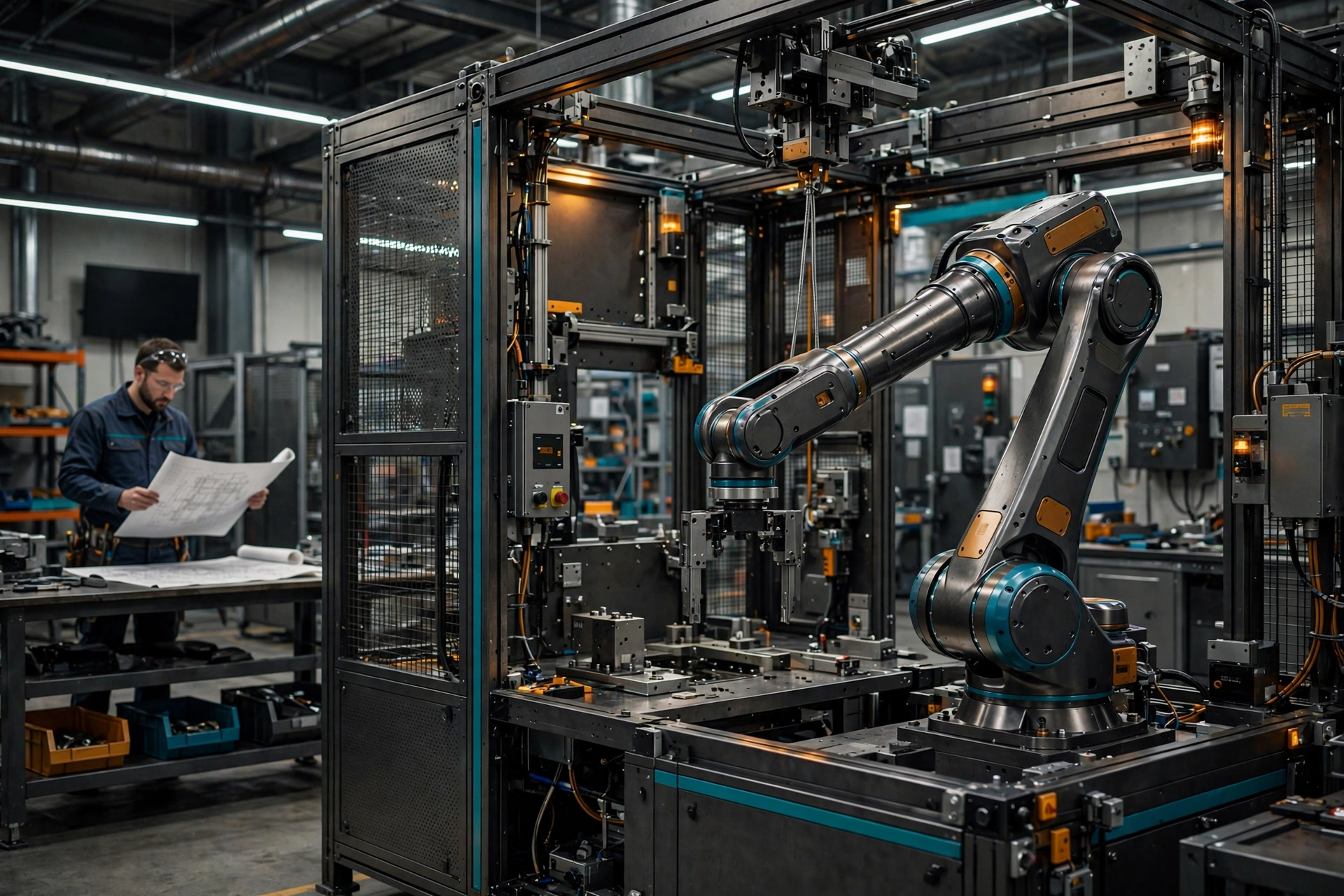
Custom robotics automation goes further than turnkey. The robot, the end-of-arm tool (gripper, welder, camera), the fixturing, the safety fencing, and the control software are all engineered around the actual product — its materials, tolerances, and production targets. Custom work needs its own approach because fixed, high-volume automation architectures don’t fit low-volume or variable jobs, as an industrial automation guide explains.
How a Custom Robotic System Is Built
A custom project typically follows the same sequence: process analysis (cycle time, part variation, quality targets), cell design (choosing the robot type — six-axis arm, SCARA, collaborative robot, or gantry — plus tooling, conveyors, and safety), integration (wiring the robot into PLCs, machine vision, and factory data systems), and validation (proving throughput, defect rate, and uptime before handover).
This work is usually done by a robotics integrator, a specialist firm that designs and commissions the cell. Integration is where custom projects succeed or fail: the same arm behaves very differently depending on how it’s programmed, tooled, and connected. See our explainer on what automating operations really involves for how the integration layer decides the outcome.
Custom vs. Off-the-Shelf: When Each Wins
Engineered Vision’s 2026 comparison guide argues the choice should be made on line outcomes — defect performance, integration risk, deployment speed, lifecycle cost — not feature lists:
- Choose off-the-shelf for stable, standard tasks: palletizing uniform boxes, tending one CNC machine, packing a single SKU. Same-day installation, lower upfront cost, no programmer needed for changeovers.
- Choose turnkey for high-volume, very specific jobs where you can accept that an integrator will still customize and program the system on site.
- Choose custom when standard tools can’t cover the basics: variable part shapes, tight space limits, traceability requirements, regulated environments, or robot-guided handling mixed with vision, assembly, and inspection in one cell.
A classic example is medical-device manufacturing, where standard equipment fails on precision, traceability, and the validation trail regulators demand — and retrofitting generic machinery can cost more than building the system correctly from the start.
Costs, Trade-offs, and the Honest Math
Custom robotics automation is neither cheap nor fast. Upfront costs exceed standard products, implementation stretches over months, and skilled engineers are in short supply. Evaluate a project on total lifecycle cost: uptime, scrap and rework avoided, and labor reallocated over years. A custom cell that costs twice as much can still win if it handles variants a standard system can’t and avoids the rework of forcing generic equipment into a job it wasn’t designed for. Related reading: commercial automation services.
Analysis: for most small manufacturers, the smart sequence is off-the-shelf first, custom only where standard options genuinely fail. Companies usually overspend when they custom-build something a catalog product could have done.
Frequently Asked Questions
What is custom robotics automation?
Custom robotics automation is the engineering of robotic systems — robot, tooling, sensors, safety, and software — designed specifically around one production process. Every element is chosen and integrated to fit the actual parts, tolerances, and targets of a single job.
How much does a custom robotic system cost?
Costs vary with complexity, but custom systems are consistently more expensive up front than off-the-shelf alternatives because design, integration, and validation are done per project. Judge them on lifecycle cost — uptime, scrap avoided, and labor savings over years — not sticker price.
How long does it take to deploy custom robotics automation?
A typical custom cell takes months from process analysis through validation. Off-the-shelf systems can install in a day, so if speed matters more than fit, standard products are the better route.
When should a company choose custom over standard automation?
Choose custom for variable part shapes, tight tolerances, strict traceability or regulatory requirements, awkward line constraints, or high-mix production that standard systems can’t adapt to. For stable tasks like basic palletizing, off-the-shelf usually wins.
Sources
- The Robot Report — “Why OnRobot isn’t betting on turnkey robotic systems” (March 2025)
- Engineered Vision — “Custom vs Off-the-Shelf Vision Systems for Factories in 2026” (Oct 2026)
- Craftsmen Industries — “Automation and Robotics in Modern Industrial Fabrication”