High Speed Automation Machines: What They Are, How They Work, and Where They Pay Off
High Speed Automation Machines: What They Are, How They Work, and Where They Pay Off
Key takeaway: High speed automation machines are industrial systems that repeat manufacturing tasks — filling, sealing, labeling, sorting, packing — at dozens to hundreds of units per minute. They pair conveyors with robotic arms or actuators, machine-vision sensors, and a central controller to run with minimal human input, and they pay off wherever volume is high and consistency matters: food, pharma, electronics, and logistics.
What a high speed automation machine actually is
The defining idea: the machine, not the operator, sets the pace. Products move through stations continuously or in rapid cycles while sensors confirm everything is in position. Speed is relative to the job — a pouch filler doing 15 bags a minute is high speed for its class, while a twin-tube form-fill-seal machine reaches 500 (Soontact). Robotic picking cells have packaged up to 1,600 pharma items a minute with reject rates under 1% (Packaging Scotland).
If your operation already uses custom robotics automation, high speed machines are the next layer: dedicated, single-purpose cells that trade flexibility for throughput.
How high speed automation machines work
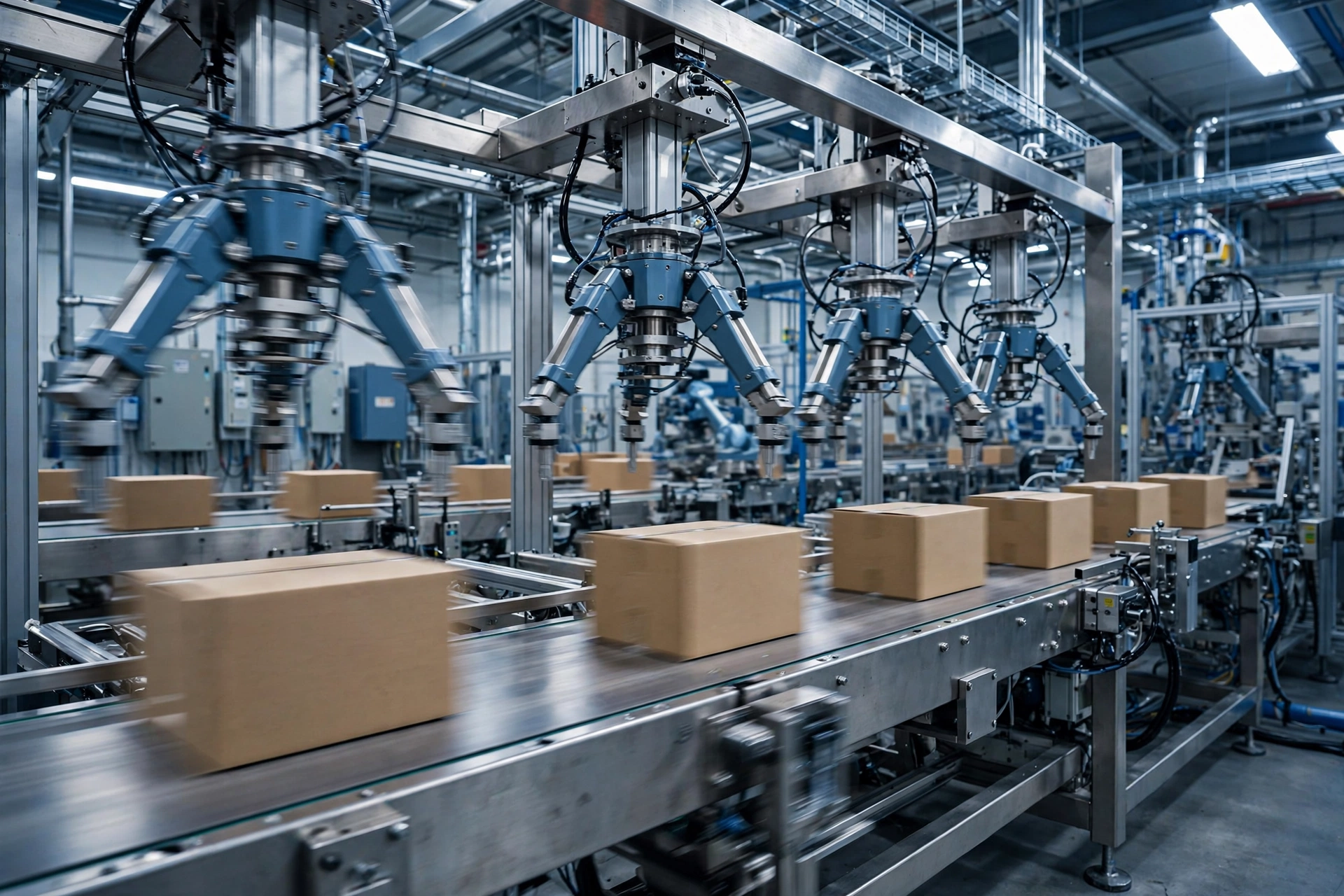
Nearly all of them share the same building blocks around a conveyor or rotary table:
- Infeed and conveying: belts, vibratory feeders, or bucket conveyors space and orient products entering the machine.
- Robots and actuators: delta, SCARA, Cartesian, or articulated arms do the physical work. Deltas are the speed specialists for light items on fast belts; SCARAs dominate rapid assembly like screw driving (Standard Bots).
- Machine vision: cameras act as the machine’s eyes — checking shape, position, or fill level and telling robots which items to skip, so defects go straight to the reject bin.
- Control system: a programmable logic controller (PLC) synchronizes every axis, often over fast fieldbuses like EtherCAT that keep servos and sensors in lockstep (Packaging World).
The main types of high speed automation machines
Pick-and-place machines move items from point A to point B — sorting, loading, unloading — tens of thousands of times an hour. Form-fill-seal machines form bags from roll film, fill, and seal them in one continuous motion, the backbone of snack and powder packaging at 300+ bags per minute.
Case packers and erectors form cartons, pack product, and seal them: one servo-driven packer runs 27 cases a minute — about 140 frozen pizzas — doing the work of three conventional machines, with changeovers cut from 30 minutes to five (Packaging World). Labeling machines apply pressure-sensitive, wrap-around, or tamper-evident labels at line speed (Medium), while palletizing cells stack finished goods — vision-guided systems stack around 70 bags a minute.
Where high speed automation machines are used
Food and beverage is the biggest home for them: washdown-rated delta robots like ABB’s IRB 360 FlexPicker handle open food under strict hygiene rules, with IP69K stainless designs for meat, dairy, and ready meals (Food Manufacturing). Pharma and cosmetics depend on them for sterile, traceable handling — blister packing, vial filling — where vision inspection catches what people miss. Electronics factories use them to populate circuit boards, and e-commerce logistics for carton erecting and palletizing, where packing is the volume bottleneck.
When they are worth the investment
The math is straightforward but unforgiving. These machines pay off when three conditions hold: volumes are high and steady, the product is consistent, and the cost of an error — contamination, mislabeling, injury — is large. The pharma line that cut 12 operators per shift and over 30% of floor footprint with a robotic cell is a textbook case (Packaging Scotland).
They don’t pay off for short, variable runs with constant changeovers, or where fragile products demand human judgment. The machine is fast because it does one thing; ask it to do many things and the advantage evaporates — the same trade-off behind AI agents for business automation.
Analysis: speed is a system property, not a spec
(Analysis — opinion based on the reporting above, not a measured fact.) Headline numbers like 1,600 per minute are machine ceilings, not what real lines sustain. “High speed” belongs to the whole system: infeed, vision, conveying, and changeover routines all cap real throughput. The best machines sell integration — servo synchronization, quick changeover, vision-based reject handling — because that’s where speed survives contact with production reality.
Frequently asked questions
What is a high speed automation machine?
An industrial system that performs repetitive manufacturing tasks — picking, filling, sealing, labeling, or packing — at dozens to hundreds of units per minute, under PLC or robotic control with machine-vision guidance and minimal human input.
How fast are high speed automation machines?
It depends on the type: pouch fillers run 15–45 bags per minute, continuous-motion form-fill-seal machines reach 300, twin-tube designs hit 500. Robotic delta cells have packaged up to 1,600 pharma items per minute, and one servo case packer runs 140 frozen pizzas a minute. Real line speeds always sit below published maximums.
Which industries use high speed automation machines most?
Food and beverage, pharmaceuticals, cosmetics, electronics, and e-commerce logistics. Food and pharma lead because hygiene, traceability, and defect rates make machine consistency especially valuable.
Are high speed automation machines worth it?
For high, steady volumes with consistent products — yes, often cutting several operators per shift and shrinking floor footprint. For short, variable runs or fragile products, changeover costs and flexibility matter more than raw cycle speed.
Sources
- Soontact — How Many Bags Can the Packaging Machine Make Per Minute
- Packaging Scotland — Robotic packaging innovation helps pharma manufacturer increase production throughput
- Packaging World — How one case packer does the work of three machines
- Food Manufacturing — Sanitary Pick-and-Place System (ABB IRB 360 FlexPicker)
- Standard Bots — Pick and place robot types: An easy guide
- Medium — The Role of Automatic Labeling Machines in High-Speed Manufacturing