Conversational AI Consultant: What They Do, When to Hire One, and How to Choose
Key takeaway: A conversational AI consultant is a specialist who helps businesses plan, build, and improve chatbots, voice assistants, and other systems that talk with people in natural language. They connect business goals to the right conversational AI technology — covering strategy, platform choice, conversation design, system integrations, and ongoing optimization — so the final product actually serves customers instead of frustrating them.
Chatbots are everywhere now — on websites, in apps, and even answering phone calls. But there’s a big difference between a chatbot that feels helpful and one that makes you type “speak to a human” in all caps. Behind the good ones, there is often a conversational AI consultant: the person who figured out where the bot should live, what it should say, and how it should connect to the rest of the business.
What a conversational AI consultant does
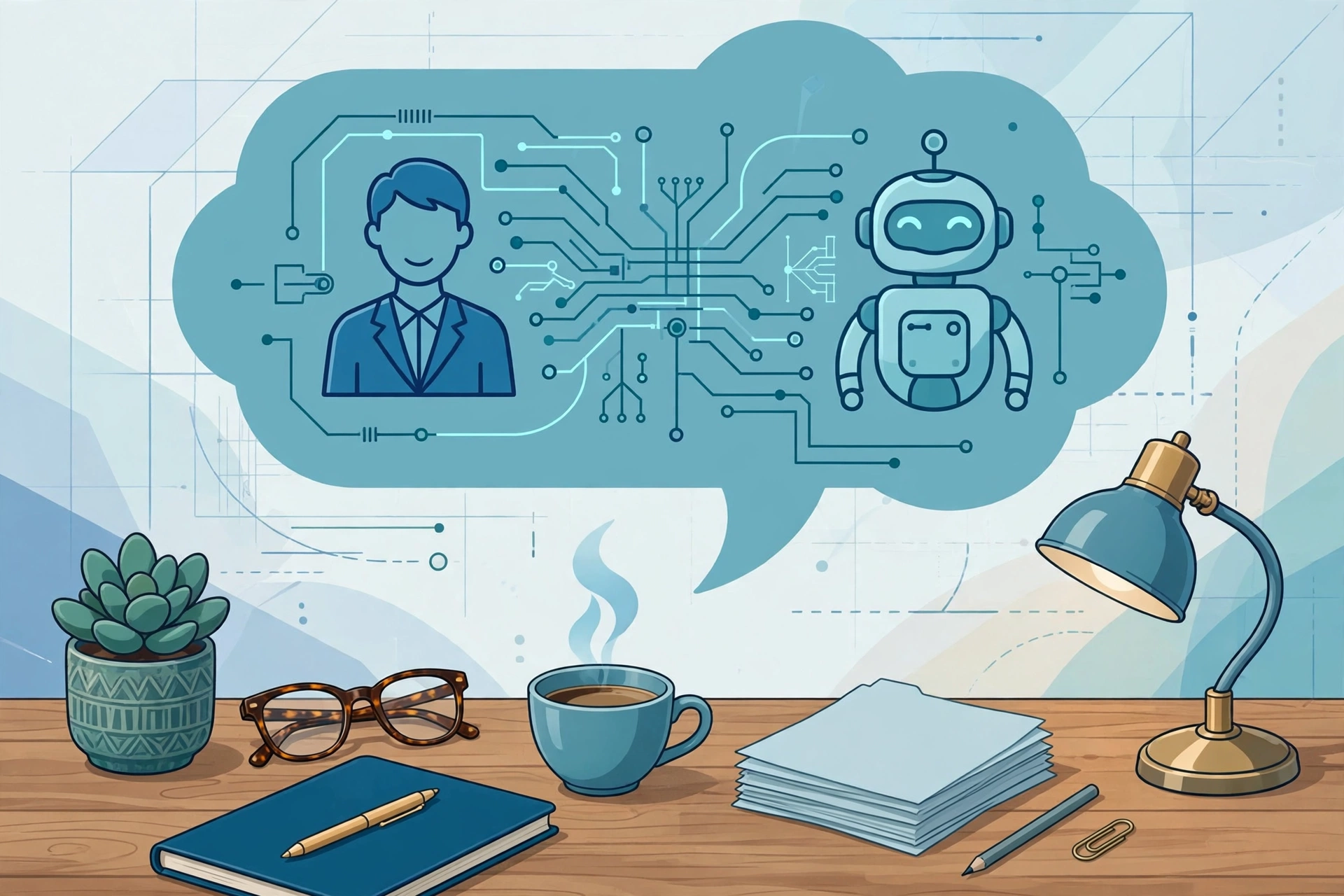
A conversational AI consultant blends business strategy with AI know-how to help organizations design and deploy systems that communicate naturally with people — chatbots, voice assistants, and AI agents that understand human language and respond in context (Biz4Group).
The job is really two jobs in one. The consulting side is strategic: analyzing your business goals, customer journeys, and communication channels, then identifying where conversational AI can help, which platform fits best, and how to measure success. The implementation side is technical: designing conversation flows, building and testing the bot, integrating it with systems like your CRM or helpdesk, and improving it after launch (SoftTeco; AnyforSoft).
Common services a consultant provides include:
- Use-case discovery and prioritization — finding the interactions where a bot will actually save time or money, rather than adding noise.
- Conversation design — writing the dialogue flows, the bot’s tone of voice, and fallback strategies for when it doesn’t understand a question.
- Platform and architecture selection — choosing between off-the-shelf platforms (like Dialogflow or Botpress) and custom LLM-based builds, based on scale, budget, and data-privacy needs.
- Integrations — connecting the bot to real business data: CRM platforms, ticketing systems, knowledge bases, booking tools, and payment systems (SoftTeco).
- Risk and ROI analysis — estimating costs, setting KPIs, and deciding what success looks like before a single line of code is written.
- Ongoing optimization — monitoring how the bot performs, retraining it on real conversations, and expanding its abilities over time.
When hiring a consultant is worth it
Not every business needs a consultant. If you run a small shop and just want a simple FAQ bot on your website, a no-code platform you configure yourself may be enough.
A conversational AI consultant becomes worth the money when things get complex:
- You need the bot to work with internal systems (order databases, patient records, policy engines) rather than answering from a static FAQ list.
- You’re rolling out across several channels at once — website, mobile app, WhatsApp, phone calls — and want one consistent experience.
- You operate in a regulated industry like finance or healthcare, where wrong answers carry legal risk.
- A previous chatbot attempt failed, and you want to figure out why before spending again.
The stakes are real. Research firms put the global conversational AI market at about $17.97 billion in 2026, growing toward $82.46 billion by 2034 (Fortune Business Insights, via PitchAvatar) — and companies are spending that money because, when done right, conversational AI can cut customer-service costs by up to 30% (IBM research, cited by Ringly). The consultant’s job is to make sure your project lands on the “done right” side of that statistic.
How to choose the right consultant
Ask for proof, not promises. A good conversational AI consultant should be able to:
- Show past work: real bots they’ve shipped, with measurable results (containment rate, resolution rate, customer-satisfaction scores) — not just screenshots.
- Explain their process: discovery, conversation design, development, testing, and maintenance are the standard five stages (AnyforSoft). Be wary of anyone who jumps straight to building.
- Talk about failure: they should be upfront about what conversational AI can’t do, like handle emotionally sensitive complaints without a human handoff.
- Start small: most consultants offer a fixed-scope pilot — one use case, one channel — so you can judge results before committing to a full rollout (BotPenguin).
Our take
Analysis: hiring a conversational AI consultant is a risk-management purchase, not a technology purchase. The technology itself — LLMs, speech recognition, platform APIs — is commoditized and getting cheaper. What stays hard is the business side: picking the right problems, designing conversations people actually want to have, wiring the bot into real data, and keeping it accurate as the business changes. That’s the gap a consultant fills. If your project is simple enough to configure in a weekend, skip the consultant and use a platform. If it touches revenue, compliance, or more than one system, a good consultant usually pays for itself by killing the bad ideas before you build them.
If USABite’s AI explainers help you make sense of technology like this, consider adding USABite as a preferred source in Google Search — it helps our coverage reach you first.
Frequently asked questions
What does a conversational AI consultant do day to day?
They interview stakeholders, map customer journeys, write and test conversation scripts, choose the right chatbot platform or AI model, integrate the bot with business systems, and track metrics like resolution rate and customer satisfaction. The mix of strategy and hands-on building is what separates them from a pure advisor or a pure developer.
How much does it cost to hire a conversational AI consultant?
Costs vary widely with scope. A small pilot covering one use case on one channel is the cheapest entry point, while multi-channel enterprise rollouts with deep system integrations cost far more. Ask for a fixed-scope pilot with defined success metrics before committing to a larger engagement, and compare at least two quotes.
Do I need a consultant, or can I just use an off-the-shelf chatbot platform?
For a simple FAQ bot on your website, a no-code platform is usually enough. Hire a consultant when the bot must connect to internal systems, work across several channels, operate in a regulated industry, or recover from a failed earlier attempt — that’s where strategy and integration expertise earn their fee.
What is the difference between a conversational AI consultant and a chatbot developer?
A consultant handles the strategy first: which problems to solve, which platform to use, how to measure success, and how the bot fits the business. A developer builds the bot. Good consultants do both, but the strategic layer — choosing the right thing to build — is the part most businesses struggle with on their own.
Sources
- USABite — AI Agents for Business Automation: What They Are and How Companies Use Them
- USABite — Boutique AI Applications and Services: What They Are and How Businesses Use Them
- Biz4Group — A Guide to Conversational AI Consulting and Development Services
- SoftTeco — Conversational AI Consulting & Development Services
- AnyforSoft — Chatbot Consulting Services
- BotPenguin — What Are Chatbot Consulting Services? A Complete Guide
- PitchAvatar — Conversational AI Statistics 2026 (Fortune Business Insights market data)
- Ringly — 52 Conversational AI Statistics You Need to Know in 2026 (IBM research cost data)