Automation Tools for Component Manufacturing Explained: CNC, Robots, Vision and MES in 2026
Key takeaway: Automation tools for component manufacturing — CNC machines, robots, machine vision, PLCs and MES software — turn raw material into finished parts with less labour, tighter tolerances and fewer defects. In the best setups they connect into one workflow: a robot loads the CNC, vision checks the part, and the MES records the result. Start with the bottleneck, not the shiniest machine.
Factories installed a record 603,000 industrial robots in 2025, up 11% on the year before, according to the International Federation of Robotics, taking the global stock past 5 million machines. Component makers — the shops producing gears, brackets, housings and fittings — are a big part of that growth. This guide explains what each tool does, how they fit together, and how to choose.
What automation tools for component manufacturing are
It is not one machine but a stack of tools, each handling a different job. The Sciotex engineering guide to industrial automation breaks it into four layers: sensors and cameras that measure the process, controllers such as PLCs that decide, actuators and robots that act, and software — HMI screens, data logging and MES or ERP links — that lets people run the system and use its data.
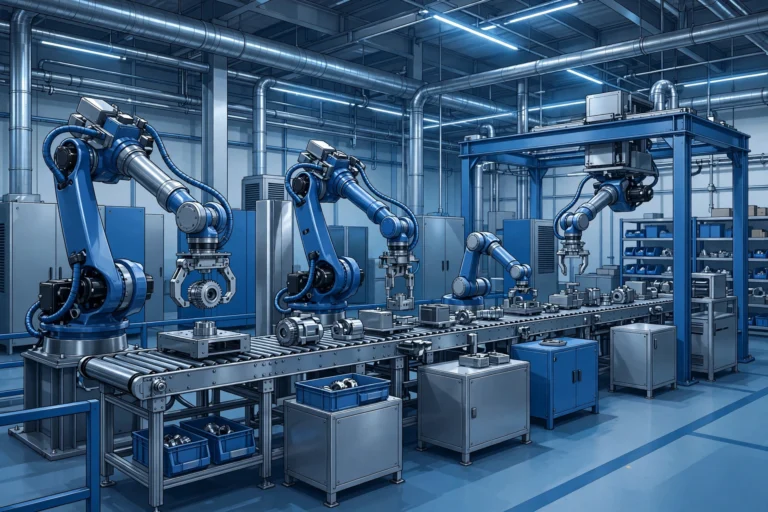
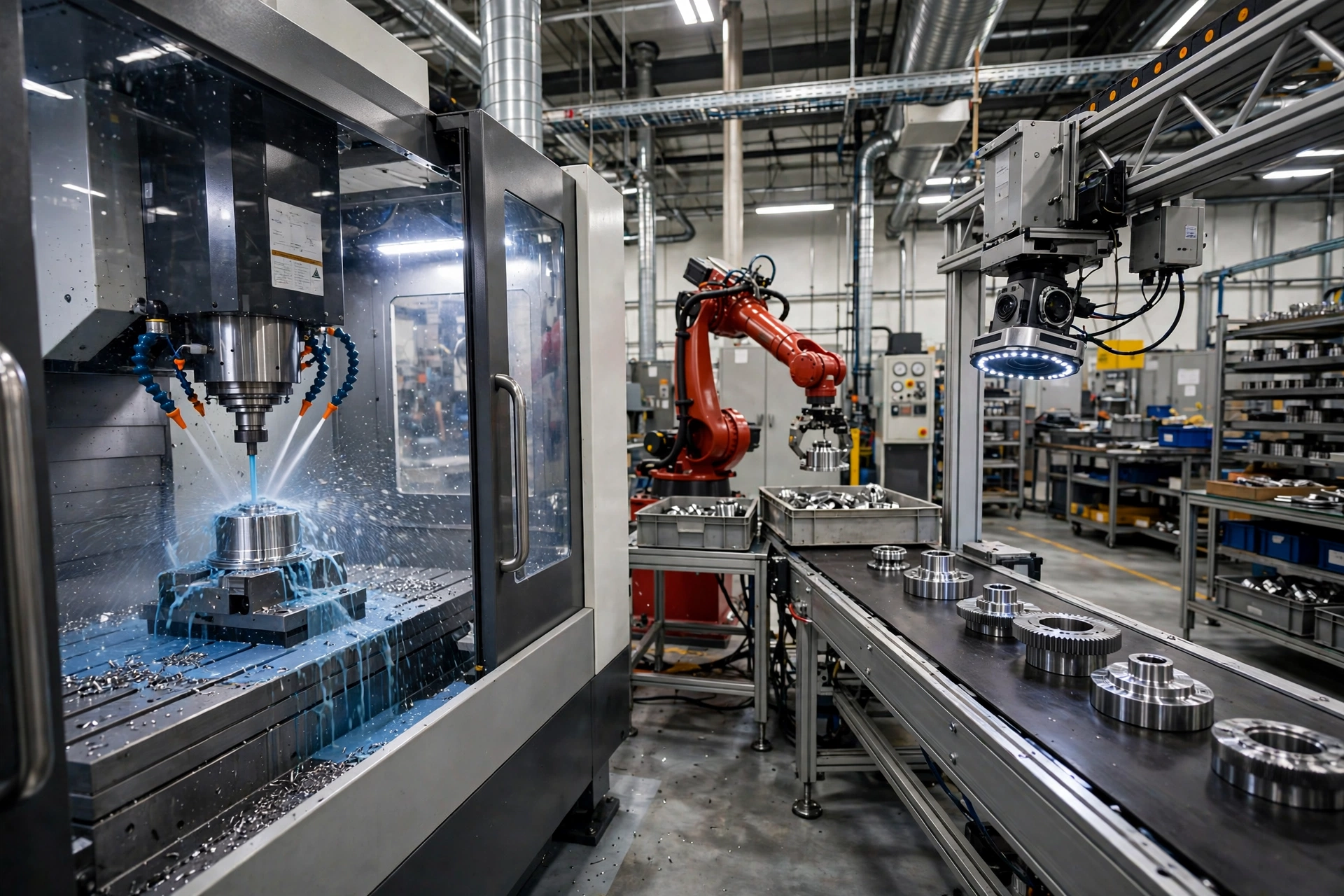
For a component plant, the practical list is shorter: a CNC machine that cuts the part, a robot or cobot that loads and unloads it, a vision system that inspects it, a PLC that sequences the cell, and an MES that tracks jobs and quality. The newest layer is connectivity: the connected-production model links those pieces so information flows from CNC machine to robot to vision inspection to production data to the next action, using standards such as OPC UA and MTConnect.
Automation tools for component manufacturing compared
| Tool | What it does | Best for |
|---|---|---|
| CNC machine | Cuts, mills or turns parts to exact dimensions from a program | Precision metal and plastic components |
| Industrial robot / cobot | Loads, unloads, moves and assembles parts; cobots work beside people | Repetitive handling and machine tending |
| Machine vision | Cameras and software inspect dimensions and surface defects | 100% quality inspection at speed |
| PLC and controls | Sequences machines, interlocks and safety logic | Every automated cell |
| MES software | Tracks jobs, materials, quality and output in real time | Plants running many jobs or variants |
| AMR (mobile robot) | Moves material between stations without fixed tracks | Material transport across the floor |
Automation tools for component manufacturing vs manual production
Automation beats manual production on repeatability, not on flexibility. A CNC machine holds tolerances a human cannot match over a full shift, and a vision system checks every part instead of sampling a few. But manual production still wins for one-off prototypes and very low volumes, where programming and setup time outweigh the run time. The honest rule: automate the work you repeat, keep people on the work that changes every day.
Estimates of the global industrial automation market in 2026 range from about $226 billion to $299 billion depending on how broadly the category is defined, with forecasts of roughly 7–10% annual growth. Collaborative robots accounted for 66,000 new installations in 2025, about 11% of the total, as smaller plants automate without cages and fences.
What does it cost to automate component manufacturing?
There is no single price: the range runs from a single cobot cell to a fully connected line. A realistic way to think about cost is by layer — the CNC machine is usually the biggest single purchase, the robot and vision system together often cost less than the machine they serve, and the PLC and MES are the cheapest parts of the build. Integration, the engineering that makes the pieces talk, is the cost buyers most often underestimate, and the place projects most often stall.
The return is framed by labour scarcity: the US National Association of Manufacturers projects 2.1 million unfilled factory jobs by 2030, and North American robot orders rose 6.6% in units and 10.1% in revenue in 2025 — buyers spending more per robot on smarter, better-connected systems.
What you need before you automate
Three prerequisites decide whether a project succeeds. First, a stable process: automating a process that still produces defects just produces defects faster — fix it, then automate it. Second, clean data: an MES is only useful if job, material and quality data are accurate. Third, someone on staff who owns the system and can change a program, clear a fault and call the integrator when needed.
For a practical rollout, see our guide to automation project management, and for the difference between attended and unattended operation, unattended automation explained.
Risks and limits to watch
A cell built for one part family can be expensive to retool when the product changes, so flexible automation — recipe-driven robots and vision — matters more than raw speed for high-mix plants. Cybersecurity is a second risk: connected machines are networked machines, and an MES-linked cell needs the same patching and access discipline as any IT system. At IMTS 2026, FANUC showed “Physical AI” — robots using vision and force data for complex assembly — and AI tools that generate robot programs from natural-language instructions, which lowers the programming barrier but raises a question buyers should ask: who owns the generated programs, and do they run without the vendor’s cloud?
Analysis: the win is connection, not more machines
Analysis: Robot sales are at record levels, yet the next productivity gain in most component plants will not come from adding another robot — it will come from making the machines already on the floor communicate. A CNC that idles while a robot waits, or a vision system whose defect data never reaches the MES, is automation that looks complete and performs like isolated machines. Buyers who budget for integration and connectivity, not just hardware, get more from the same spend. For the wider context of AI on the factory floor, see AI for industrial process control and our plain-English guide to what process automation is.
Frequently asked questions
What are automation tools for component manufacturing?
They are the machines and software that make parts with minimal manual work: CNC machines that cut parts, robots and cobots that load and move them, machine vision that inspects them, PLCs that sequence the cell, and MES software that tracks jobs and quality. Together they form a connected production cell rather than a set of standalone machines.
Which automation tool should a small manufacturer buy first?
Start with the bottleneck. For most small component shops that is machine tending — a cobot that loads and unloads the CNC so it runs through breaks and unattended hours. It is the cheapest entry point, it pays back fastest, and it does not require changing the cutting process itself.
How much does it cost to automate a component manufacturing line?
Costs range from tens of thousands of dollars for a single cobot cell to millions for a fully connected line, with the CNC machine usually the largest single purchase. Integration engineering is the most underestimated cost. The return comes from higher machine uptime, less scrap and fewer unfilled shifts.
Do automation tools replace machinists?
They replace repetitive loading, unloading and inspection, not machinists. Programming, setup, troubleshooting and quality judgment still need skilled people, and the US manufacturing sector faces a projected 2.1 million unfilled jobs by 2030 — automation is filling gaps, not emptying a full workforce.
What is the difference between fixed, programmable and flexible automation?
Fixed automation is built for one product at high volume and is hard to change. Programmable automation, such as CNC machines, is reprogrammed between batches. Flexible automation switches between product variants with little or no downtime, using recipe-driven robots and vision — the best fit for high-mix component plants.
Sources
- Wissen Research via PR Newswire — industrial automation market valued at $266.7 billion in 2026, projected to reach $410.3 billion by 2031; IFR record 603,000 robot installations in 2025.
- Accelerated Manufacturing Brokers — 2026 market estimates of $226–299 billion; IFR 542,076 installations in 2024; North American robot orders in 2025.
- Sciotex — industrial automation guide: sensors, PLCs, robots, HMI and MES/ERP layers; automation types.
- Market Prospects — connected production: CNC to robot to vision to AMR to MES, OPC UA and MTConnect.
- American Machinist — FANUC at IMTS 2026: Physical AI, digital twins and AI-generated robot programs.