What Is the Primary Goal of a Generative AI Model? Explained in Plain English
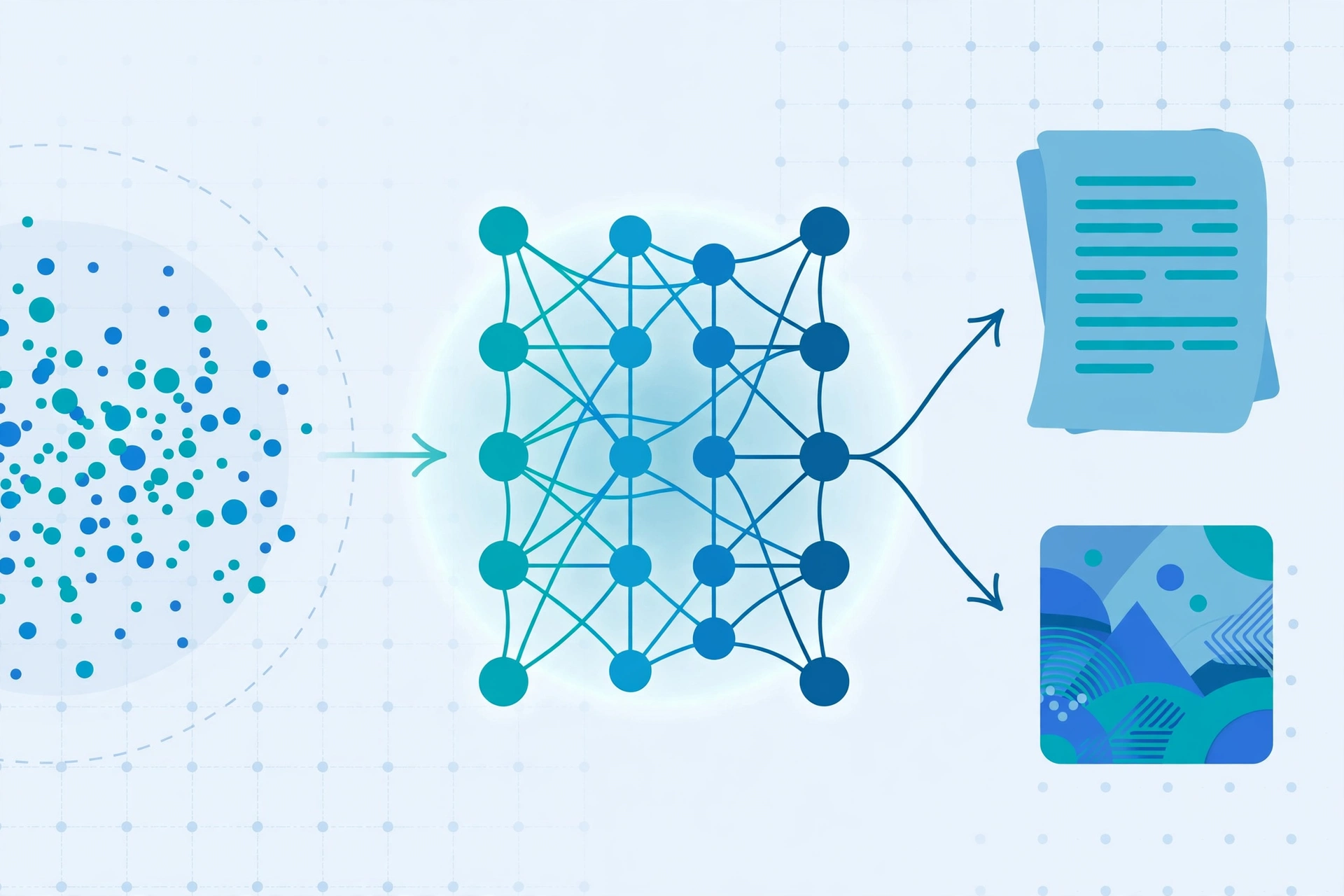
Key takeaway: The primary goal of a generative AI model is to learn the patterns and structure of its training data so it can create new content — text, images, code, or audio — that resembles that data without copying it. It is judged not by how well it recalls examples, but by how plausibly and usefully it generates something new.
What is the primary goal of a generative AI model, exactly?
A generative AI model exists to make something new. Given a prompt — a question, an instruction, or an image description — it produces fresh output that fits what it learned during training. IBM describes a generative model as a machine learning model designed to create new data similar to its training data, learning the patterns and distributions in that data and then applying them to novel input.
That distinction matters. Most older AI tools sort, rank, or predict: they label a photo, flag a suspicious transaction, or forecast next month’s sales. A generative model does a different job. Its output did not exist before you asked for it, even though it is built from patterns the model absorbed earlier.
How a generative model learns
Training is where the goal is actually pursued. A generative model studies huge collections of examples — text, images, code, or audio — and works out how those examples are put together: which words tend to follow which, or how light and shape behave in a photograph. NVIDIA explains that generative AI models use neural networks to identify the patterns and structures within existing data in order to generate new and original content.
During training, the model is scored on how close its outputs come to real examples, and adjusted to close that gap. IBM puts it plainly: the goal of training is to minimize the loss function, bringing generated outputs as close to reality as possible. The model does not store training data like a database. It stores a compressed, statistical sense of it — which is why two prompts can produce two different, original answers.
Different model families chase the same goal in different ways. Transformers, the architecture behind today’s leading language models, predict likely sequences of words or other elements. Generative adversarial networks (GANs), introduced in 2014, pair a generator that creates content with a discriminator that judges it, so each improves the other.
Generative AI compared with predictive AI
Generative AI and predictive AI are often confused because both learn from data. Their goals point in opposite directions.
| Generative AI | Predictive AI | |
|---|---|---|
| Primary goal | Create new content similar to training data | Forecast or classify based on existing data |
| Typical output | A new article, image, song, or piece of code | A label, score, or prediction |
| Example | Drafting an email from a short prompt | Estimating which customers may cancel |
| Success looks like | Original, plausible, useful new output | Accurate predictions on unseen data |
IBM’s comparison draws the same line: generative AI responds to a prompt with generated original content, while predictive AI is a separate class of AI built around prediction. Knowing which one you are using tells you what to expect — and what to check afterwards.
What does a generative AI model cost to use?
Using a generative AI model can cost nothing or a great deal, depending on how you use it. Many consumer chatbots and image tools offer a free tier, while heavier use usually means a paid subscription or paying per use through an API. Training a large model from scratch is a different scale of cost entirely — it needs vast data and computing power — which is why most people and businesses use a model someone else trained.
What do you need before using a generative AI model?
You need three things before a generative model is useful: a clear task, a good prompt, and a way to check the result. A vague prompt produces generic output, because the model can only work with the direction you give it. And a brainstorming draft needs far less verification than a published fact or a piece of production code.
For a closer look at models built for one job rather than every job, see our explainer on purpose-built AI. For how these models show up inside workplace tools, see our guide to conversational AI for employee support.
Risks and limits of generative AI models
A generative model can produce confident-sounding output that is wrong. Because it generates what is statistically plausible rather than what it has verified, it can invent facts, citations, or details — the failure often called hallucination. It can also reproduce biases present in its training data; IBM notes that generative models may learn societal biases from training data or human feedback used to tune them, and then generate biased or unfair content.
Other limits follow from the goal itself. A model trained on old data knows nothing newer, and a model asked to do a job its training never covered will still answer — generating is what it does. Treat every output as a draft, not a verdict.
Analysis: why the goal explains both the magic and the mistakes
Analysis — this section is our interpretation, not a sourced fact. Once you accept that a generative model’s goal is plausible new content rather than verified truth, its strengths and weaknesses stop being a mystery. The same mechanism that writes a fluent poem also invents a plausible-looking reference: both are statistically likely sequences, and the model itself does not know which kind it just produced. Use these models as a starting point for human work — fast first drafts and rough ideas — with a human doing the checking the model was never built to do.
Frequently asked questions
What is the primary goal of a generative AI model?
The primary goal of a generative AI model is to learn the patterns and structure of its training data so it can generate new content that resembles that data. It creates text, images, code, or audio in response to a prompt, rather than simply classifying or predicting from existing examples.
How is a generative AI model different from other AI?
Other AI systems typically analyze, classify, or predict: they label data, rank options, or forecast outcomes. A generative AI model instead produces original output that did not exist before, such as a new paragraph, picture, or program, based on patterns it learned during training.
Does a generative AI model copy its training data?
No, not in the normal case. A generative model learns statistical patterns from its training data rather than storing it as a database, and it uses those patterns to create new samples. Outputs can occasionally resemble training examples closely, which is why checking originality matters for published work.
Can a generative AI model be trusted for facts?
Not on its own. Generative models produce plausible-sounding text, which is not the same as verified fact, and they can invent details with confidence. Use them for drafts and ideas, then verify names, dates, numbers, and claims against reliable sources before relying on them.
What are common examples of generative AI models?
Well-known examples include large language models such as OpenAI’s GPT models, Anthropic’s Claude, Meta’s Llama, and Google’s Gemini, as well as image models such as Stable Diffusion. Each is built around the same goal: learning data patterns in order to generate new content.
Sources
- IBM — What is a Generative Model?
- NVIDIA — What is Generative AI and How Does it Work?
- IBM — Generative AI vs. Predictive AI: What’s the Difference?