Automated Case Loading Explained: What It Is, How It Works, and When to Use It
Key takeaway: Automated case loading is the end-of-line step where machines collate finished products and load them into shipping cases or trays without manual handling. Case packers erect or accept a case, group products into a set pattern, load them from the top, side, or by wrapping a blank around them, then seal the case for palletizing and shipping.
On most factory lines, making the product is not the bottleneck. Getting finished goods into boxes, quickly and consistently, shift after shift, is. That is where automated case loading earns its keep: a machine replaces hand packing with the same pack pattern, at a steady pace, every time. This guide covers packaging-line case loading, not automated truck or trailer loading, which is separate equipment.
What is automated case loading?
Automated case loading is the use of a machine, usually called a case packer, to place finished products into a shipping case, carton, or tray. The case is secondary packaging: the corrugated box holding a fixed number of consumer units, such as bottles, cans, pouches, or cartons. CRG Automation describes case packing as the orderly filling and sealing of finished goods into a shippable form. It sits between upstream packaging (filling, cartoning, flow wrapping) and downstream steps (case sealing, palletizing, stretch wrapping), and because the job is so repeatable, it is often the first step plants automate.
How automated case loading works
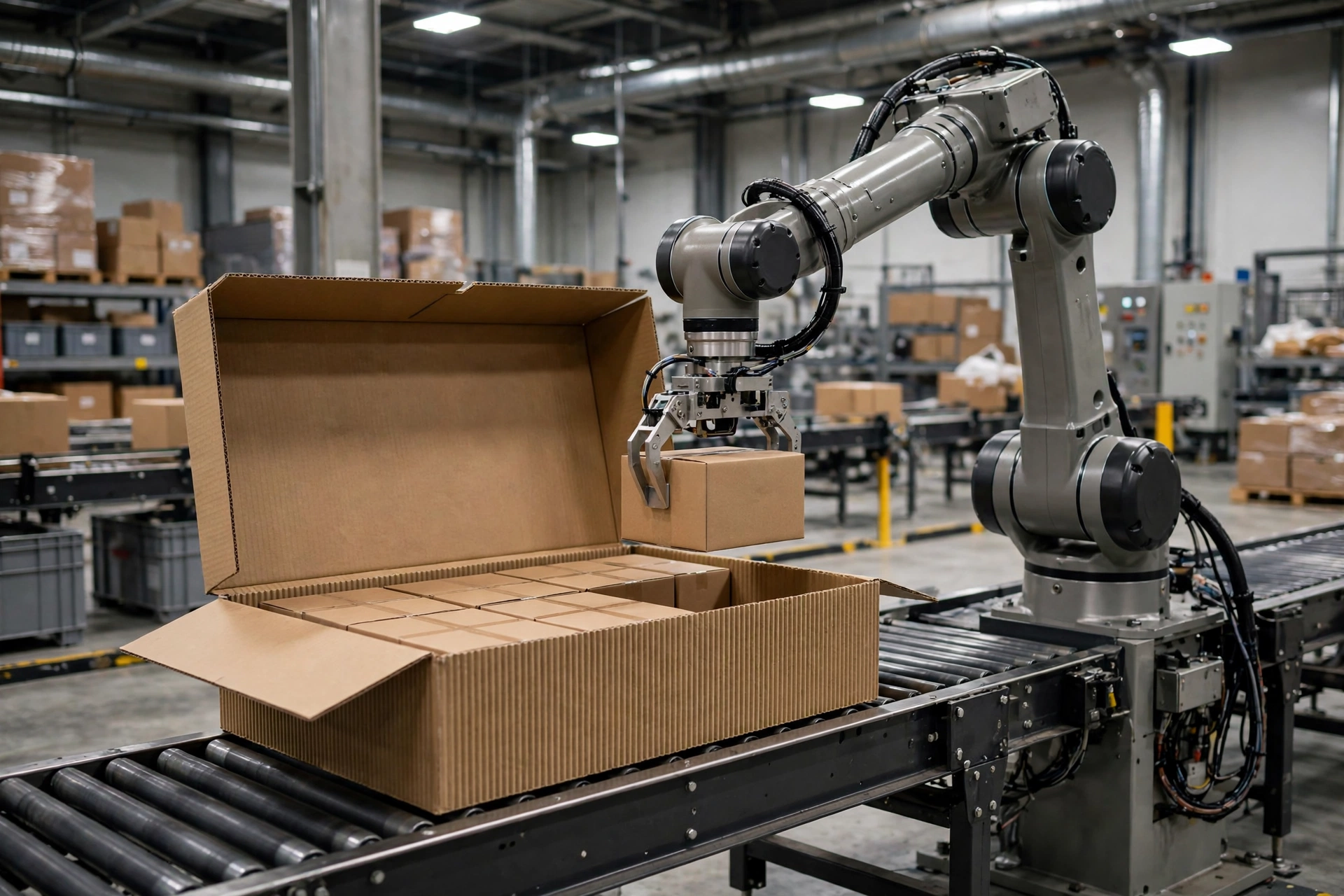
Most lines follow four steps. First, an empty case arrives: a case erector folds a flat blank into an open case, or pre-formed cases arrive on a conveyor. Second, products are collated into the required pattern, such as rows of 3 by 4. Third, the machine loads the group from the top, from the side, or by wrapping a flat blank around it. Fourth, the filled case moves to sealing, labelling, and palletizing. (Soontrue Packaging; The Packaging Edge) Vision systems increasingly check each product’s position before a robot picks it, so small variations do not stop the line.
Automated case loading machine types compared
The right machine depends on your product. The table below draws on guides from Aagard, Douglas Machine, and IndustrySearch.
| Type | How it loads | Best for | Trade-off |
|---|---|---|---|
| Top-load (including robotic) | Picked or dropped vertically into an open-top case | Pouches, bags, fragile items | Gentle, but slower and more complex |
| Side-load (horizontal) | Pushed horizontally into a pre-erected case | Rigid items such as bottles and cans | Fast, but poor for fragile shapes |
| Wrap-around | A flat blank folded tightly around the group | Uniform products at high volume | Very fast, but inflexible on mixed formats |
| Bottom-load | Case placed over the products, or loaded from below | Heavy or fragile items | Protective, but specialised |
Speeds vary by design: IndustrySearch puts standard case packers at roughly 10–30 cases per minute and continuous wrap-around packers at 20–60, while Foil Machinery lists robotic top-load systems at 20–50 and continuous wrap-around at 40–75 or more. Treat those as architecture ranges, not promises — real speed depends on product size, case pattern, and how reliably products arrive upstream.
Automated case loading vs manual packing
Automated case loading beats manual packing on consistency, speed at volume, and worker safety, while manual packing stays cheaper and more flexible at low volumes. A machine repeats the same pattern without fatigue, so cases arrive at palletizing square and uniform; inconsistent manual stacking produces leaning pallets and crushed boxes. Manual packing wins when volumes are low or products change constantly. For related automation choices, see our explainers on equipment automation and business process testing automation. Safety matters too: supplier BradyPlus notes repetitive motion injuries are a leading cause of missed work in manufacturing. (BradyPlus)
What automated case loading costs
Automated case loading costs range from tens of thousands for a basic semi-automatic machine to several hundred thousand for a fully integrated robotic line. IndustrySearch lists top-load and side-load packers at roughly $30,000–$200,000+ AUD and wrap-around packers at roughly $80,000–$250,000+ AUD, noting wrap-around blanks can cost 15–30% less per unit than pre-formed cases above 50,000 cases per month. For scale, PASCO reports a robotic palletizing cell typically starts in the $300,000 range — a downstream step, not a case packer, but a warning that budgets grow fast once conveyors, guarding, and integration are included. (PASCO Systems) The Packaging Edge claims payback in under 12–24 months, but that is a vendor claim, not a guarantee.
What you need before you automate case loading
Before you automate case loading, you need stable products, a defined case pattern, and upstream equipment feeding the machine at a steady rate. Check line balance first: a packer bought for 40 cases per minute is wasted if the filler delivers 20, and becomes a bottleneck if the filler delivers 60. If you run many formats per shift, favour a flexible top-load or robotic system over a high-speed wrap-around machine built for one format, and budget for guarding, training, and maintenance from day one.
Risks and limits of automated case loading
Automated case loading can fail when the product mix is too varied, the case board is poor quality, or the machine is bought for speed the rest of the line cannot sustain. Board warp and crushed flutes hurt high-speed reliability, and a machine tuned for one rigid product can damage fragile items. Changeovers between very different sizes may need new tooling or reprogramming, so a plant with constant small-batch changeovers may be slower with a machine than with a trained manual team. The test is simple: stable products, volumes, and patterns favour automation; daily change does not.
Analysis: buy fit, not speed
The common mistake is buying speed instead of buying fit. A wrap-around packer at 60 cases per minute is wrong for a plant packing five fragile formats a day, just as a gentle robotic top-load system is overkill for a single-SKU beverage line. Standardise the case pattern first, match the machine to the product’s fragility and shape, and treat the packer as one link in a chain with sealing, palletizing, and wrapping. Bought that way, automated case loading is less a labour replacement than a quality system: every case the same, every pallet square, every shipment predictable.
Frequently asked questions
What is automated case loading?
Automated case loading is the machine-based step of grouping finished products into a set pattern and loading them into a shipping case, carton, or tray. A case packer erects or accepts the case, collates the products, loads them from the top, side, or by wrapping a blank around them, and sends the filled case on for sealing and palletizing.
How fast is an automated case packer?
Speed depends on the machine type. Buyer guides put standard case packers at roughly 10 to 30 cases per minute, robotic top-load systems at roughly 20 to 50, and continuous-motion wrap-around packers at roughly 20 to 75 or more cases per minute. Real throughput depends on product size, case pattern, and how steadily products arrive from upstream equipment.
How much does automated case loading cost?
Costs vary widely with speed and flexibility. Industry guides list basic top-load and side-load case packers from roughly 30,000 to over 200,000 Australian dollars, and mid- to high-speed wrap-around packers from roughly 80,000 to over 250,000 Australian dollars. Integration, conveyors, safety guarding, and installation add to the machine price, so quotes should cover the full line, not just the packer.
Is automated case loading worth it for a small operation?
It depends on volume and stability. If you pack the same products in steady volumes, even a semi-automatic machine can pay back through consistent output and less strain on workers. If volumes are low or products change constantly, manual packing is usually cheaper and more flexible, and automation may cost more than it saves.
What is the difference between case loading and palletizing?
Case loading puts individual products into a shipping case, while palletizing stacks filled cases onto a pallet in a stable pattern for transport and storage. Case loading comes first on the end-of-line sequence, and palletizing comes after case sealing, so the two machines solve different problems and are often bought together.
Sources
- CRG Automation — Automated Case Packers: How They Work
- Aagard — Case Packers: Complete Buyer’s Guide (2026)
- Douglas Machine — Top Load vs Horizontal Load Case Packing
- IndustrySearch — Case Packer vs Wrap Around Case Packer
- BradyPlus — Safer By Design: Injury Prevention with Packaging Automation
- PASCO Systems — What to Know Before Investing in Robotic Palletizing