The Future of Information Technology: What Comes Next in 2026 and Beyond
Key takeaway: The future of information technology is a convergence: AI agents that act instead of just answering, computing that moves to the edge, quantum systems tackling specialised problems, and an energy bill that is forcing the whole industry to rethink how it builds. The next decade belongs to organisations that can govern and power these systems, not just buy them.
For thirty years, information technology mostly meant the same thing: faster computers, cheaper storage, and software that moved from desktops to the cloud. That pattern is breaking. In 2026, software is starting to act on its own — and everything around it, from chips to power grids, is being rebuilt to keep up.
The future of information technology: five shifts to watch
No single technology defines the next era. The change comes from five shifts arriving at once, and they reinforce each other.
| Shift | What changes | When it matters |
|---|---|---|
| AI agents | Software plans and completes multi-step work on its own | Now — scaling through 2026 |
| Physical AI | AI moves into robots, vehicles, and machines | 2026–2028 |
| Edge computing | Processing moves from the cloud to devices | Now — growing fast |
| Quantum computing | Specialised problems solved beyond classical limits | Specialised use from 2026; broad use later |
| Energy-constrained infrastructure | Power, not chips, becomes the bottleneck | Now — through 2030 |
AI agents: software that does the work
The biggest change is agentic AI. Gartner named agentic AI its number-one strategic technology trend for 2026, and projects that 40% of enterprise applications will feature task-specific AI agents by the end of 2026, up from under 5% a year earlier. These are systems that receive a goal, plan the steps, use tools, and check their own work — very different from a chatbot that waits for the next prompt.
Adoption is still early. Gartner’s figures show 75% of enterprises are experimenting with AI agents, but only 15% have moved to fully autonomous, goal-driven systems; most deployments still keep a human in the loop. The technology is real, but the governance, testing, and trust around it are still catching up. For a closer look at how businesses already use these systems, see our guide to AI agents for business automation.
AI is leaving the screen and entering the physical world
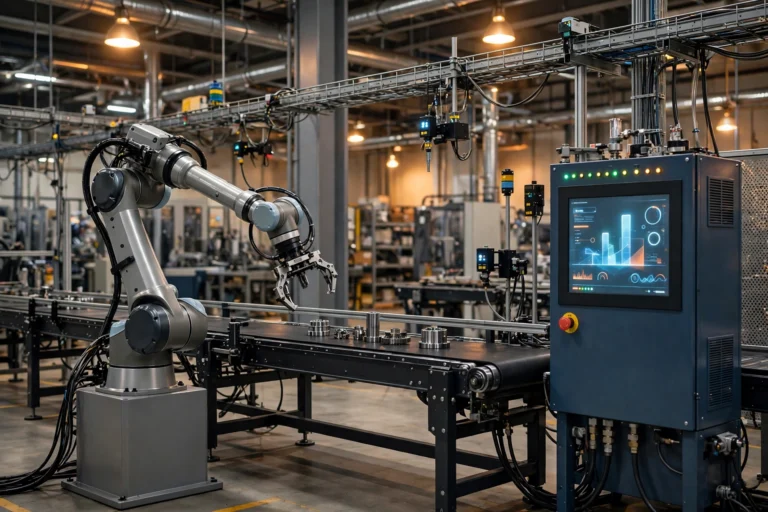
The second shift is physical AI: the same models that write and reason are now steering robots, warehouse machines, and vehicles. Analyst firm Forrester has summed up 2026 as the year “AI has left the chat,” as AI moves from digital workflows into the physical and infrastructure layers of the economy. Early warehouse and factory deployments report efficiency gains of 20–50%, according to industry coverage of Forrester’s research, though broad enterprise value from physical AI is still estimated at two to four years out.
That is why robotics, sensors, and edge computing now appear in the same conversations as language models. An agent that can book a meeting is useful; an agent that can also inspect a machine, order the part, and schedule the repair is a different kind of system — and it needs reliable, low-latency computing wherever the work happens.
Edge computing and the cost of intelligence
As AI spreads to devices and machines, more processing is moving out of central data centres and onto the device itself — phones, factory sensors, vehicles, and wearables. Edge computing cuts latency, reduces cloud costs, and keeps working when connectivity drops. Smaller, hardware-aware models running on modest accelerators are becoming as important as the largest frontier models.
But the overall energy picture is stark. The International Energy Agency estimates that data centres consumed about 415 terawatt-hours (TWh) of electricity in 2024 — around 1.5% of global electricity — and its base case sees that more than doubling to about 945 TWh by 2030, roughly as much electricity as Japan uses today. AI-focused data centres used about 155 TWh in 2025, up 50% in a single year, and the IEA expects that figure to roughly triple to about 465 TWh by 2030. Power, not chips, is becoming the binding constraint on AI growth.
Quantum computing: specialised power, not a replacement
Quantum computing is the longest-horizon piece of the picture, but it is getting closer to practical use. IBM’s researchers have said 2026 marks a milestone where quantum systems begin to outperform classical methods on specific problems — not as a replacement for ordinary computers, but as a complement for tasks like optimisation and materials simulation. The practical consequence is already visible in security planning: organisations are preparing for post-quantum cryptography, the point at which quantum computers could break current encryption, which some forecasts place as early as 2030.
What could go wrong: the governance gap
Analysis: The honest risk in the future of information technology is not that the technology stalls — it is that organisations deploy it faster than they can govern it. Gartner’s Data & Analytics Summit 2026 shared a sobering pair of numbers: four out of five organisations are deploying AI, but only one in five is seeing a return on investment. Gartner also predicts 60% of AI projects will fail by 2028 without a consistent semantic layer — the shared definitions that let systems understand data the same way.
The winners of the next decade will not be the companies that buy the most agents or the biggest models. They will be the ones that fix their data, set clear rules for what agents may do unsupervised, and budget for the electricity to run them. The technology is converging; the discipline to use it well is the real bottleneck.
What this means for you
If you work in IT, the skill set is shifting from managing servers to managing systems that act: designing agent workflows, checking their outputs, and setting guardrails. If you run a business, the practical first step is not buying a new platform — it is cleaning up the data and processes an agent would need to act on, as our guide to automating IT operations explains. And if you are choosing hardware or cloud capacity, energy efficiency is now a buying criterion, not an afterthought — a shift visible in new chips like Microsoft’s Maia 300 and in the energy-saving AI work in our manufacturing AI case studies.
Frequently asked questions
What is the future of information technology?
The future of information technology is the convergence of AI agents that act autonomously, physical AI in robots and machines, edge computing on devices, quantum systems for specialised problems, and energy-constrained infrastructure. Gartner named agentic AI its top strategic technology trend for 2026, and the IEA projects data-centre electricity use will more than double by 2030.
Will AI agents replace IT jobs?
Not wholesale, but they will change them. Gartner reports 75% of enterprises are experimenting with AI agents while only 15% run fully autonomous systems, so humans remain in the loop in most deployments. Routine tasks such as triage, testing, and documentation are automated first, while designing, governing, and checking agent work becomes more valuable.
How much electricity will AI data centres use by 2030?
The International Energy Agency’s base case puts total data-centre electricity use at about 945 TWh by 2030, up from about 415 TWh in 2024. AI-focused data centres are the fastest-growing part: about 155 TWh in 2025, expected to roughly triple to about 465 TWh by 2030.
When will quantum computing become practical?
Quantum computing is already reaching practical use for narrow, specialised problems — IBM says 2026 is the year quantum systems start outperforming classical methods on specific tasks. Broad, general-purpose quantum value is still years away, and most organisations’ near-term quantum work is preparing for post-quantum cryptography.
Sources
- Inside Logistics — Gartner identifies agentic AI, physical AI among top supply chain technology trends for 2026
- Kurums — Data Center Electricity Consumption Statistics 2026 (IEA figures)
- Tech Startups — From Agentic AI to Quantum: The Trends Shaping AI and Tech in 2026 (IBM perspectives)
- DataFlowly — 10 Technology Trends Shaping 2026: AI, Robotics & Quantum Computing