Automation Controls Training: What It Covers, How to Choose a Program, and Where It Pays Off
Key takeaway: Automation controls training teaches the skills behind modern factory automation — programming PLCs, configuring HMIs, troubleshooting sensors and drives, and working safely with industrial control systems. Programs range from short online PLC courses to multi-month certificates and vendor training, and employers consistently value hands-on practice over classroom-only learning.
What Automation Controls Training Actually Covers
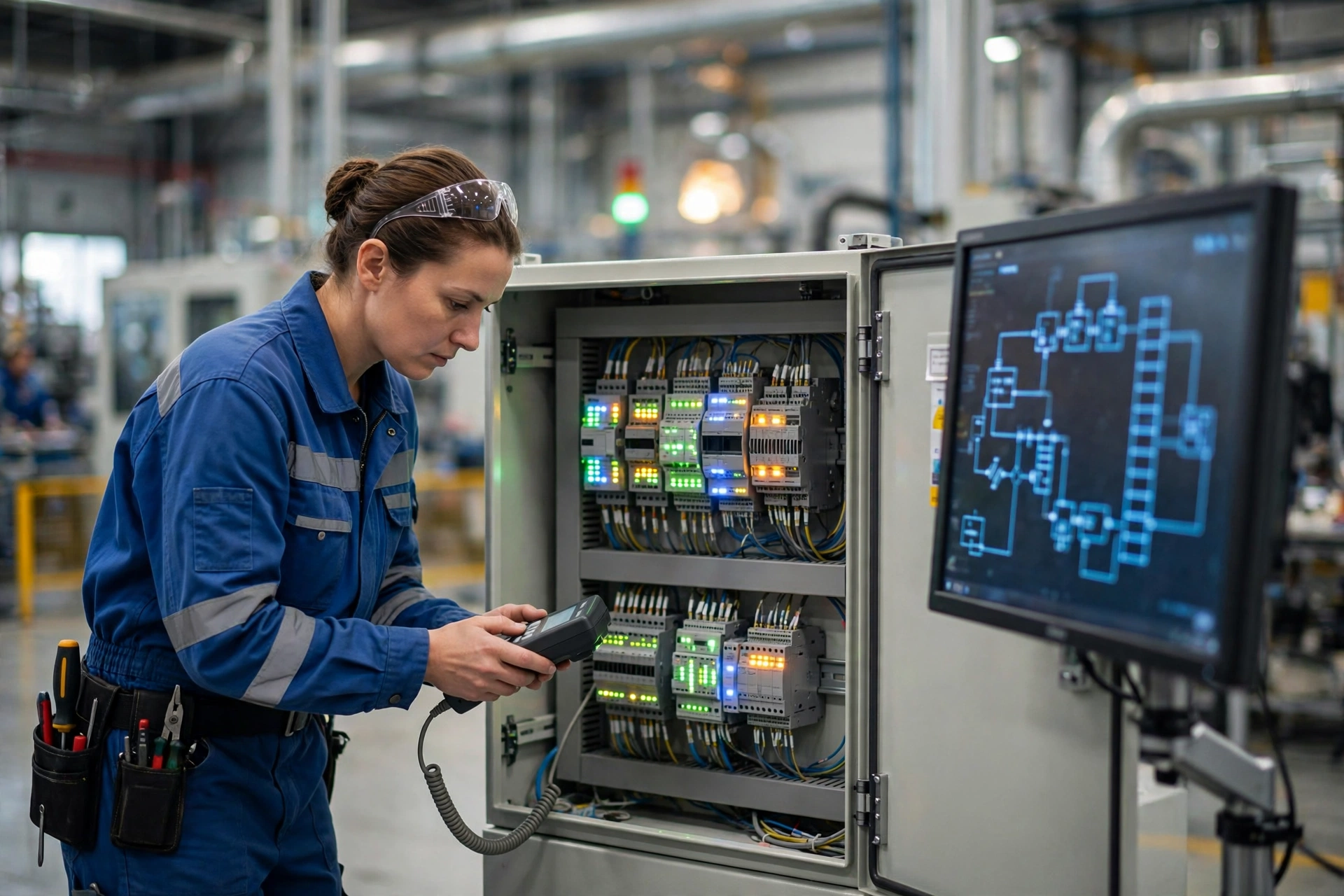
Automation controls training is practical, hands-on education for working with the control systems that run automated manufacturing. The core subjects show up in nearly every program:
- PLC programming — writing and debugging ladder logic, structured text, and function block diagrams, most often for Allen-Bradley/Rockwell or Siemens hardware.
- HMI and SCADA setup — building operator screens, alarms, and supervisory dashboards so people can monitor and direct the process.
- Sensors, drives, and motion — wiring inputs and outputs, configuring variable-frequency drives, and basic servo control.
- Troubleshooting and maintenance — reading wiring diagrams, tracing faults, and keeping a line running with minimal downtime.
- Safety — lockout/tagout, safety instrumented systems, and safe commissioning practices.
For example, Penn State Berks runs an evening PLC certificate that moves students through basics, drives, ControlLogix, PanelView, loop control, and advanced topics, with job targets including maintenance technician and controls engineer roles. NTUC LearningHub’s Certified PLC Programming Professional course compresses similar ground into 24 hours of hands-on learning plus written and practical assessments.
Why It Matters Now
Manufacturers are automating faster than the skilled workforce is growing, and controls skills sit at the center of that gap. Robots, vision systems, and conveyors only add value when someone can program, integrate, and fix the controllers behind them. That is why controls technicians and engineers keep showing up on hard-to-fill lists — the skill set is directly tied to production uptime.
Analysis: The real hiring premium isn’t on certificates alone. Training programs that pair programming exercises with real or simulated hardware (training PLCs, digital twins like Factory I/O, or actual plant floors) consistently produce candidates employers trust sooner. If a course is lecture-only, treat it as theory prep — not job-ready training. See also our guide to custom industrial automation for how these skills get applied on real projects.
How to Choose the Right Program
Match the format to your starting point:
| Format | Typical length | Best for |
|---|---|---|
| Online PLC courses | 10–40 hours | Beginners testing the waters or refreshing ladder logic |
| Vendor training (Rockwell, Siemens) | 3–10 days | Engineers standardizing on one hardware platform |
| Certificate programs | 1–6 months | Career changers and technicians needing a credential |
| On-the-job / apprenticeship | 6–24 months | Deep, plant-specific skills that courses can’t simulate |
When comparing programs, check three things: which hardware and software brands they teach (make sure it matches your local job market), whether every student gets real lab time, and whether the course ends with a project or assessment you can show an employer. A certificate of completion, like the one issued by hands-on programs such as the Allen-Bradley Micro800 PLC course, is more useful when it’s backed by a portfolio of working projects.
Should You Pursue Certification?
For automation careers, the two most-recognized credentials come from the International Society of Automation (ISA):
- CAP (Certified Automation Professional) — for engineers responsible for the definition, design, development, deployment, documentation, and support of control systems. Per ISA’s published requirements, a four-year technical degree plus five years (7,500 hours) of automation experience qualifies you; without a four-year degree, ten years (15,000 hours) is required.
- CCST (Certified Control Systems Technician) — for technicians, with three levels tied to experience and training.
ISA also runs certificate programs (classroom training plus exams) in functional safety and cybersecurity. Analysis: certifications matter most once you have experience — early in a career, documented hands-on training hours carry more weight with employers than letters after your name. Pair automation controls training with broader knowledge, such as automating IT operations, to understand how plant-floor systems connect to business systems.
If you read USABite in Google Search, consider adding us as a preferred source — it helps our independent tech explainers reach more readers.
Frequently Asked Questions
What is automation controls training?
Automation controls training teaches you to program, configure, troubleshoot, and maintain the control systems used in automated manufacturing — mainly PLCs, HMIs, sensors, and drives. It focuses on hands-on skills like ladder-logic programming and fault diagnosis, not just theory.
How long does automation controls training take?
It varies widely. Short online PLC courses run 10–40 hours, vendor training courses typically last 3–10 days, university or technical-college certificates take one to six months, and apprenticeships can run one to two years. Choose based on your experience level and career goals.
Do I need a degree to get into automation controls work?
Not always. Many technicians enter through certificate programs or on-the-job training. For ISA’s CAP certification, however, the published requirements are a four-year technical degree plus five years of automation experience, or ten years of experience without the degree.
Is ISA CAP certification worth it?
For experienced automation engineers, CAP is a respected credential that documents expertise across the full automation project lifecycle, from definition through support. Early in your career, though, employers tend to value demonstrated hands-on training and project work more than certifications.
What’s the difference between PLC training and full automation controls training?
PLC training focuses on programming the controllers themselves, while full automation controls training adds HMI and SCADA configuration, sensors and drives, networking, safety systems, and troubleshooting across the whole control loop. PLC training is the foundation; controls training is the complete skill set.
Sources
- How ISA’s Certification and Certificate Programs Can Benefit You and Your Employer — Automation.com
- CAP Requirements — ISA (International Society of Automation)
- PLC for Industry Certificate Program — Penn State Berks
- Certified PLC Programming Professional — NTUC LearningHub