Industrial Automation Design Services: What They Are and How They Work in 2026
Key takeaway: Industrial automation design services are engineering services that plan and design automated factory systems — from the mechanical layout and electrical design to PLC programming, control panels, and commissioning. Manufacturers hire them when automating a line or upgrading a plant, because designing the system correctly upfront determines its uptime, safety, and cost.
What Industrial Automation Design Services Are
Industrial automation design services are specialist engineering services that design complete automation systems for factories and process plants. Rather than buying a single robot or machine, a manufacturer hires a design firm (often called a system integrator) to engineer the entire automated workflow: the mechanical equipment, the electrical systems, the control software, and the safety systems — all coordinated as one project.
These services typically cover front-end engineering (concept studies, feasibility analysis), detailed mechanical and electrical design, PLC and HMI/SCADA programming, control panel design and fabrication, industrial network architecture, and commissioning and startup support on the factory floor. Some firms, like Kasa Controls — a US integrator with more than 50 years in the field — handle everything from consulting and factory acceptance testing to maintenance agreements.
What Is Typically Included
Most industrial automation design service packages include the same core deliverables:
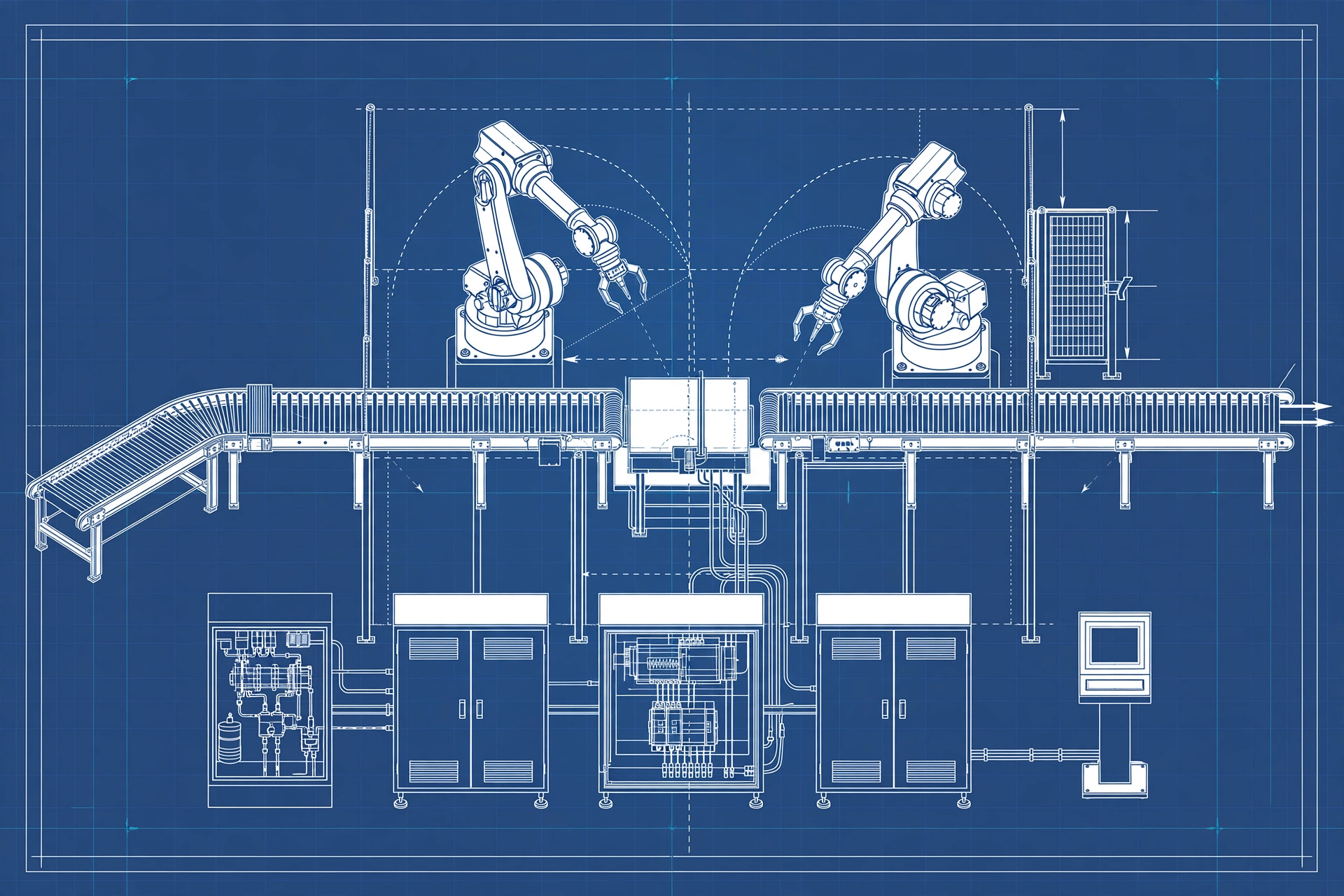
- Mechanical design: custom machine frames, fixtures, conveyors, and enclosures, often modeled in 3D CAD tools like AutoCAD or ePLAN.
- Electrical and controls design: schematic drawings, motor control design, component selection, and UL 508A-compliant control panel design and fabrication.
- Control software: PLC programming (Allen-Bradley, Siemens, Beckhoff), HMI/SCADA development, motion control, and robotics simulation.
- System integration: connecting sensors, actuators, drives, and industrial networks (Ethernet/IP, Modbus, Profibus) so the whole line communicates seamlessly.
- Commissioning and support: loop checking, functional testing, startup on the plant floor, operator training, and as-built documentation.
Industry guides such as GlobalSpec’s automation equipment and system integrators selection guide note that integrators also frequently offer retrofitting of existing lines, in-house prototyping, and on-site training.
How a Typical Engagement Runs
A standard design engagement follows a predictable sequence. First comes a feasibility and concept phase, where the firm studies the process and proposes an automation approach. Next is detailed design — mechanical layouts, electrical schematics, and control software architecture. Then fabrication and factory acceptance testing (FAT), where the system is built and tested before it ever reaches the plant. Finally comes installation, commissioning, and turnover, including as-built drawings and O&M manuals.
Because design mistakes discovered during commissioning are expensive, experienced firms front-load the design work: simulation, emulation, and thorough documentation. For brownfield (existing) plants, the design phase also covers integration with legacy equipment and OT networks.
Why Manufacturers Hire Design Services Instead of Building In-House
The main reason is accountability and speed. A full automation cell needs mechanical engineers, controls engineers, PLC programmers, panel builders, and commissioning specialists — a team most mid-size plants cannot justify keeping full-time. Design firms bring that cross-disciplinary team on demand.
The market is substantial: Stratistics MRC values the global system integrator for industrial automation market at $24.8 billion in 2025, growing to $36.01 billion by 2032 at a 5.4% compound annual rate, driven by smart-factory adoption and digitalization. By technology, PLC-based integration holds the largest share at about 26.1%, with oil and gas the largest end-market at roughly 21.3% of revenues, per Dataintelo’s analysis.
Analysis: with skilled-labor shortages and digitalization pressure rising, the trend is toward integrators that design data in from the start — MES integration, OEE tracking, and cloud connectivity built into the initial design, not bolted on later. Related reading: our guides on custom industrial automation and industrial automation and IIoT.
Frequently Asked Questions
What do industrial automation design services include?
They typically include mechanical design, electrical and controls engineering, PLC/HMI/SCADA programming, control panel design and fabrication, industrial network design, and commissioning with factory acceptance testing. Some firms also provide retrofitting of existing lines, operator training, and long-term maintenance support.
How much do industrial automation design services cost?
Costs vary widely with scope: a simple machine control retrofit may run tens of thousands of dollars, while a full turnkey production cell can run into the hundreds of thousands or millions. Most firms quote after a feasibility study, since the design effort depends on process complexity, safety requirements, and hardware platform choices.
What is the difference between a system integrator and an in-house controls team?
A system integrator is an outside firm hired per project to design and implement automation systems, bringing cross-disciplinary expertise without the overhead of full-time staff. An in-house team handles ongoing improvements and maintenance. Many plants use both: integrators for new projects, internal engineers for daily operations.
Which industries use industrial automation design services most?
Oil and gas is the largest end-market at roughly 21% of global integration revenues, followed by automotive (growing about 8.9% annually on EV manufacturing demand) and pharmaceuticals (about 9.4% annual growth on biologic drug manufacturing). Food and beverage, metals, mining, and water utilities are also major users.
Sources
- GlobalSpec — Automation Equipment and System Integrators Selection Guide
- Stratistics MRC — System Integrator for Industrial Automation Market
- Dataintelo — Automation System Integrator Market
- Cotmac — Engineering Services for Industrial Automation
- Kasa Controls — Industrial Automation Integrator