
AI in Safety Management: The Shift From Reactive to Predictive Workplace Safety
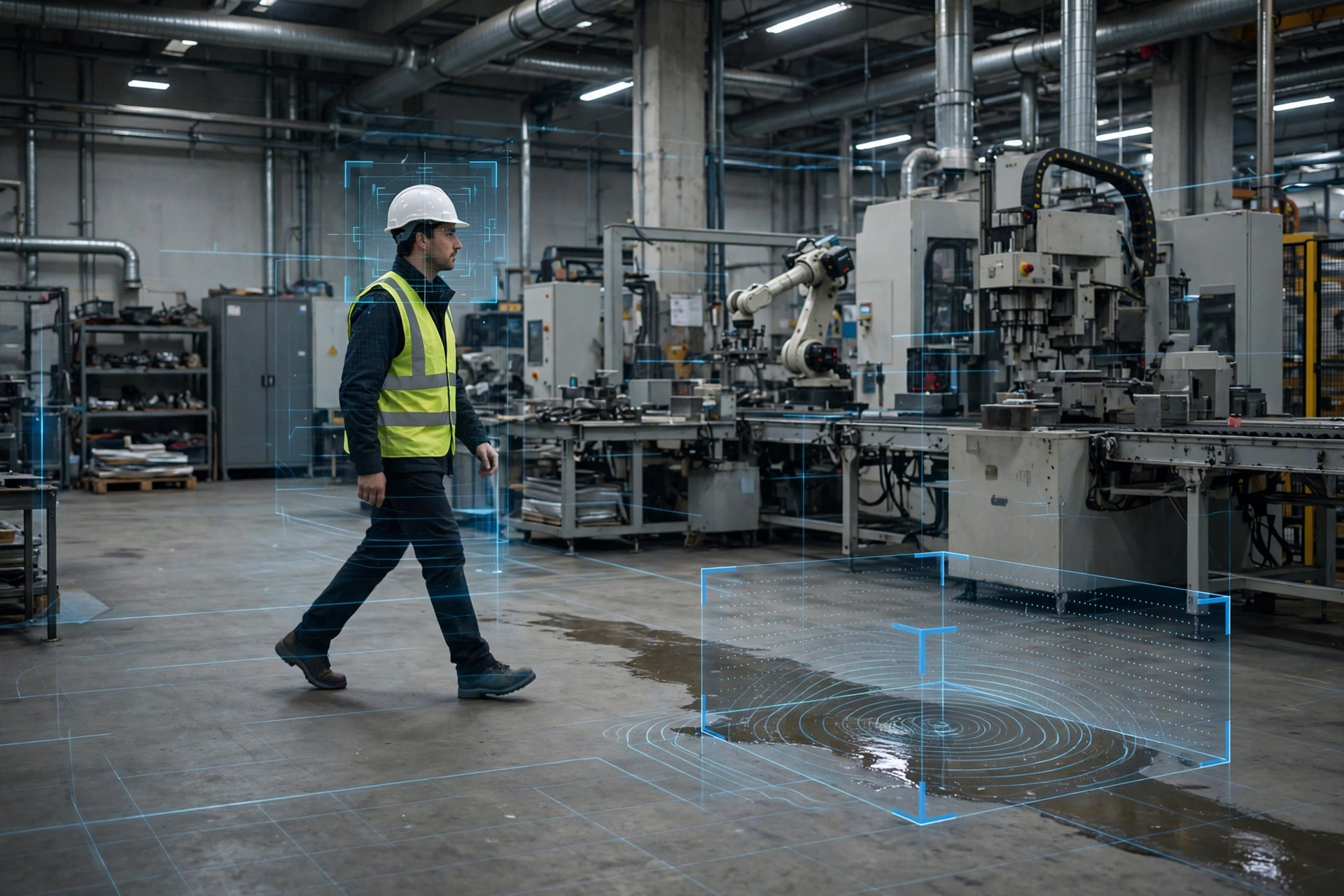
For decades, workplace safety has run on a familiar loop: train once a year, walk the floor with a checklist, file the incident report after something goes wrong. AI in safety management is rewriting that loop. Instead of learning from injuries after they happen, companies are starting to spot risk beforehand — using cameras that watch for missing hard hats, sensors that flag fatigue, and software that predicts where the next accident is statistically likely to occur.
This isn’t science fiction, and it isn’t a replacement for good safety culture. It’s a new layer of tools. Here’s what they do, what the evidence actually supports, and where the hype ends.
What “AI in safety management” actually means
Strip away the marketing and the term covers three technologies working together. Machine learning crunches historical incident data, sensor readings, and shift patterns to find risk patterns humans miss. Computer vision — cameras paired with AI models — watches video feeds to detect things like missing personal protective equipment (PPE), blocked emergency exits, spills, or workers entering restricted zones. Wearables and IoT sensors track heart rate, movement, heat, and noise exposure to catch fatigue or dangerous conditions early.
The unifying idea, as the National Safety Council puts it in its research on the topic, is a move from lagging indicators (injury counts, audit findings — things that tell you where risk *was*) to leading indicators (real-time signals that tell you where risk *is*). That’s the whole pitch in one sentence.
Three ways AI in safety management is already being used
1. Computer vision on the floor. AI-enabled cameras on factory floors, warehouses, and construction sites can now detect missing PPE, unsafe proximity to machinery, or blocked exits in real time and alert a supervisor within seconds — not at the next scheduled walkthrough. The National Safety Council’s review of the technology notes that today’s most effective detection systems are based on deep learning, and that beyond hazard-spotting, the same systems can log what happened around an incident to help predict when similar conditions might recur.
2. Predictive risk analytics. By analyzing past incidents, near-misses, equipment data, and even weather and shift schedules, AI models flag which tasks, locations, or times carry the highest risk. Some systems review permit-to-work requests and score their risk before the job starts. EHS publications also describe a newer use: generative AI simulating operational scenarios so safety teams can rehearse responses to incidents that haven’t happened yet.
3. Wearables and automated inspections. Sensors paired with machine learning monitor fatigue indicators — heart rate, motion patterns — and environmental exposure like heat or gas levels. Drones and robots with AI can inspect confined spaces or hazardous areas, returning reports without putting a human inspector at risk. Vendors are also pushing AI vehicular-safety tech: in-cab cameras that detect driver fatigue, geofencing around danger zones, and proximity alerts between workers and moving machinery.
What’s verified — and what’s still early
Honest separation matters here, because vendor marketing routinely blurs it.
Verified: the core technologies work as described. Computer vision reliably detects objects and behaviors it was trained on — hard hats, vests, spills, zone intrusions. Predictive models can surface genuine risk patterns from historical data. Regulators and industry bodies, including the National Safety Council, treat these as legitimate, deployed tools with real use cases across manufacturing, logistics, and construction.
Still early or overstated: the big payoff claims. You’ll see vendors promise dramatic incident reductions, but independent, peer-reviewed evidence tying AI safety deployments to specific injury-rate drops is thin — most published “results” come from the vendors themselves. The National Safety Council’s own researchers flag real drawbacks: building models from scratch is expensive, systems trained on broad datasets can bake in bias, continuous camera and wearable monitoring raises genuine privacy concerns, and there’s a constant tradeoff between effectiveness, cost, and complexity.
Analysis (our read): AI in safety management is best understood as an early-warning layer, not a fix. It makes the invisible visible — the missed hard hat at 2 a.m., the fatigue pattern across night shifts — but it doesn’t replace training or a culture where workers report near-misses.
The practical angle: if you’re evaluating this
A few grounded takeaways for safety leads, operations managers, or just the curious:
- Pilot narrow. Pick one high-risk, well-defined problem — say, PPE compliance at a single site — before rolling cameras across every facility. Measurable pilots beat grand deployments.
- Involve workers early. The National Safety Council specifically recommends bringing employees at all levels into trials of new monitoring tech. Surveillance that feels imposed breeds workarounds; transparency builds trust.
- Budget for the unglamorous parts. Data labeling, model tuning, false-alarm triage, and privacy compliance are where these projects actually succeed or fail — not the demo.
- Keep humans in the loop. An AI flag is a suggestion, not a verdict. The final call on stopping work or disciplining a worker should stay human.
AI in safety management won’t end workplace accidents. But the shift it represents — from documenting harm to anticipating it — is real, already deployed, and worth understanding on its own terms rather than the vendors’.
Sources
- National Safety Council — Using Computer Vision as a Risk Mitigation Tool
- National Safety Council — Using Data and AI to Gain Insights into Your Safety Program
- EHS Today — Prioritizing Workplace Safety with AI
- Fatigue Science — Understanding AI in Workplace Safety
- viAct — Top 5 Workplace Safety AI Trends in 2026

One Comment
Comments are closed.