AI for Workplace Safety: How Computer Vision, Wearables, and Predictive Analytics Prevent Injuries
Key takeaway: AI for workplace safety uses computer vision, wearable sensors, and predictive analytics to spot hazards as they appear and flag where injuries are most likely next. Cameras watch for missing hard hats and forklift-pedestrian conflicts, wearables track fatigue, and models rank risky tasks. It adds early warning — it does not replace guards, rules, or people.
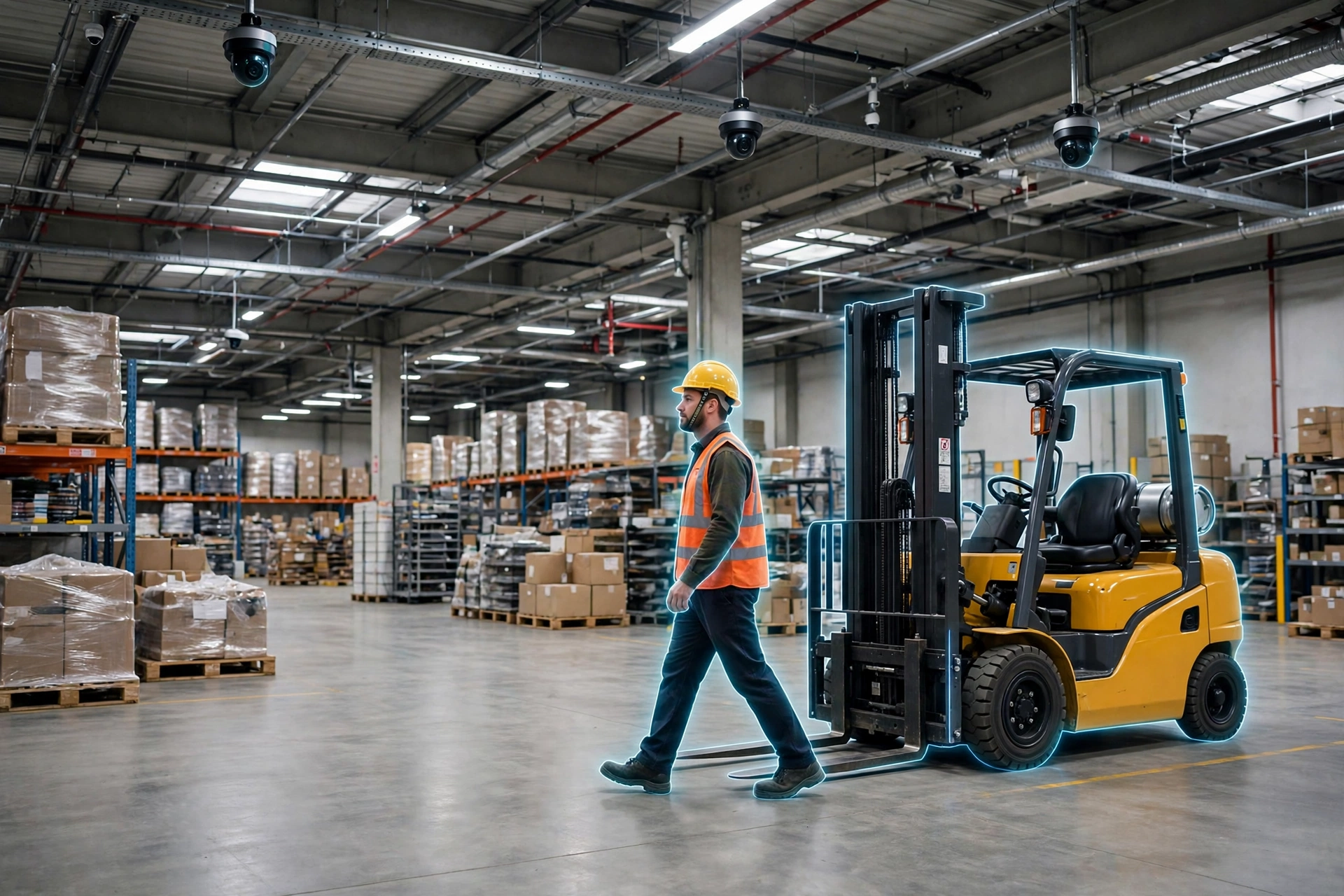
A forklift turns a blind corner. A worker steps into a marked zone without a hard hat. AI for workplace safety catches those moments seconds earlier — and shows safety teams where the next one is likely.
Why workplace safety still needs help
In 2024, 5,070 people died from work-related injuries in the United States, down 4.0% from 5,283 in 2023, according to the U.S. Bureau of Labor Statistics. Nonfatal injuries are far more common: 2.3 cases per 100 full-time workers, about 2.5 million in total. The 2025 Liberty Mutual Workplace Safety Index puts the annual cost of serious workplace injuries to U.S. businesses at over $58.78 billion, as reported by Protex AI. Rates run highest where work is physical: warehousing 4.8 per 100 workers, hospitals 5.1, against 2.3 overall.
How AI for workplace safety works
Three jobs cover almost everything vendors sell. Hazard detection: cameras and sensors watch for known dangers — a missing hard hat, a forklift and a pedestrian on a collision course, a spill — and raise an alert. Incident prediction: models study past injuries, near misses, and shift patterns, then score where risk is rising. The output is a ranked list of places to look, not a forecast of who will be hurt. Reports: language models read free-text near-miss reports, group them by cause, and draft investigation summaries — often the quickest win. Detection tells you something is wrong now; prediction tells you where to look next. We covered the broader shift in our guide to AI in safety management.
Computer vision vs wearables vs predictive analytics
| Approach | What it watches | Best for | Main weakness |
|---|---|---|---|
| Computer vision | Camera feeds: PPE use, exclusion zones, vehicle-pedestrian conflicts | Visible, repeatable hazards | Misses in poor light; false alarms |
| Wearables | Heart rate, movement, fatigue signals | Fatigue, falls, lone workers | Comfort and acceptance; privacy concerns |
| Predictive analytics | Injury logs, near misses, schedules | Ranking risky tasks and shifts | Biased by under-reported data |
Cameras dominate the research: a 2025 review in Sensors covered 61 studies and found cameras the most common data source (23), ahead of wearables (12) and environmental sensors (8), with privacy and weak standardization as the main limits, as detailed in Rework’s guide to AI for workplace safety.
What does AI workplace safety cost?
There is no standard price, and vendors rarely publish one. Most quote per camera or per site, usually as a subscription covering the software, alerts, and dashboard, with cameras and installation often priced separately. A single-zone pilot costs far less than a site-wide rollout, which is why most deployments start small. Price the pilot first, and ask for a trial on your own footage before believing a detection rate.
What you need before you start
Pull three years of recordable cases, near misses, and first-aid events, and find the two or three task types behind most harm. Check camera coverage, lighting, and blind spots — poor footage defeats good models. Decide who owns each alert and how fast they must respond; an alert nobody owns is worse than none. Run it silently for a few weeks first, logging what it would have flagged, and compare with what supervisors saw. In manufacturing, the layout and guarding choices in our industrial automation design services guide shape what cameras can see. Finally, use the hierarchy of controls: NIOSH ranks elimination first and PPE last, and AI alerts sit in the administrative tier — if a guard or a redesigned walkway removes the hazard, do that first.
The risks and limits of AI for workplace safety
Privacy is the first limit. The EU AI Act lists AI that monitors workers as a high-risk category, and the UK Information Commissioner’s Office says consent is usually not appropriate at work because of the power imbalance. Design for it: detect conditions, not people; blur identities by default; tell workers what is captured and what it will never be used for. Overreliance is the second. In a 2026 survey of 1,053 EHS professionals by the National Safety Council and Wolters Kluwer Enablon, 90% were concerned about AI’s implications and 65% named overreliance as a key risk; only 20% had extensive AI integration in safety programs. The third limit is the data: near misses are chronically under-reported, so a model learns where people report, not only where people get hurt. Add alert fatigue, and the picture is clear — AI is an early-warning layer, not a safety program.
Analysis: where AI earns its place — and where it doesn’t
Analysis. AI for workplace safety is at its best doing one narrow, visible job well: watching a forklift lane, checking hard hats at a gate, sorting near-miss reports. It is at its worst sold as a safety program in a box. The evidence base is still young — mostly lab studies, not live-site trials — and vendor injury-reduction figures, typically 25–30%, are company-reported, not independently verified. The National Safety Council’s line is the right one: “While AI offers significant opportunities to enhance workplace safety, it must be implemented thoughtfully,” with AI augmenting — not replacing — human expertise. Judge the system on one number: fewer injuries on the tasks it watches, against your own baseline.
Frequently asked questions
What is AI for workplace safety?
It is the use of computer vision, sensor analytics, and machine learning to spot hazards as they appear and flag where incidents are most likely next. It sits on top of data a site already produces — camera feeds, sensors, reports, and injury logs — and adds early warning to an existing safety program.
Can AI replace safety officers?
No. AI is strongest at noticing and alerting; fixing a hazard is still a human job. The National Safety Council says AI should augment, not replace, human expertise — incorrect safety information can be the difference between life and death.
Is it legal to use AI cameras to monitor workers?
It depends on where you operate. In the U.S., the general duty clause requires employers to provide a workplace free from recognized hazards, and an unanswered AI alert can be evidence the employer knew about a risk. In the EU, AI that monitors workers is classed as high-risk under the EU AI Act. Check local rules with counsel first.
Does AI workplace safety actually reduce injuries?
There is no independent, large-scale proof yet. Vendors report 25–30% reductions in workplace incidents, but those are company-reported figures, not verified benchmarks. The honest test is your own baseline.
Sources
- U.S. Bureau of Labor Statistics — Injuries, Illnesses, and Fatalities (5,070 fatal work injuries in 2024; 2.3 nonfatal cases per 100 full-time workers)
- Rework — AI for Workplace Safety: Hazard Detection and Incident Prediction (2025 Sensors review of 61 studies; EU AI Act and ICO guidance)
- AI Journal — National Safety Council and Wolters Kluwer Enablon report on AI adoption among EHS professionals (2026 survey of 1,053 professionals)
- Occupational Health & Safety — NSC Report: Rapid AI Adoption in EHS Requires Guardrails
- Protex AI — Leveraging AI: Top Workplace Safety Trends (2025 Liberty Mutual Workplace Safety Index: $58.78 billion annual cost)
- Vanguard EHS — Top Workplace Safety Trends for 2026