How to Boost Manufacturing Productivity with Automation Technologies
Key takeaway: Factories can boost manufacturing productivity with automation technologies — robotics, AI quality inspection, predictive maintenance, and autonomous mobile robots — that in documented cases cut build time by 66%, reduced unplanned downtime by 26% or more, and raised output per worker by over 150%. The gains come from combining machines with good data and workflow integration, not from automating a single station in isolation.
Manufacturing has a productivity paradox right now: almost everyone is investing in automation, but only a minority has reached the stage where it pays off at scale. Redwood Software’s Manufacturing AI and Automation Outlook 2026 — a survey of 300 manufacturing professionals conducted by independent research firm Leger Opinion — found that 98% of manufacturers are exploring or considering AI-driven automation, yet only 20% say they feel fully prepared to use it at scale, and seven in ten have automated half or less of their core operations.
The plants that are pulling ahead treat automation as a connected system: sensors feeding data, AI models making decisions, and robots executing — not one clever robot in a manual process.
Which automation technologies actually boost manufacturing productivity
Four technology categories show up most consistently in real production results:
1. Industrial and collaborative robots
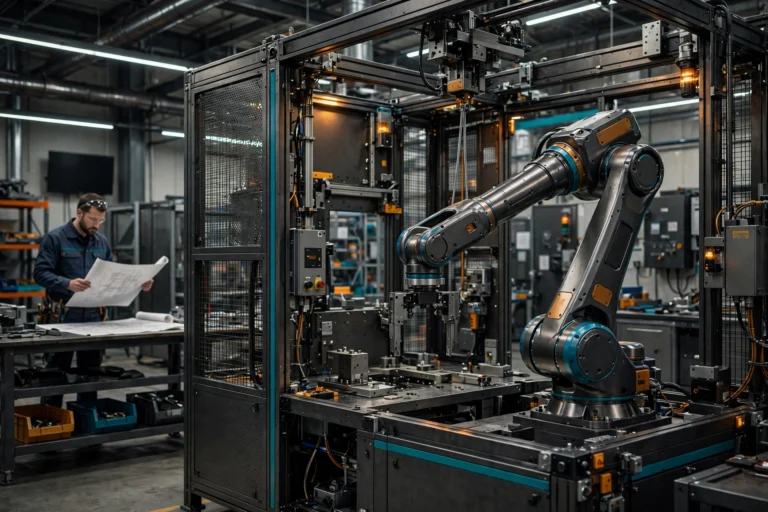
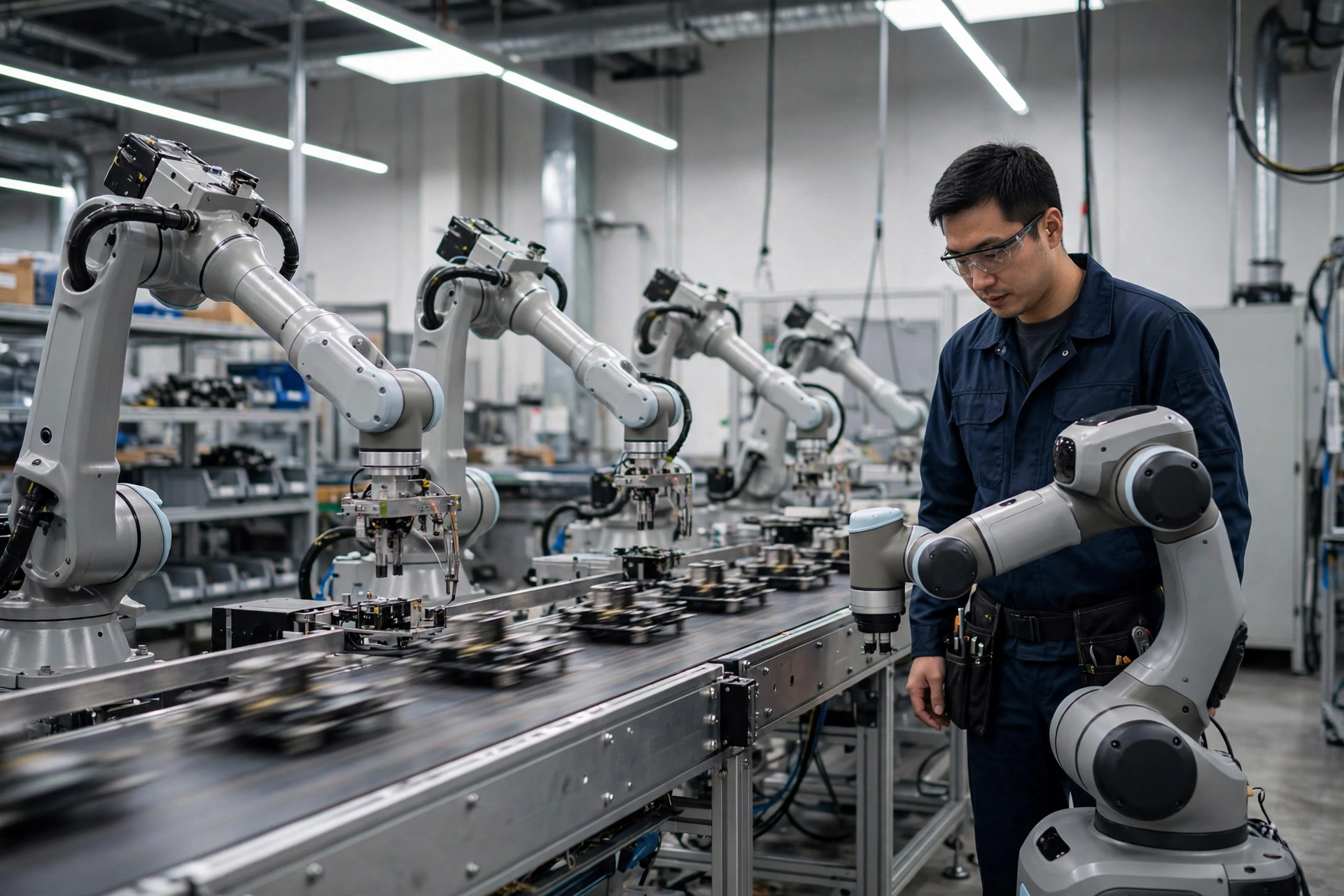
Robot arms handle welding, assembly, pick-and-place, and packaging at speeds and precision no manual line can match, around the clock. Collaborative robots (cobots) work alongside people without safety cages, making them practical for smaller plants and mixed tasks. In one documented case from the Association for Advancing Automation (A3 application stories), remanufacturer Dorman installed a robotic storage tower to match and retrieve battery modules in its hybrid battery pack business: module matching went from manual bin-pulling to an automated process storing and retrieving one module every eight seconds, cutting battery build time by 66% and raising daily output of finished battery packs by 300%.
2. AI-powered quality inspection
Machine-vision cameras trained on defect images inspect every part — not a sample — and flag flaws humans miss, in milliseconds. Indian automotive plants using AI-driven vision systems for defect detection have reduced defect rates by as much as 25%, according to a report in Express Computer. Because inspection is continuous, quality stops being a trade-off against throughput.
3. Predictive maintenance with IoT sensors
Sensors on motors, spindles, and pumps feed vibration, temperature, and current data to AI models that spot failure signatures weeks before a breakdown. The Redwood survey found 60% of manufacturers report reducing unplanned downtime by at least 26% through automation — and downtime is the silent killer of productivity metrics like OEE (overall equipment effectiveness). An earlier USABite piece on AI energy optimization shows how the same sensor data also cuts power waste.
4. Autonomous mobile robots (AMRs) and smart material handling
AMRs move parts, kits, and finished goods between stations without fixed tracks or human drivers. Machine builder Lenze Drive Systems deployed a MiR200 AMR at its Ruitz, France plant to automate product transport between packing and sorting; the robot travels close to 3.1 miles (5 km) autonomously each day, improved productivity by 10–15%, and freed operators from repetitive load-carrying (A3).
Why it matters now
Three pressures are pushing manufacturers toward deeper automation at once. Labor shortages in skilled trades make “dull, dirty, and dangerous” roles hard to staff. Energy costs and ESG reporting mandates make waste visible — and the TCS/AWS Future-Ready Manufacturing Study 2025 found 75% of manufacturers expect AI to become one of the top three contributors to operating margins by 2026. And the technology itself matured: 89% of manufacturers anticipate increased human–AI collaboration on the factory floor, meaning the future is people plus machines, not machines instead of people.
What to do: a practical starting sequence
If you run or advise a plant, consider this order:
- Measure first. Baseline your OEE, defect rate, and unplanned downtime for one production line before buying anything.
- Automate the bottleneck, not the showcase. The highest-ROI project is usually material handling or inspection — not a robot arm bolted onto a process nobody timed.
- Fix the data flow. The Redwood survey’s blunt finding: automation stalls at system boundaries. Only 40% have automated exception handling, and 78% have automated less than half of critical data transfers. Connect your systems before adding more machines.
- Start with one line, scale the pattern. Pilot on a single cell, document the playbook, then replicate. More than 30% of manufacturers forecast meaningful productivity gains from AI-led modernization — but the prepared ones get there by scaling what works, per the TCS/AWS study.
Analysis: where plants typically go wrong
The following is analysis, not a reported fact. The most common failure mode I see in the survey data is treating automation as a hardware purchase instead of a workflow redesign. A plant that buys robots but keeps manual scheduling, paper quality logs, and siloed OT/IT systems gets 70% of the cost and 30% of the benefit. The consistent pattern in the case studies that work — Dorman, Lenze, the Indian automotive plants — is that each one connected the automation to a measured workflow, so gains in output, defects, and energy were visible in the numbers, not assumed. The takeaway: the robot is the easy part. The integration is the investment.
Frequently asked questions
How much can automation increase manufacturing productivity?
Documented results vary by technology and starting point: automated inspection and handling have cut defect rates by up to 25% and build time by 66% in real plant cases, while surveys report 60% of manufacturers reducing unplanned downtime by at least 26%. More than 30% of manufacturers forecast meaningful productivity gains from AI-led modernization. Treat any vendor claiming a single universal percentage as a starting point for your own pilot, not a guarantee.
What is the easiest automation to start with in a factory?
Machine-vision inspection and autonomous mobile robots are the lowest-friction entries: they bolt onto existing processes without redesigning the line, and their results — defect rates, material-move time — are easy to measure before and after. Predictive maintenance is next, but it needs sensor infrastructure and several months of data first.
Does factory automation replace workers?
It changes roles more than it eliminates them. 89% of manufacturers expect more human–AI collaboration on the factory floor, and the reported cases (AMRs freeing operators from load-carrying, robots handling repetitive module matching) describe workers shifting to supervision, maintenance, and higher-value tasks. Plants report a 20% rise in reported job satisfaction where automation removes tedious tasks, per workplace-automation survey data.
How long does it take for manufacturing automation to pay for itself?
Payback depends on utilization and the problem being solved. Automation-focused projects commonly target payback within 12–24 months; material-handling and inspection projects on bottleneck processes are often on the faster end because their labor and scrap savings are easy to quantify. Running a measured pilot on one line first is the reliable way to estimate your own payback before scaling.
Sources
- Redwood Software, “Manufacturing AI and Automation Outlook 2026” (survey of 300 manufacturing professionals by Leger Opinion), via PR Newswire
- Tata Consultancy Services / AWS, “Future-Ready Manufacturing Study 2025,” via Industrial Equipment News
- Association for Advancing Automation, “Application Stories: Highlighting Automation Benefits” (automate.org)
- Express Computer, “Smart Factories and Automation in India – How IoT and AI are driving efficiency in Indian Manufacturing” (expresscomputer.in)