Clinical Depth AI Documentation: What It Is and How Healthcare Teams Use It
Key takeaway: Clinical depth AI documentation refers to AI scribe systems that go beyond transcription: they listen to a doctor–patient visit, understand the clinical conversation, and draft a structured, accurate note for the electronic health record. Health systems report major time savings, but every note still needs a clinician’s review before it enters the chart.
What “clinical depth AI documentation” actually means
When clinicians talk about clinical depth AI documentation, they are describing documentation software that understands medicine, not just language. A basic transcription tool turns speech into text. A clinical-depth tool goes further: it recognizes symptoms, medications, dosages, and assessments in the conversation, filters out casual chatter, and organizes everything into the structured format a practice uses — such as a SOAP note or a specialty-specific template. The result is a draft clinical note that reads like one a trained scribe would write, ready for the clinician to review, edit, and sign into the record.
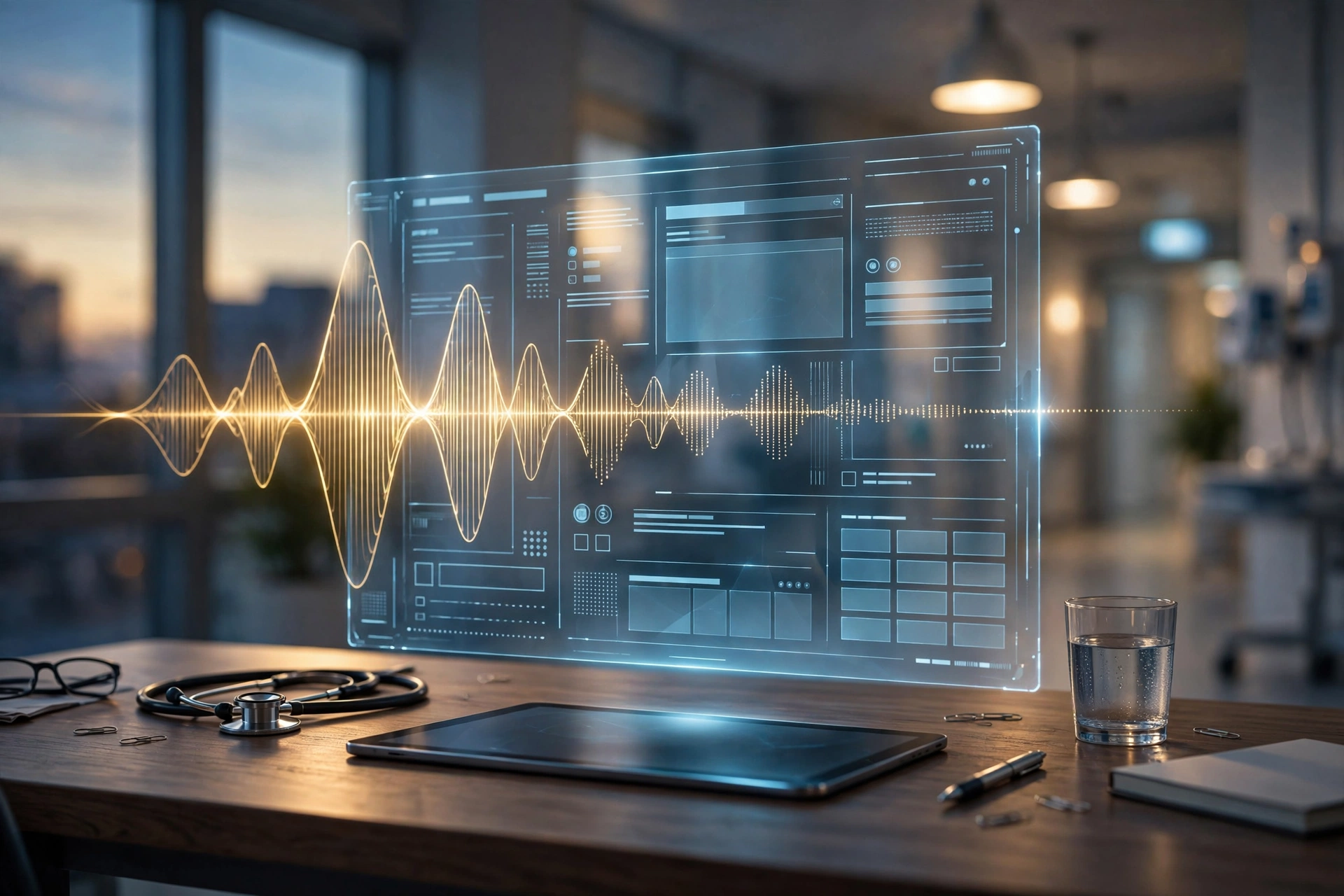
The category exists because documentation has become one of the heaviest burdens in medicine. Time spent finishing notes after hours — often called “pajama time” — is a leading contributor to physician burnout. Ambient AI scribes aim to reverse that by capturing the visit conversation in real time, so the clinician can look at the patient instead of the keyboard. Similar documentation AI is also spreading beyond medicine: see our explainer on AI for FMLA certification and documentation.
How ambient clinical documentation works
Most clinical depth AI documentation tools follow the same six-stage pipeline:
- Audio capture: The system records the encounter in real time through a phone, tablet, or dedicated microphone, with the patient’s knowledge and consent.
- Speech-to-text conversion: Automatic speech recognition engines trained on clinical audio convert the conversation into a raw transcript, with speaker labeling that separates the clinician’s words from the patient’s.
- NLP analysis: Large language models identify clinical entities such as symptoms, medications, dosages, and assessments, while filtering out small talk.
- Note structuring: The platform organizes the information into SOAP sections or specialty-specific templates, rather than a wall of text.
- EHR integration: The draft note is pushed into the electronic health record — Epic, Oracle Health, athenahealth, MEDITECH, and others — sometimes with suggested ICD-10 or CPT codes.
- Clinician review: The provider edits, approves, and signs the note. Nothing enters the chart until the clinician signs it.
Clinical depth AI documentation: the evidence so far
The strongest real-world evidence comes from Kaiser Permanente. Between October 2023 and December 2024, 7,260 of its physicians used ambient AI scribes across about 2.5 million patient visits. The group estimated the tools saved 15,791 hours of documentation — the equivalent of roughly 1,794 eight-hour workdays. In surveys, 84% of physicians said the tools improved how they connect with patients, and 82% said they raised job satisfaction. Permanente Medical Group’s chief data officer, Vincent Liu, said the study showed the technology alleviates workloads for doctors, noting that the AI scribe supports the face-to-face contact both doctors and patients value. The analysis was published in NEJM Catalyst and covered by the American Medical Association, Becker’s Hospital Review, and Medical Economics.
Adoption has accelerated far beyond one health system. As of 2026, about 70% of physicians in the University of California, San Francisco health system were using AI scribes in daily practice, and an American Medical Association survey found 66% of U.S. physicians were using some form of AI in practice by 2024, up from 38% the year before. In June 2026, the U.S. Veterans Health Administration rolled out ambient scribe technology to primary care providers nationwide after first testing it at 10 VA medical centers.
What clinical depth buys you in practice
Not every AI documentation tool has the same clinical depth, and the differences matter when choosing one:
- Specialty fit: The best tools offer templates tuned to a specialty’s documentation patterns — the wrong template generates generic notes that need heavy editing.
- Structured output: Clinical-depth tools produce structured data (not just paragraphs), which supports coding suggestions, quality reporting, and downstream analytics.
- EHR write-back: Tools that write directly into the EHR remove the copy-and-paste step and reduce the chance of notes landing in the wrong chart.
- Review safeguards: The safest designs keep every note a draft, link each statement back to the transcript, and flag gaps or low-confidence sections for the clinician.
Limitations and what to check before adopting
The honest caveats matter as much as the time savings. AI-generated clinical notes can make mistakes — published error rates vary because studies define errors differently. In practice, omissions (leaving out something clinically relevant) are the most common error type, which is why the clinician review step is essential rather than optional.
Privacy and compliance are deployment questions, not technology properties. Audio is patient data from the moment it is captured, so any vendor in the chain must sign a business associate agreement, and you need encryption, access logging, and defined retention rules. Consent rules differ by state: HIPAA generally does not require a separate authorization when a business associate handles the audio for treatment and operations, but state recording laws can require everyone in the room to agree. Confirm your state’s rules with counsel, and prefer vendors that contractually guarantee your data is not used to train their models.
On cost, published 2026 pricing guides put small-practice scribes at roughly $40 to $120 per clinician per month, while enterprise tools such as Abridge and Microsoft’s Nuance DAX cost several hundred dollars per clinician per month, with large health systems negotiating individually. For a broader look at how AI tools are being adopted across industries, see our overview of AI advice generators and where the technology is actually used.
Analysis: where clinical depth AI documentation is heading
Analysis — the following is our read of the direction, not verified fact. The 2026 generation of tools is shifting from passive transcription to active clinical assistance: agentic systems that draft orders, suggest codes, and surface prior authorization requirements at the point of care. Epic’s native AI scribe, announced in 2025 and rolling out through 2026, handles notes, orders, and diagnoses inside the Epic workflow. If that shift holds, the differentiator for standalone tools will be specialty depth, multi-EHR support, data ownership, and proven accuracy — not transcription quality alone.
What is clinical depth AI documentation?
Clinical depth AI documentation is software that captures a patient visit conversation and drafts a structured, clinically accurate note for the electronic health record. Unlike plain transcription, it understands medical terminology, extracts diagnoses, medications, and plans, and organizes them into formats like SOAP notes or specialty templates. The clinician reviews and signs every note before it enters the chart.
How accurate are AI clinical documentation tools?
Published error rates vary widely because studies define errors differently, so a single headline accuracy figure is misleading. The most common error type is omission — leaving out something clinically relevant — rather than fabrication. That is why review workflows are essential: every note should stay a draft until a clinician reviews, edits, and signs it.
Are AI scribes HIPAA compliant?
They can be, but compliance depends on the deployment, not the technology alone. Any vendor handling patient audio must sign a business associate agreement, and you need encryption, access controls, and defined retention rules. Patient consent is a separate question — HIPAA generally does not require a separate authorization for treatment and operations use, but state recording laws differ and some require everyone in the room to agree.
How much does AI clinical documentation cost?
According to published 2026 pricing guides, small-practice scribes cost roughly $40 to $120 per clinician per month, with some vendors publishing plans at $39, $79, and $119. Enterprise tools such as Abridge and Microsoft’s Nuance DAX cost several hundred dollars per clinician per month, with large health systems negotiating prices individually.
Sources
- American Medical Association — AI scribes save 15,000 hours and restore human side of medicine
- Becker’s Hospital Review — 16K hours saved: Ambient AI scribes at Kaiser Permanente
- Medical Economics — Take note: The AI scribe era is here
- VeteranLife — VHA is now using Ambient Scribe: how it’s changing veteran care
- Bushe — What is an AI scribe? How AI medical scribes work and cost
- Adamo Software — AI Medical Scribe in 2026: How it works, costs, and top tools
- Biz4Group — Ambient AI medical scribe development: build guide 2026