Smart Cara Explained: How the Countertop Food-Waste Processor Works
Key takeaway: Smart Cara is a South Korean countertop food-waste processor that dehydrates and grinds kitchen scraps into a dry, odorless powder in about three hours, cutting their volume by up to 90%. It is not a composter — it removes moisture and mulches waste. The resulting powder works as a plant fertilizer or, thanks to its 4,000 kcal heating value, as a solid fuel.
If you searched for “smart cara,” you have probably seen a sleek white box promising to make kitchen food waste disappear. Smart Cara is exactly that: a countertop food-waste disposer made in South Korea by SmartCara. One reviewer who tested it called it an award-winning, number-one-selling food waste disposal unit in Korea — and one of the first things to understand is what it is not: it is not a composter. It is a dehydrator and grinder that turns wet scraps into a dry, shelf-stable powder.
What is Smart Cara?
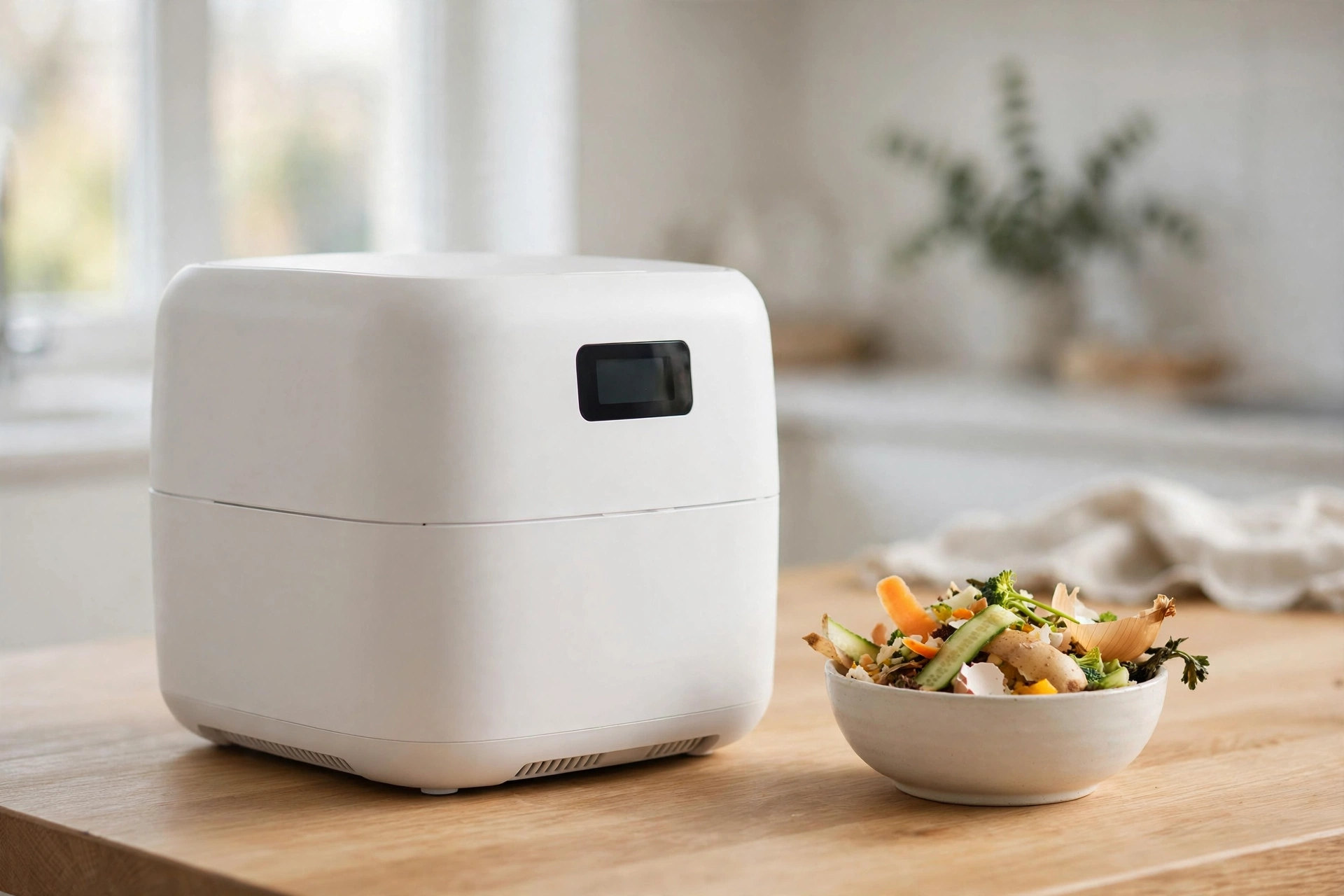
Smart Cara is a stand-alone kitchen appliance, roughly the size of a small microwave (about 270 x 300 x 350 mm and 9 kg for the original model), designed to sit on a countertop with no installation and no plumbing. You collect food scraps in its removable container over a few days, press a button when it is full, and the machine runs a heated drying and grinding cycle.
The output is not compost — composting is biological breakdown over weeks. Smart Cara’s output is simply dried, sterilized, and ground-up food: an odorless powder that reviewers describe as ready to add to garden soil or a compost heap to finish breaking down.
How the Smart Cara process works
Each cycle runs through four stages — insert, grind, dry, and cool. The company describes a three-stage “Imperial Crushing System” that grinds waste before drying, so moisture leaves faster than in machines that dry first and grind later. Drying combines heat with circulating air, which the company says cuts processing time well below the 10+ hours older hot-air-only machines needed.
A multi-sensor system measures the amount and moisture of the waste during the drying phase and adjusts the cycle time automatically — the brand’s “SMART AI” feature — so the machine stops when the waste is done rather than running a fixed timer. An active carbon filter traps odors during the cycle, and the unit has a one-touch self-cleaning mode for its inner container.
What can go in a Smart Cara — and what can’t
Smart Cara handles most cooked and uncooked food waste: fruit, vegetables, meat, fish, and even small bones such as chicken and fish bones. A retailer listing notes it can process all food waste except:
- Large, solid beef or pork bones
- Large fruit seeds
- Paper towels and tea bags
A typical cycle on the original CS10 model processes about 1.5 kg of waste in an average of 3 hours (retailers quote 3–7 hours depending on the food type), reducing its weight by 80–90% and drawing about 0.5 kW. Newer models push further: the BladeX, launched alongside the Smart Cara 400 Pro 2 in 2024, holds 5 liters, adds a powerful mode that grinds chicken bones and crab shells, sterilizes 99.9% of pathogenic bacteria, and uses an in-house BLDC motor with a 10-year warranty.
What to do with the powder it produces
The dried powder has two main uses. First, as a soil enhancer: gardeners mix it into raised beds and containers to feed plants. Second, as solid fuel: the dried powder reaches a heating value of about 4,000 kcal, so it can be burned in wood-burners and campfires. Reviewers also note it makes food-waste storage far less unpleasant — no rotting bin, no flies, no smell while you wait for a collection day.
Smart Cara models, specs, and price
The original model is the CS10. Its published specifications are:
| Spec | Smart Cara CS10 |
|---|---|
| Capacity | 1.5 kg per cycle |
| Cycle time | ~3 hours average (3–7 hours by food type) |
| Power | 0.5 kW, 230V |
| Size / weight | 270 x 300 x 350 mm, 9 kg |
| Weight reduction | 80–90% |
| Odor control | Active carbon filter |
| Country of origin | South Korea |
Later models include the Smart Cara 400 Pro 2 and the larger BladeX (5L capacity, dual standard/powerful modes, detachable 21L storage tower), both launched in 2024 with colors Snow White and Light Beige. Pricing varies by market: Harvey Norman Australia lists a 2-litre model at 1,969 AUD. Running costs are modest — one UK reviewer estimated roughly £2 per month when run every other day — though the carbon filters need replacing a few times a year.
Analysis: who should actually buy a Smart Cara?
The case for it: apartments and small homes without outdoor composting space, households that hate the smell of rotting food waste, and anyone who wants fertilizer-grade output without waiting months. The hands-off cycle and odor control are the real product, not the powder itself.
The honest downsides: it is an expensive appliance with ongoing electricity and filter costs; the output is not compost and needs soil or a compost pile to become truly useful; and if your city already collects food waste for composting, a bin is cheaper and simpler. Like other automated home systems, Smart Cara trades running cost for convenience — the multi-sensor drying is genuinely clever, but it does not change the basic math of buying a gadget versus just composting. See our guide to automation and sustainability for where home automation is actually cutting waste.
Smart Cara FAQs
Is Smart Cara a compost bin?
No. Smart Cara is a dehydrator and grinder, not a composter. It removes up to 90% of the moisture and weight from food waste and grinds it into a dry, odorless powder. True composting is biological breakdown over weeks; the powder Smart Cara produces can be added to compost or soil, but it is not compost on its own.
What food waste can you put in a Smart Cara?
Almost all kitchen food waste: fruit, vegetables, cooked food, meat, fish, and small bones like chicken and fish bones. Avoid large beef or pork bones, large fruit seeds, paper towels, and tea bags. The newer BladeX model adds a powerful mode that can handle harder items like chicken bones and crab shells.
How long does a Smart Cara cycle take?
About 3 hours on average for the original CS10 model, though retailers quote 3–7 hours depending on the type and moisture of the food. A multi-sensor system measures the waste during drying and automatically adjusts the cycle time so it does not run longer than needed.
What do you do with the powder Smart Cara makes?
Use it as a soil enhancer for gardens and containers, or as a solid fuel — the dried powder has a heating value of about 4,000 kcal, so it can be burned in wood-burners or campfires. It is odorless and shelf-stable, so you can store it until you need it.
How much does a Smart Cara cost to run?
The unit draws about 0.5 kW per cycle. One long-term UK reviewer estimated roughly £2 per month running it every other day. The purchase price varies by region — Harvey Norman Australia lists a 2-litre model at 1,969 AUD — and the carbon filters need replacing a few times a year.
Sources
- Smart Cara Food Waste Processor: Review — ekko.world
- Smart Cara — a revolutionary kitchen composting system — Zero Waste Week
- The Smart Cara composter is a genius way of recycling food waste — Ideal Home
- SMART CARA — The Green Organisation
- SmartKara launches two products including ‘BladeX’ — Asia Business Daily
- Smartcara Food Waste Disposer – 2 Litre — Harvey Norman
- Smartcara Food Waste Disposer specifications — TradeKorea
- SmartCara product detail — HKTDC Sourcing
Enjoying USABite’s AI and tech explainers? Add USABite as a preferred source in Google Search so you never miss our latest coverage.