
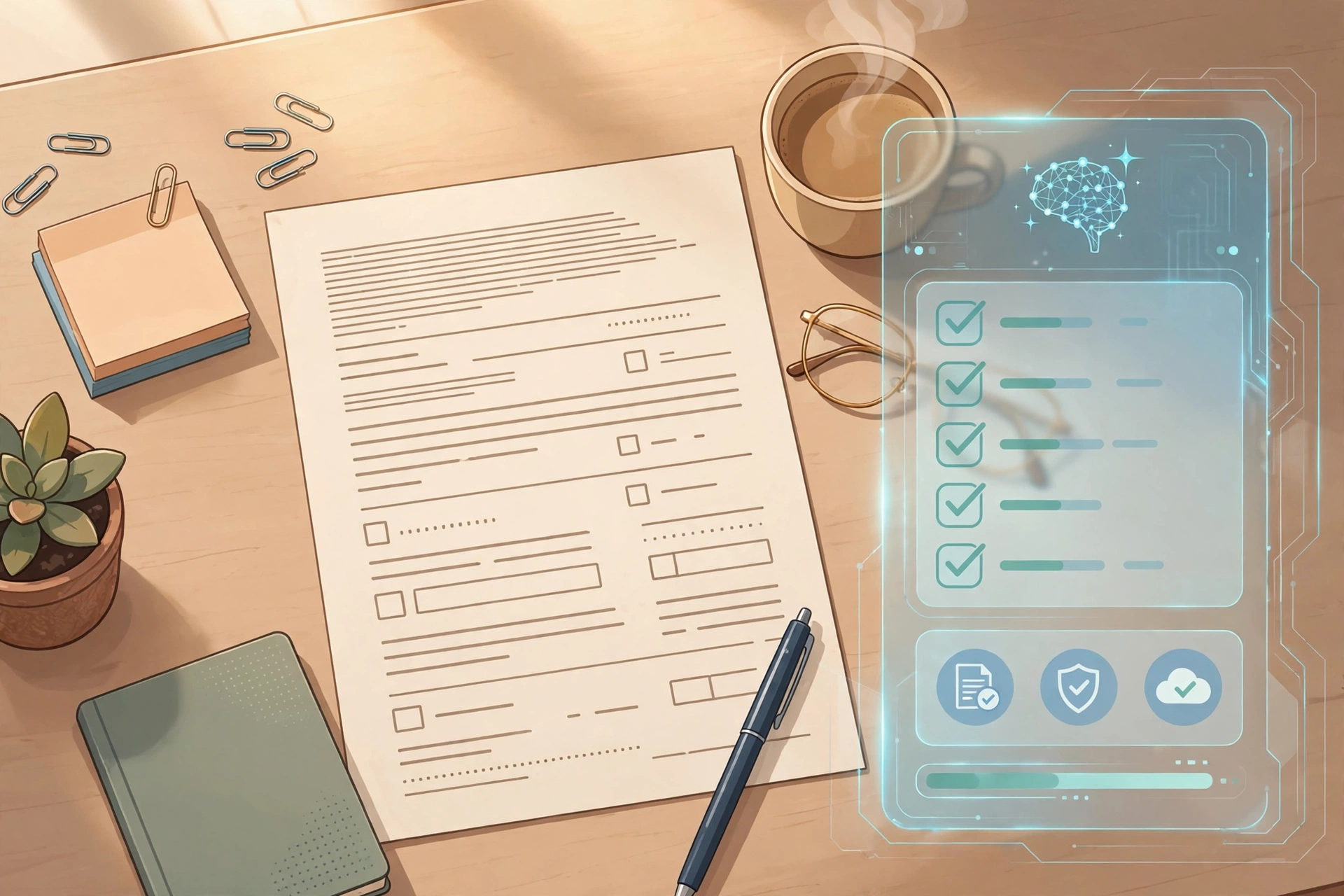
AI for FMLA Certification and Documentation: What It Is, How It Works, and the Rules
Key takeaway: AI for FMLA certification and documentation automates the paperwork side of the Family and Medical Leave Act: checking medical certification forms for completeness, assembling the right Department of Labor forms, and tracking deadlines. But AI does not decide who gets leave — the Department of Labor requires human oversight, because an AI error can turn into violations across an entire workforce.
The FMLA is one of the most paperwork-heavy laws in American HR. It gives eligible employees up to 12 weeks of unpaid, job-protected leave for qualifying family and medical reasons — and wraps that promise in a chain of forms, notices, and deadlines that HR teams have to get exactly right. AI tools are now moving into that workflow, not to approve leave, but to keep the documentation from falling through the cracks.
What AI for FMLA certification and documentation actually does
The Family and Medical Leave Act only covers employees who meet specific criteria: at least 12 months with the employer, 1,250 hours worked in the 12 months before the request, and a worksite with at least 50 employees within a 75-mile radius. Once eligibility is established, the documentation clock starts — and it has three interlocking deadlines employers must hit:
- 5 business days to send the employee the WH-381 eligibility and rights notice after learning of a leave request.
- 15 days for the employee to return the completed medical certification form.
- 7 days for the employee to fix (“cure”) a certification that comes back incomplete.
AI tools slot into this process in a few practical ways. Some absence-management platforms use AI to review incoming medical certification forms for completeness — checking that required fields have responses, the health care provider’s signature is present, and dates, duration, and frequency are specified. AbsenceSoft, for example, uses AI to assist with completeness reviews of certifications while keeping HR in the loop for the final call. Its ACE Packet Generator automatically sends the right form for each case.
Other tools handle the document assembly side. Genie AI maintains a large template library of legal documents, including FMLA certification materials, aimed at helping HR teams draft and customize compliant paperwork without starting from scratch. And on the employee side, a new service called myFMLA launched on May 9, 2026, connecting workers with licensed physicians to complete FMLA, short-term disability, and ADA documentation digitally — built for employees facing the tight certification deadlines the law imposes.
The Department of Labor’s guardrails: human oversight is mandatory
This is where AI for FMLA gets more constrained than AI in most HR tasks. The Department of Labor’s Wage and Hour Division has issued guidance on employers’ use of AI that sets clear limits:
- Don’t delegate eligibility and entitlement calculations to AI. A timekeeping program that miscounts hours worked can produce systematic eligibility errors — and unlike a human mistake, an AI error “could result in violations across the entire workforce,” in the DOL’s words.
- Don’t let AI handle medical certifications on its own. Under the FMLA, employers may collect only the medical information necessary to process the leave. An AI system might prompt employees for more medical detail than the law allows — a violation.
- Keep AI out of retaliation and interference. AI systems that track leave must not be used to target leave users or count FMLA leave as a negative factor in hiring, promotions, or discipline. Assigning negative attendance points for FMLA use is unlawful interference.
As HR Dive’s reporting on the guidance put it: employers are ultimately responsible for making sure these systems comply with the law. The DOL’s position is that AI should be overseen by the employer — “responsible human oversight” is the standard phrase — especially where eligibility determinations, certification reviews, and anti-retaliation rules are involved.
Why it matters: fewer paperwork failures, not fewer humans
The biggest value of AI here is mundane but real: compliance discipline. Manual leave administration — spreadsheets, email chains, paper files — is where FMLA compliance typically breaks down, with missed 15-day certification deadlines and lapsed response windows creating liability, according to Qcera. Automated tracking of those deadlines, standardized checklists applied identically to every employee, and a full audit trail are the concrete wins. One digital-leave vendor’s customers report roughly a 47% reduction in administrative processing time and a 28% decrease in compliance errors, though those are vendor-reported figures, not independent studies.
Consistency also has a legal upside: applying the same certification standards to every case helps employers demonstrate a pattern of compliance if a discrimination claim ever arises. Automation enforces that consistency — but only if the underlying rules are right, which is exactly why the DOL keeps humans in the decision seat.
What this means for HR teams (analysis)
The practical takeaway is a division of labor: let AI do the administrative checks — completeness scans, deadline reminders, form assembly — and keep humans on the decisions the law reserves for them: eligibility determinations, certification evaluations, and any request for additional medical information. This mirrors the broader principle behind automating IT operations: push routine execution to the edges and keep people focused on judgment and exceptions.
Three practical notes for teams evaluating these tools. First, use the official Department of Labor forms (the WH-380 series) as the standard — AI that works on top of official forms beats AI that invents its own. Second, build the “cure” workflow into the system: when AI flags a certification as incomplete, the employee still gets their 7 days to fix it. Third, document the human review step itself; “the AI approved it” is not a compliance defense under the DOL’s guidance.
FAQ
What is AI for FMLA certification and documentation?
It is software that uses AI to handle the paperwork side of Family and Medical Leave Act administration: checking medical certification forms for completeness, assembling the correct DOL forms for each case, and tracking the law’s notice and certification deadlines. It assists HR teams rather than replacing their decisions.
Can AI approve or deny FMLA leave?
No — at least not without creating serious compliance risk. The Department of Labor warns employers not to delegate eligibility and entitlement calculations to AI, and requires responsible human oversight of automated leave systems. Errors in AI-driven eligibility determinations can produce violations across the entire workforce.
What are the main FMLA documentation deadlines?
Employers have 5 business days to send the eligibility notice (WH-381) after learning of a leave request, employees have 15 days to return their completed medical certification, and employees get 7 days to fix a certification that is returned incomplete. AI tools are commonly used to track all three.
Is AI allowed to review medical certifications?
AI can assist with reviewing certifications for completeness — checking for blank fields, missing signatures, and unspecified dates or duration — but it should not handle certifications on its own. The FMLA limits employers to collecting only the medical information necessary to process leave, and HR oversight is required to keep AI from requesting more.
Sources
- Absence Management Software for FMLA Compliance — Qcera
- How to Handle FMLA Certification of Health Care Provider Forms Compliantly — AbsenceSoft
- Understanding the DOL’s Guidance on Using AI for FMLA Management — AbsenceSoft
- DOL issues guidance addressing AI’s interaction with FMLA, FLSA — HR Dive
- DOL Issues Guidance to Agency Staff on Employers’ Use of Artificial Intelligence in the Workplace — Jackson Lewis (DOL Field Assistance Bulletin summary)
- Simplify FMLA Certification: Checklist & Templates — Genie AI
- myFMLA Introduces Expert Online FMLA Certification Service — ZEX PR Wire via New Jersey News Journal, May 9, 2026


One Comment
Comments are closed.