Inception Mercury 3: The Diffusion AI Model Generating 1,068 Tokens Per Second
Key takeaway: Inception released Mercury 3 on October 19, 2026, a diffusion-based large language model the company says generates 1,068 tokens per second on NVIDIA GPUs with a 1-million-token context window. Inception claims it matches or beats GPT-6 Luna and Claude Haiku 5.5 on quality at launch pricing of $0.10 per million input tokens — but all benchmark figures are self-reported, and independent verification is still pending.
What Inception announced
Inception, the Redwood City startup founded by Stanford researchers Stefano Ermon, Volodymyr Kuleshov and Aditya Grover, released Mercury 3 — the fourth model in its Mercury line after Mercury 1 (2025), Mercury 2, and Mercury 2.5, which added tunable reasoning and a 260,000-token context window. Mercury 3 is available through the Inception API, OpenRouter, Baseten and Vercel, and it is OpenAI API compatible, so developers can swap it in without rewriting integration code.
The headline numbers come straight from Inception’s launch announcement:
- Speed: 1,068 tokens per second on NVIDIA GPUs — 4 to 8 times faster than the models it compares itself against, according to the company.
- Context: 1 million tokens, up from 260,000 in Mercury 2.5.
- Size: more than 40 times larger in total parameters than Mercury 1, the company says, with throughput essentially unchanged.
- Pricing: $0.20 per million input tokens and $0.70 per million output tokens, cut in half during the launch period to $0.10 and $0.35. Cached input tokens are discounted 90% off the input rate, and new API keys come with 100 million free tokens.
How diffusion models differ — and why speed matters
Nearly every mainstream model from OpenAI, Anthropic and Google writes one token at a time, each word conditioned on everything before it. That is the autoregressive approach: reliable, but slow, because the model cannot start word six until it finishes word five.
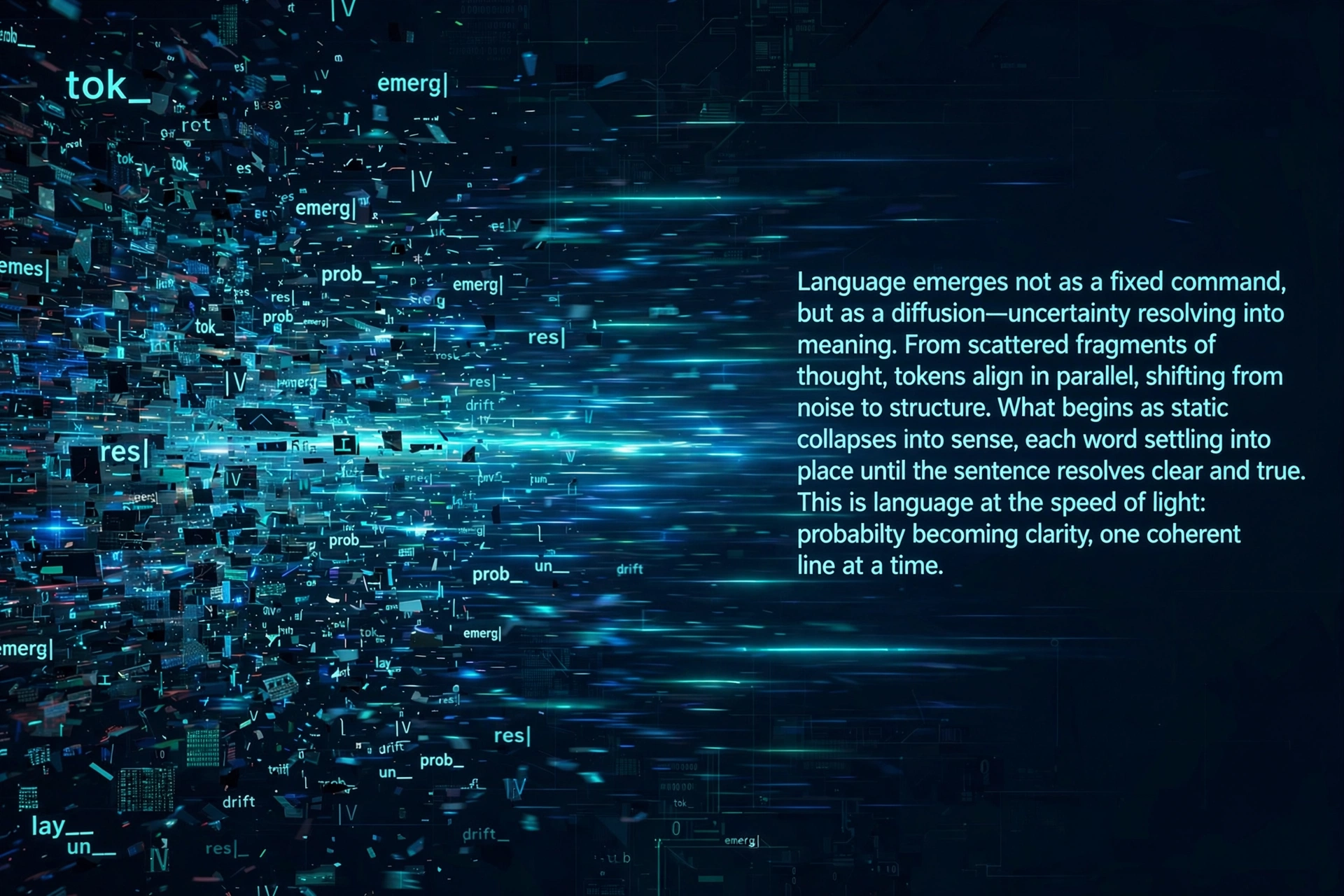
Inception bet on diffusion, borrowed from image generation. Instead of writing left to right, a diffusion model starts with a noisy draft of the entire response and refines all of it in parallel, in a handful of steps. That has always bought speed; what it had not bought — until now, Inception argues — is quality at the top end. The company claims the scaling laws that drove progress in autoregressive models hold for diffusion too, and that compute and data, not the algorithm, are the limits.
Speed is the bottleneck for AI agents, which call a model repeatedly to finish a single task. OpenRouter confirmed the model went live on its platform on launch day, and Inception names browser agents, tutoring, search and customer support as the first applications.
What the benchmarks actually say
This is the part to read carefully. Inception’s own benchmark table shows Mercury 3 leading GPT-6 Luna and Claude Haiku 5.5 on 8 of 12 tests. Its best result is SWE-Bench Atlas at 51.08, roughly 18 points ahead of both rivals; its worst is DeepSWE v1 at 46.31, about 5 points behind Haiku 5.5. Named evaluations include IFBench, GPQA Diamond, Mind2Web, JevBench and LegalBench — but the company has not published the full test list, nor which NVIDIA GPU produced the 1,068-token figure. The announcement also names partners’ results: TinyFish AI says Mercury 3 completed 50% of 50 live Mind2Web tasks, and Octen AI reports a median generation time of 0.9 seconds with 2.2 seconds end-to-end.
A comparison table makes the claimed positioning clear — every figure below is the vendor’s claim, not an independent test:
| Model | Claimed speed | Context | Input price / 1M tokens (launch) |
|---|---|---|---|
| Mercury 3 | 1,068 tok/s (NVIDIA GPUs) | 1M tokens | $0.10 |
| GPT-6 Luna | Speed-tier class | Not disclosed in launch materials | Not compared on price |
| Claude Haiku 5.5 | Speed-tier class | Not disclosed in launch materials | Not compared on price |
Knowns, unknowns, and what to watch
Known: Mercury 3 is live on four platforms, OpenAI-compatible, and priced to undercut the speed tier during launch. Mercury 2 and 2.5 are closed to new users; existing customers keep access until November 15, 2026. Inception says it has started training its next model.
Unknown: the exact parameter count, the GPU behind the speed figure, the end date of the 50% launch discount, and whether diffusion quality holds up on long, complex reasoning tasks where autoregressive models still dominate.
What to watch: independent benchmarks. The sharpest claim — that diffusion scales like autoregressive training — was made by the company that benefits most if true, and independent researchers will now try to break it. If third-party tests confirm the quality, diffusion becomes a genuine second architecture for production AI; if they don’t, Mercury 3 remains a fast, cheap option for latency-sensitive tasks rather than a frontier competitor.
What this means for you
If you build anything where a model answers in real time — voice bots, coding agents, customer-support flows, search tools — Mercury 3 is worth a test drive, especially with 100 million free tokens for new API keys. The OpenAI-compatible API keeps the switching cost low. But don’t re-architect around it yet: treat the launch benchmarks as a starting hypothesis and run your own evals on your own workload. Speed is a number; “outperforms” is a sentence.
Found USABite’s coverage useful? You can mark USABite as a preferred source in Google Search so our articles appear more prominently in your AI Overviews and results.
Frequently asked questions
What is Mercury 3?
Mercury 3 is a diffusion-based large language model released by Inception on October 19, 2026. Unlike most chatbots that write one token at a time, it drafts many tokens in parallel and refines them, which Inception says lets it generate 1,068 tokens per second on NVIDIA GPUs with a 1-million-token context window.
How much does Mercury 3 cost?
Standard pricing is $0.20 per million input tokens and $0.70 per million output tokens. During the launch period, Inception is offering 50% off ($0.10 and $0.35), cached input tokens are 90% off the input rate, and new API keys include 100 million free tokens. No end date for the launch discount has been announced.
Where can I access Mercury 3?
Mercury 3 is available through the Inception API, OpenRouter, Baseten and Vercel. The API is OpenAI-compatible, so existing OpenAI API integrations can switch with minimal code changes. It is API-only — there is no open-weights release.
Does Mercury 3 really beat GPT-6 Luna and Claude Haiku 5.5?
That claim comes from Inception’s own benchmark table, which shows Mercury 3 leading on 8 of 12 tests, including a strong SWE-Bench Atlas result. These are self-reported figures on company-selected evaluations; independent benchmarks had not been published at the time of writing.
What happened to Mercury 2 and 2.5?
Mercury 2 and Mercury 2.5 are closed to new users following the Mercury 3 launch. Existing customers who used the older models before October 19, 2026 keep access until November 15, 2026.
Sources
- PANews — Inception releases diffusion LLM Mercury 3 (Oct 20, 2026)
- MarkTechPost — Inception Releases Mercury 3 Diffusion LLM at 1,068 Tokens per Second (Oct 19, 2026)
- SiliconNoon — Mercury 3: a diffusion LLM at 1,068 tokens/sec (Oct 20, 2026)
- Startup Fortune — Inception Labs claims Mercury 3 beats Haiku and GPT-6 Luna (Oct 19, 2026)
- Golden Era — Inception releases Mercury 3 (Oct 20, 2026)
- USABite — DeepSeek V4.1-Flash-1017: What the Faster, Leaner AI Model Upgrade Means for You