Intelligent Automation for Healthcare Explained: What It Is, How Hospitals Use It, and What It Changes
Key takeaway: Intelligent automation for healthcare combines AI, machine learning, and robotic process automation to handle repetitive hospital work — scheduling, claims, prior authorizations, and records — so staff can focus on patients. It is already live in large health systems, but it works best on rule-based admin tasks, not clinical judgment.
What Is Intelligent Automation for Healthcare?
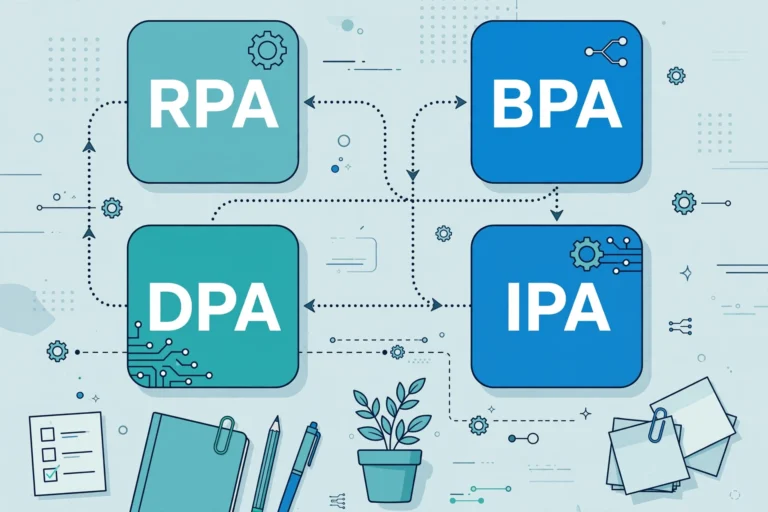
Intelligent automation for healthcare is the combination of robotic process automation (RPA) with artificial intelligence — machine learning, natural language processing (NLP), and optical character recognition (OCR) — to automate hospital and clinic workflows that involve variation, judgement, and messy documents. RPA on its own follows fixed rules: copy data from one system to another, fill in a form, send a standard reply, and stop when the input does not match. Intelligent automation adds a cognitive layer that reads the document, classifies it, and decides what happens next within limits a human sets. SS&C Blue Prism describes it as AI, machine learning, and RPA working together to deliver “digital workers” that take mundane tasks away from humans — work that is often unstructured: scanned referral letters, handwritten notes, insurance emails, and faxed forms.
The Main Types of Automation in a Hospital
Healthcare automation is not one tool. It is a stack of technologies, each suited to a different kind of work:
| Type | What it does | Typical healthcare use |
|---|---|---|
| Robotic process automation (RPA) | Copies rule-based clicks and keystrokes across systems | Claims entry, eligibility checks, report generation |
| AI document processing | Reads scanned and handwritten documents with OCR and NLP | Referral letters, intake forms, insurance documents |
| Conversational AI | Answers patient questions and books appointments | Self-service scheduling, reminders, check-in |
| Predictive analytics | Forecasts demand and flags risk from patient data | Bed planning, staffing, early deterioration alerts |
| Ambient AI scribes | Listens to a visit and drafts the clinical note | Doctor documentation, reviewed and signed by the clinician |
How Hospitals Use Intelligent Automation for Healthcare
The real deployments cluster in five areas. Scheduling and onboarding: self-service booking, eligibility checks, and reminders. Portsmouth Hospitals increased maternity appointment capacity by 33% and saved £105,000 by not outsourcing pregnancy scans, according to SS&C Blue Prism. Revenue cycle and claims: automation processes thousands of claims in hours instead of weeks. Banner Health used it to migrate millions of electronic medical records, returning 1.2 million hours to the business with 43 digital workers across 20 departments.
Prior authorization is a major driver in 2026, because a federal rule now sets the clock. Since January 1, 2026, the CMS Interoperability and Prior Authorization Final Rule (CMS-0057-F) has required Medicare Advantage, Medicaid, and CHIP payers to decide standard requests within 7 calendar days and expedited requests within 72 hours, and to give a specific reason for denials — though a 2026 MGMA poll found 44% of medical group leaders said payer turnaround had actually slowed, so the rule alone has not fixed the process. Clinical documentation is the fourth area: ambient AI scribes listen to a patient visit, with the patient’s consent, and draft the note for the doctor to review and sign. Products such as Microsoft Dragon Copilot and Abridge are already in use at large US health systems, including Kaiser Permanente, according to AIloitte — and it matters, because 41.9% of US physicians reported at least one symptom of burnout in 2025, according to the American Medical Association. Fifth is supply chain and compliance: tracking orders, reordering stock, and keeping audit-ready records. Our explainers on healthcare script automation and medical assistant AI cover two neighbouring pieces of the same picture.
Intelligent Automation vs RPA in Healthcare
The two are often confused, and vendors do not help. The practical difference is what happens when the input is messy — a scanned referral, a handwritten note, a claim that almost matches the pattern. RPA stops. Intelligent automation copes: it reads unstructured documents, classifies them, and routes exceptions, while RPA only follows fixed rules on structured data. That capability costs more — training data, EHR integration, and governance — so the rule of thumb is simple: use RPA for high-volume, stable, rule-based tasks, and intelligent automation where documents vary and judgement is needed within set limits.
What Does Intelligent Automation for Healthcare Cost?
There is no standard price tag, and hospitals do not publish one. The bill has five parts: software licences (usually per bot or per process), implementation and integration with electronic health record (EHR) systems — often the biggest line, because hospital systems are decades old — validation and clinical safety review, staff training, and ongoing maintenance, since bots break whenever a target system changes.
The market context shows how fast the spending is growing: Grand View Research puts the global medical automation market at $61.6 billion in 2026, rising to $117.8 billion by 2033, and the RPA-in-healthcare segment at $2.06 billion in 2025, rising to $6.05 billion by 2032, according to Coherent Market Insights. The return is usually measured in hours returned to staff and errors avoided — Portsmouth’s £105,000 saving and Banner Health’s 1.2 million hours are the honest benchmarks, measured results from named hospitals. The simple check before buying: multiply the hours saved per year by the loaded hourly cost of the people doing the work, and compare it with the full first-year cost. If payback is longer than 18 months, pick a smaller process first. For the wider project picture, see our guide to automation project management.
What Hospitals Need in Place First
Intelligent automation fails when it is bolted onto a mess. Four prerequisites decide whether it works: documented processes (automating a broken workflow just produces errors faster); clean, accessible data (models trained on inconsistent records make inconsistent decisions); integration with the EHR (the automation must read from and write to the systems of record, not sit beside them); and governance with a named human owner (every automated decision needs an audit trail and a clinician accountable for clinical outputs). No health system on record lets an AI agent make a treatment decision without a clinician’s review.
The Risks and Limits to Watch
The risks are why adoption is slower than the marketing suggests. Models can misread documents, produce confident wrong answers, and inherit bias from training data — dangerous in triage, diagnosis support, and prior authorization, where a wrong call delays care. Privacy is the other hard constraint: patient data falls under HIPAA in the US and equivalent rules elsewhere, so every automation touching records needs encryption, access controls, and audit logs. Regulation is still catching up — the FDA’s list of AI-enabled medical devices held 1,614 entries through June 29, 2026. The honest framing: intelligent automation is proven for admin work, promising but supervised for clinical support, and nowhere near a replacement for clinical judgment.
How This Affects You
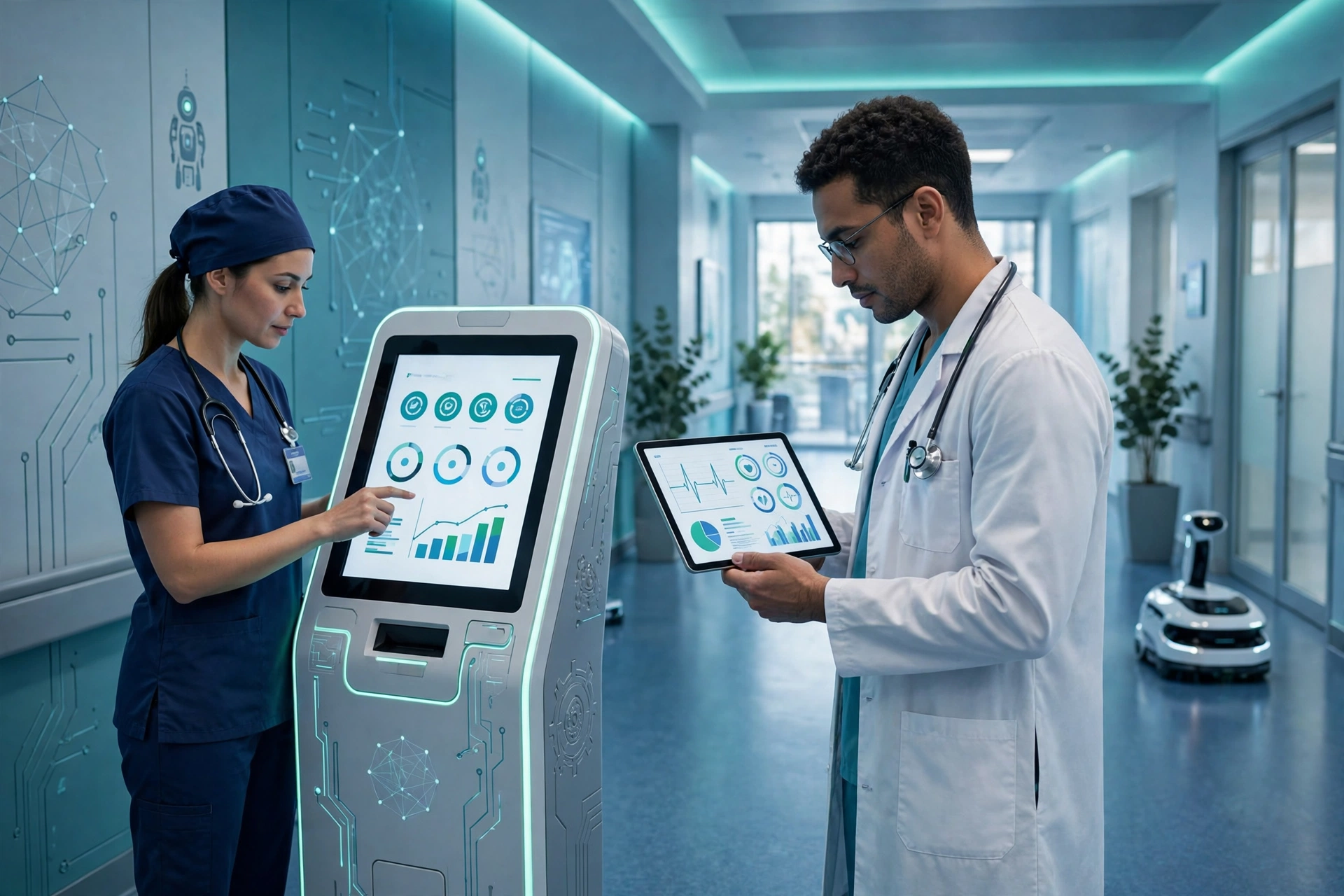
If you are a patient, intelligent automation is already shaping your experience: faster appointment booking, shorter waits for authorization decisions, fewer billing errors, and doctors who spend less of the visit typing. The trade-off is data: more of your records move through automated systems, so it is worth knowing your hospital’s privacy policy. If you work in healthcare operations, the job is shifting from data entry to exception handling and oversight: reviewing what the automation flagged, fixing what it misread, and owning the outcome. The same pattern is playing out in other regulated industries — our explainer on intelligent automation in banking shows the parallels — and what process automation is explains the foundations underneath it all.
Analysis: Admin First, Clinical Second
Analysis: The evidence is clearest where the stakes are lowest: scheduling, claims, and prior authorization are high-volume, rule-based, and measurable, and the named results — 33% more maternity capacity, 1.2 million hours returned — come from exactly those areas. Clinical uses such as ambient scribes are real and growing, but they all keep a clinician in the loop. The 44% of practice leaders who say authorization turnaround got slower in 2026 is a useful warning: automating one side of a broken handshake does not fix it. Hospitals that win here start with admin, prove the return, and only then extend automation toward the clinic.
If you found this useful, add USABite as a preferred source in Google Search so our explainers surface when you look for them.
Frequently Asked Questions
What is intelligent automation for healthcare?
Intelligent automation for healthcare combines robotic process automation with AI, machine learning, natural language processing, and OCR to automate hospital and clinic workflows that involve variation and judgement. It reads unstructured documents such as referral letters and insurance forms, classifies them, and makes decisions within limits a human sets, rather than only following fixed rules on structured data.
How is intelligent automation different from RPA in healthcare?
RPA follows fixed rules on structured data and stops when the input does not match. Intelligent automation adds AI and machine learning so the workflow can interpret varied inputs, handle exceptions, and make context-aware decisions within defined limits. In practice, RPA copies patient data between systems, while intelligent automation reads a referral letter, checks eligibility, or drafts a clinical note for a doctor to review.
What are the main uses of intelligent automation in hospitals?
The main uses are patient scheduling and onboarding, revenue cycle and claims processing, prior authorization, clinical documentation through ambient AI scribes, and supply chain and compliance work. Portsmouth Hospitals raised maternity appointment capacity by 33% with it, and Banner Health returned 1.2 million hours to staff using 43 digital workers across 20 departments.
How much does intelligent automation for healthcare cost?
There is no standard price. Costs cover software licences, implementation, integration with electronic health record systems, validation and clinical safety review, training, and ongoing maintenance. Grand View Research puts the global medical automation market at $61.6 billion in 2026, and the RPA-in-healthcare segment at $2.06 billion in 2025. Hospitals usually judge payback on hours saved and errors avoided.
Is intelligent automation in healthcare safe for patients?
It is safe when a clinician stays accountable: no health system on record lets an AI agent make a treatment decision without a clinician’s review. The main risks are model errors in triage and documentation, bias from training data, and patient-data privacy under rules such as HIPAA. Clinical AI is increasingly regulated — the FDA’s list of AI-enabled medical devices held 1,614 entries through June 2026.
Sources: SS&C Blue Prism, 22 IA/RPA Use Cases in Healthcare (Portsmouth, Banner Health examples); AIloitte, Automation in Healthcare — AI Use Cases, Benefits & Examples (AMA burnout figure; CMS-0057-F deadlines; ambient scribes); Grand View Research, Medical Automation Market Size Report 2026–2033; Cleveroad, RPA and AI in Healthcare Process Automation (Coherent Market Insights RPA figures); Silna Health, The Prior Authorization Process in 5 Steps (CMS-0057-F; MGMA 2026 poll); BlazeHive, AI in Healthcare Statistics 2026 (FDA AI-enabled devices list).