TomTom and DeepRoute.ai Join Forces on AI-Powered Automated Driving
Today, October 12, 2026, two companies from opposite ends of the mobility map announced they are working together. TomTom, the Dutch mapping and location-technology company, and DeepRoute.ai, the Shenzhen-based AI automated-driving company, signed a memorandum of understanding covering joint technical work on AI-based automated driving. TomTom press release / GlobeNewswire
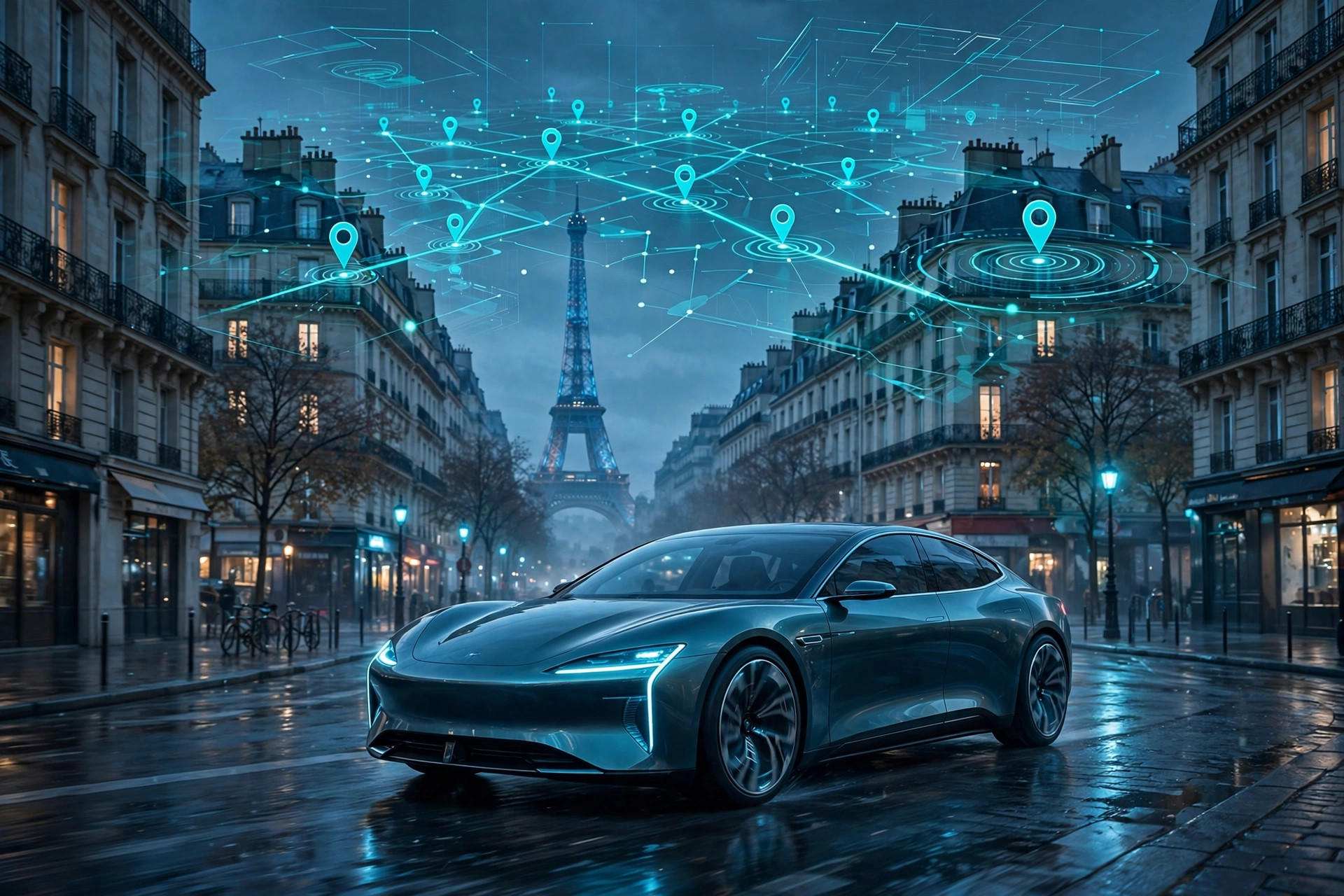
The two companies say they have already integrated TomTom’s location data into DeepRoute.ai’s automated driving stack, and an integrated demonstration vehicle will be shown during the Paris Motor Show — driving on Paris roads.
Who they are
TomTom (listed in Amsterdam as TOM2) built its name on navigation, but today describes itself as a specialist in mapping and location technology. DeepRoute.ai was founded in February 2019 in Shenzhen by Zhou Guang, and develops full-stack autonomous driving systems — the perception, decision-making, and control software that lets a vehicle steer itself. (Wikipedia)
DeepRoute has moved through several chapters. It raised a US$300 million Series B led by Alibaba in September 2021, originally pursuing Level 4 robotaxis. In 2022 it shifted strategy to Level 2+ and Level 3 driver-assistance systems, and in November 2024 raised another US$100 million — reportedly from Great Wall Motor — to develop end-to-end visual-language-action models, the kind of AI that interprets camera images and driving language directly to make driving decisions. (TechCrunch)
Why maps matter to an AI driver
Here’s the part worth understanding. Modern AI-based driving systems lean heavily on what the car can see right now: cameras, radar, and lidar feeding neural networks that interpret the scene. That works well — until it doesn’t.
A map is the car’s memory of the road. TomTom’s location data gives the driving stack things the sensors can’t see in the moment: the exact road layout ahead, the local rules of that stretch of road, and wider context about the area. The announcement frames it plainly: DeepRoute’s stack combines sensor information with TomTom’s data to “ground” the automated driving in road layouts, local rules, and the context needed to plan ahead and handle unfamiliar roads.
The specific focus is “advanced L2+ and L2++ functions” — driver-assistance systems where the human is still ultimately responsible, but the car handles more of the driving, more precisely. Precise, trustworthy decisions need precise, trustworthy context, and that’s the gap a map fills.
Why this deal is about going global
The most interesting line in the announcement isn’t about technology at all. It’s about markets.
Roads, traffic rules, driving behaviors, and even validation requirements differ from one country to another. A driving system tuned on Chinese roads doesn’t automatically behave on French ones. TomTom’s argument is that its location data captures those local differences — helping carmakers and tech partners adapt automated driving systems to regional conditions and scale them across markets faster.
Read between the lines: a Chinese automated-driving stack is looking outward, and it needs a European map partner to make that work. “Automated driving systems are becoming increasingly advanced and safer by building on a reliable understanding of the physical world,” said Willem Strijbosch, TomTom’s Head of Orbis Product Management. “As these AI-driven technologies evolve, they need a scalable, dependable understanding of real-world environments that can adapt to local road conditions.”
What this doesn’t mean — yet
A few reality checks, clearly labeled as analysis:
- An MoU is not a contract. It’s a formal statement of intent to work together — early-stage, not a commercial deal with named automaker customers or revenue attached. The real test is whether this demo vehicle turns into production cars.
- Demo vs. deployment. A showcase car on Paris roads during a motor show is a controlled demonstration. That’s normal for announcements like this — but it’s not the same as cars you can buy.
- The competition is fierce. DeepRoute is racing European, American, and Chinese rivals, including Tesla’s FSD in China. A map partnership is one piece of a very large puzzle: sensor cost, regulation, consumer trust, and local validation all matter too.
None of that makes the announcement meaningless. It tells you where the industry is heading: the AI driving stack is getting deeper, and high-quality maps are becoming part of it — not just a navigation aid, but a core input to the driving decisions themselves.
The takeaway
When you read news about automated driving partnerships, ask three questions: Which level? (Here: L2+/L2++, assistance — not full self-driving.) What’s the actual stage? (Here: an MoU plus a demo — early.) What problem does the pairing solve? (Here: giving AI drivers reliable local context so they can scale across different countries.)
That’s the pattern to watch. The race in automated driving isn’t only about smarter AI anymore — it’s about who can combine smart AI with deep knowledge of the real world, country by country.
Sources: TomTom press release (October 12, 2026) · GlobeNewswire distribution of the release · TechCrunch: DeepRoute raises $100M (November 2024) · DeepRoute.ai — Wikipedia