Automated Manufacturing Lighting Explained: What It Is and How Much Energy It Saves
Key takeaway: Automated manufacturing lighting pairs LED high-bay fixtures with occupancy sensors, daylight sensors and smart controls that dim or switch off lights in empty or sunlit areas. The US Department of Energy reports that occupancy-based controls alone cut warehouse lighting energy by 30–60%, and LED retrofits add further savings — making it one of the fastest-payback upgrades on a factory floor.
What automated manufacturing lighting is
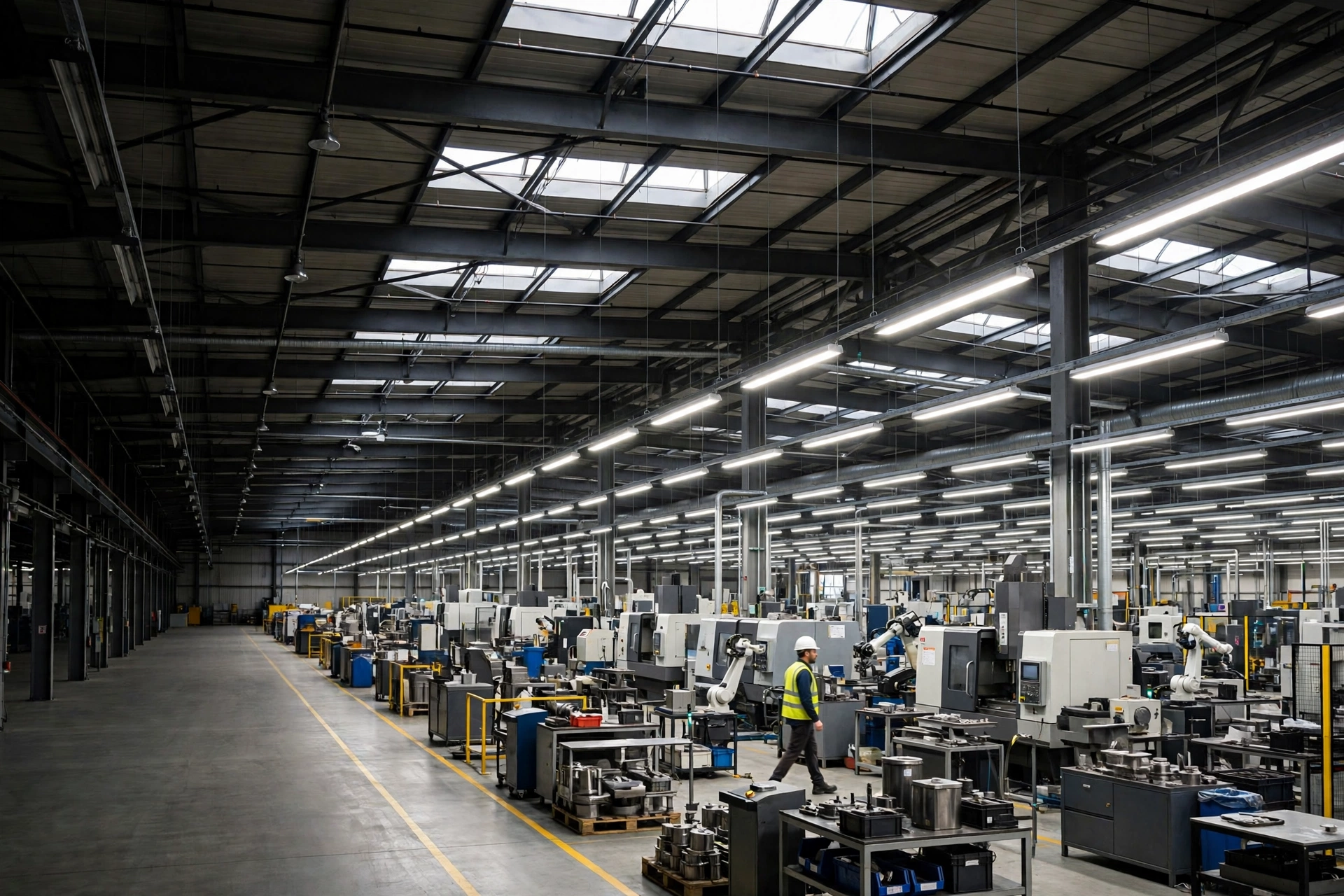
Automated manufacturing lighting is a lighting system for factories, plants and warehouses that adjusts itself without anyone touching a switch. LED high-bay fixtures are connected to occupancy sensors, daylight sensors and a central controller. When a zone is empty, the lights dim or turn off. When sunlight comes through skylights, the fixtures dim to match. When a shift starts, the right zones come on at the right brightness.
The industrial sector accounts for 24% of global energy consumption, according to Signify, the lighting company behind Philips lighting products — and lighting is one of the largest controllable slices of a plant’s electricity bill. In warehouses, lighting typically accounts for 20–30% of total electricity use, according to US Department of Energy benchmarks cited by PacLights. That is why lighting automation is often the first energy project a plant tackles: the savings are measurable within months, not years.
How automated manufacturing lighting works
Four control strategies do most of the work, usually in combination:
- Occupancy and motion sensing. Sensors detect workers in a zone and switch lights off or dim them when nobody is present. In a typical warehouse, 30–40% of lighting runs in spaces that sit empty during shifts, such as storage aisles and loading docks.
- Daylight harvesting. Light sensors measure incoming natural light and automatically reduce artificial lighting when sunlight is available. Facilities with skylights or large dock doors can cut daytime lighting energy by 30–50% this way.
- Scheduling and task tuning. Lights follow shift patterns and are set to the exact brightness each task needs — brighter over inspection stations, dimmer over bulk storage — instead of running every fixture at 100% all day.
- Networked management. A central system monitors every fixture, lets managers reconfigure zones when the floor layout changes, tests emergency lighting remotely, and flags failing fixtures before they go dark. Signify’s Interact platform is one example of this kind of wireless, cloud-based system.
Most modern systems dim fixtures smoothly from 100% down to 1% or switch them off entirely, using protocols such as DALI-2 or wireless Zigbee and Bluetooth mesh. The fixtures themselves are usually LED high-bays: efficient, instant-on, and rated for up to 100,000 hours of service life, according to Current, powered by GE.
Automated lighting vs traditional factory lighting
| Traditional factory lighting | Automated manufacturing lighting | |
|---|---|---|
| Fixtures | Metal halide or fluorescent high-bays | LED high-bays with dimmable drivers |
| Control | Manual switches, always on during shifts | Occupancy, daylight and schedule controls |
| Energy use | Full power regardless of occupancy or daylight | 30–60% less with occupancy controls; up to 80% less with managed LED systems |
| Maintenance | Frequent bulb changes, often needing lifts | Up to 100,000-hour fixture life; remote failure alerts |
| Flexibility | Rewiring needed to change zones | Zones reconfigured in software |
How much energy does automated manufacturing lighting save?
The savings come in two layers. First, the LED retrofit itself: LED fixtures consume 50–70% less energy than traditional metal halide or high-pressure sodium systems, and industrial high-bay LEDs cut lighting energy use by approximately 50–90%, according to Environment+Energy Leader. Signify puts the figure for managed LED lighting systems at up to 80% energy savings versus legacy lighting.
Second, the controls. The US Department of Energy reports that occupancy-based systems typically reduce warehouse lighting energy by 30–60%, and that combining daylight harvesting with occupancy sensors delivers cumulative savings of 40–60% compared with traditional always-on systems. Environment+Energy Leader reports that controls such as Current’s Daintree system can add roughly another 20% in savings on top of what the LEDs already deliver.
Put together, a facility that upgrades to LEDs and adds occupancy and daylight controls can expect total lighting energy reductions of 40–60% — and in the best cases more. For a plant spending $50,000 a year on lighting, a 40% cut is $20,000 a year in electricity alone, before maintenance savings.
What does automated manufacturing lighting cost, and when does it pay back?
Costs vary with facility size, ceiling height and fixture count. PacLights reports that a 100,000-square-foot warehouse retrofitting from older HID or fluorescent systems to LED with occupancy sensing and daylight harvesting typically invests $80,000–$150,000, and that real-world facilities see payback in 2–3 years once the controls are added — faster than most facility upgrades. Motion sensors for a 50,000-square-foot warehouse typically cost $8,000–$15,000 installed.
After payback, the system keeps generating savings for another 15–20 years of LED fixture life. US owners may also qualify for the Section 179D tax deduction, worth up to $1.88 per square foot for energy-efficient lighting systems, according to PacLights. Rebates from local utilities can shorten payback further, so check with your utility before ordering fixtures.
What to check before you install automated manufacturing lighting
Four prerequisites decide whether a project succeeds:
- Light levels per zone. Map the brightness each area actually needs — inspection and precision assembly need far more light than bulk storage — so task tuning saves energy without hurting quality.
- Daylight availability. Daylight harvesting only pays where skylights, clerestory windows or large dock doors let sun in. Windowless plants still benefit from occupancy sensing and scheduling.
- Sensor placement. High racks, tall machinery and forklift traffic create blind spots. Sensors need a clear view of each zone, and high-bay fixtures need sensors rated for the mounting height.
- Controls compatibility. Confirm the fixtures, sensors and management software speak the same protocol (DALI-2, Zigbee or Bluetooth mesh) before buying, or budget for a gateway.
Limits and risks of automated manufacturing lighting
Automation is not a fit-and-forget upgrade. Poorly placed sensors leave lights off while workers are present or on in empty aisles. Commissioning — the process of tuning sensor sensitivity, time delays and dimming levels — takes weeks of adjustment after installation, and a system that was never commissioned properly can save far less than the brochure promises. Networked systems also add a cybersecurity surface: a cloud-connected lighting controller should sit on a segmented network, not the open office LAN. And in areas with safety-critical work, a sensor failure that leaves a zone dark is a hazard, so emergency lighting must stay independent of the automation layer.
Analysis: the boring upgrade that funds the exciting ones
Automated lighting rarely makes a keynote speech, but it is one of the few factory upgrades where the business case is nearly self-evident: the Department of Energy’s own figures put the savings at 30–60% from controls alone, payback lands in two to three years, and the fixtures then run for a decade or more. It also fits the wider factory-automation story — the same sensors, networks and dashboards that run smart lighting are the infrastructure that AI applications on the factory floor build on. For plants weighing bigger automation bets, lighting is a low-risk first project: it proves the energy-savings model with real numbers before the plant commits to larger AI energy optimization projects.
Frequently asked questions
What is automated manufacturing lighting?
Automated manufacturing lighting is a factory or warehouse lighting system that adjusts itself using LED fixtures, occupancy sensors, daylight sensors and a central controller. It dims or switches off lights in empty or sunlit areas and follows shift schedules, so lights run only where and when they are needed.
How much energy does automated manufacturing lighting save?
LED retrofits alone cut lighting energy by 50–70% versus metal halide systems, and the US Department of Energy reports occupancy-based controls cut warehouse lighting energy by a further 30–60%. Combined, facilities typically save 40–60% compared with traditional always-on lighting, and managed LED systems can reach up to 80% savings according to Signify.
How long does automated factory lighting take to pay for itself?
Most facilities see payback in two to three years when LED fixtures are combined with occupancy sensing and daylight harvesting, according to PacLights. After payback, the system keeps saving for another 15 to 20 years of LED fixture life, and utility rebates or the Section 179D tax deduction can shorten the payback further.
Does automated lighting work in warehouses without windows?
Yes. Occupancy sensing and scheduling save energy in any building, because they switch off lights in empty zones regardless of daylight. Daylight harvesting is the only strategy that needs windows or skylights, so a windowless warehouse simply skips that layer and relies on the other controls.
What is the difference between automated lighting and smart lighting?
The terms overlap. Automated lighting means the lights adjust themselves using sensors and schedules without human input. Smart lighting usually adds a networked layer on top: remote management, energy monitoring, failure alerts and software-based zone changes. Most modern factory systems are both automated and smart.
Sources
- Signify — What connected lighting can do for industrial facilities
- Environment+Energy Leader — 5 Rock-Solid Reasons Manufacturers Should Already Be Rocking LED Fixtures
- PacLights — Warehouse Lighting Controls: Smart Ways to Cut Energy Use
- PacLights — Warehouse Lights Energy Savings: Cut Costs Without Compromising Brightness