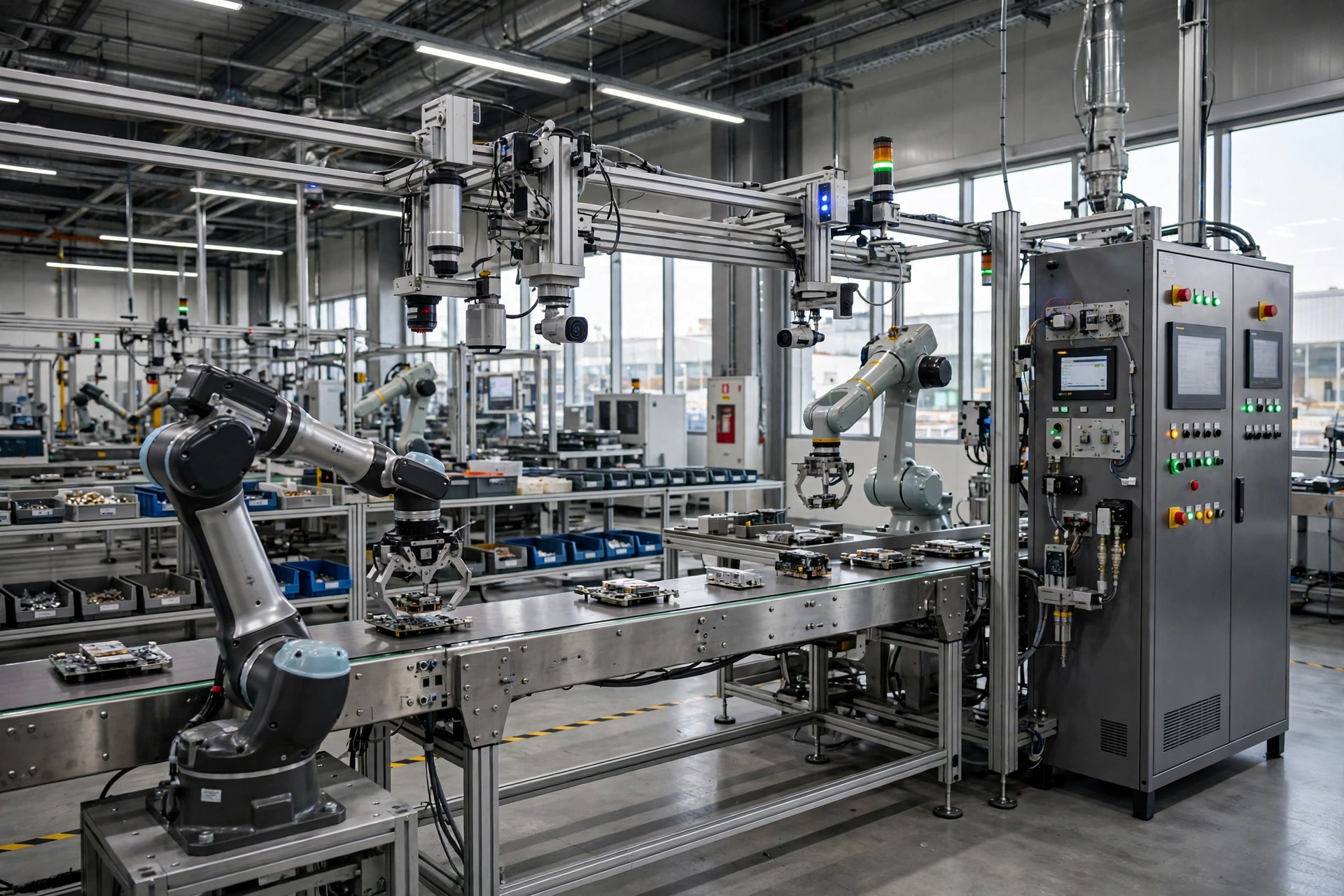
Custom Factory Automation Explained: What It Is, How It Works, and When It Pays Off
Key takeaway: Custom factory automation is automation designed around one plant’s specific products, processes, and constraints, rather than bought as a generic package. It typically combines sensors, controllers, robots, and software into a single system, and it pays off when production volume, quality demands, or labour shortages make manual work the bottleneck.
Off-the-shelf automation can speed up a standard task. Custom factory automation starts from the other end: the product, the process, and the problems a specific factory actually has. This article explains what that means, the main system types, what it costs, and how to judge whether it is worth it.
What is custom factory automation?
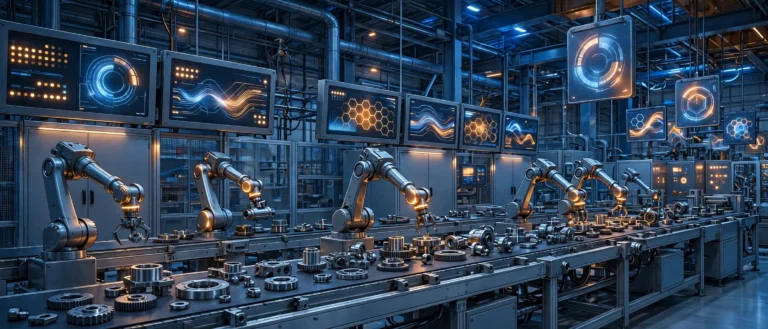
Custom factory automation is the use of machines, control systems, robotics, and software — designed or configured for a particular factory — to run manufacturing tasks with minimal human intervention. The word “custom” matters: instead of forcing a plant to adapt to a standard machine, the system is built around its parts, tolerances, cycle times, safety rules, and existing equipment.
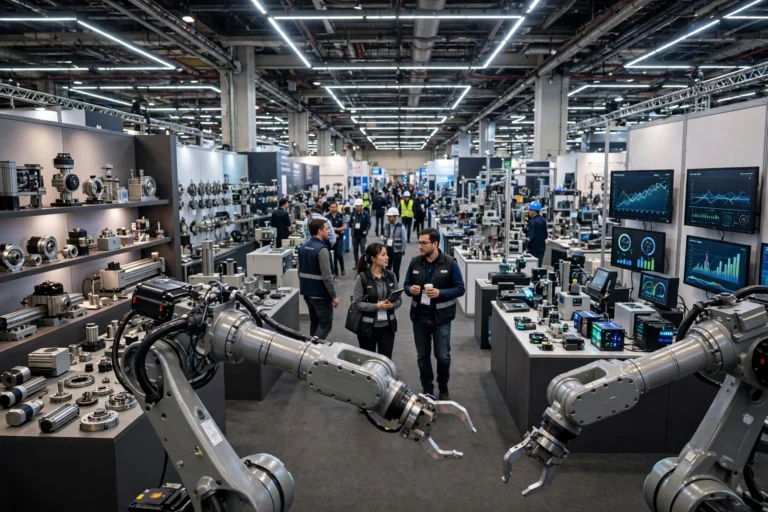
That rarely means building everything from scratch. Most custom systems combine standard building blocks — programmable logic controllers (PLCs), sensors, robots, conveyors, and machine-vision cameras — assembled and programmed for one production line. The custom part is the integration: how those blocks work together for that plant’s products. For background, see our explainers on machine automation solutions and industrial automation in IoT.
How a custom automation system works
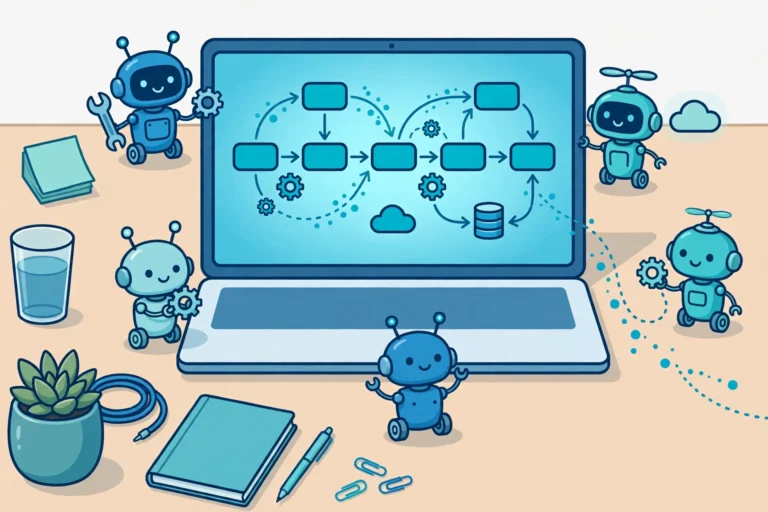
Almost every automated system runs the same loop, repeated across the line: sensors measure (cameras and temperature, pressure, or presence sensors detect a part and its condition); controllers decide (a PLC or industrial computer compares the reading with its program); actuators act (motors, pneumatic cylinders, or robots move, weld, fill, or reject the part); and supervisory software lets operators monitor the line and log events. Connected over an industrial network, that loop feeds production planning, quality records, and predictive maintenance.
Custom factory automation vs standard automation
| Approach | Best when | Trade-off |
|---|---|---|
| Standard automation | The task is common, e.g. palletising standard boxes | Faster to buy, but may not fit unusual parts or layouts |
| Custom automation | Parts, tolerances, or processes are specific to one plant | Fits the process exactly, but takes longer to design and commission |
| Hybrid: standard blocks, custom integration | Most real projects | Balances speed and fit |
A useful rule: buy standard when the task is standard, and build custom when the product or process is the reason a standard machine cannot do the job.
The four main types of factory automation
Systems are usually grouped by how easily they adapt when the product changes. Fixed automation uses dedicated equipment for one product at very high volume, such as a bottling line — fast, but hard to change. Programmable automation, such as CNC machines, is reprogrammed for different batches. Flexible automation, such as robot cells, switches between products with little or no changeover time. Integrated automation coordinates many systems through software, from design to production and logistics.
Most plants mix several types, and related approaches are covered in our guide to custom robotics automation.
What does custom factory automation cost?
There is no single price, because the system is the price: a single custom workstation costs far less than a fully integrated line, and the total depends on robotics, vision, safety guarding, software, and integration time. Budget beyond the hardware — for engineering, testing, installation, commissioning, training, spares, and maintenance.
Market forecasts give a sense of scale, not a quote. Mordor Intelligence estimates the factory automation and industrial controls market at USD 312.33 billion in 2025, rising to USD 338.46 billion in 2026 and USD 505.88 billion by 2031 (8.37% annual growth over 2026–2031), with automotive the leading end-user industry in 2025. Other firms report different totals because they define the market differently, so treat any single figure as an estimate.
Analysis: judge cost by payback, not sticker price. Compare the full project cost, including downtime during installation, against labour saved, scrap reduced, throughput gained, and quality claims avoided over the system’s life. If none of those four can be estimated, the project is not ready to approve.
What a plant needs before automating
Automation magnifies whatever process it is given, including a broken one. Before commissioning a custom system, a plant should have a stable, documented process; measured baselines for cycle time, defect rate, and changeover time; safety planning for every point where people and machines interact; operators and maintenance staff trained on the new system; and spare-parts and support cover, so one failed sensor does not stop the line for a week.
Risks and limits to watch
Common failure modes include over-automating a low-volume product, underestimating integration time, locking into one vendor’s proprietary controls, and neglecting cybersecurity on newly networked machines. A phased approach — automating the bottleneck first, proving the return, then extending — reduces all four risks. Automation also changes jobs rather than simply removing them: roles shift toward supervision, maintenance, programming, and quality analysis, so retraining should be planned alongside installation.
How to choose the right approach
- Start with the bottleneck — the step that limits output, causes defects, or creates safety risk.
- Measure first — record the baselines the project will be judged against.
- Prove it at small scale — pilot one cell before committing to a full line.
- Specify outcomes, not just equipment — cycle time, defect rate, and uptime targets in the contract.
- Plan the handover — training, documentation, and maintenance cover are part of the system, not extras.
Done this way, custom factory automation is less a purchase than a redesign of how a plant works — which is why it should start from the process, not the catalogue. For a sector example, see AI automation in beverage manufacturing.
Frequently asked questions
What is custom factory automation?
Custom factory automation is automation designed or configured for one factory’s specific products and processes, combining sensors, controllers, robots, and software into a system built around that plant rather than a generic package.
How is custom factory automation different from standard automation?
Standard automation uses ready-made machines for common tasks, while custom automation adapts the equipment, programming, and integration to a plant’s parts, tolerances, and layout. Most real projects are hybrids: standard components with custom integration.
What are the main types of factory automation?
The four main types are fixed automation for high-volume single products, programmable automation for batches, flexible automation for fast product changeovers, and integrated automation that coordinates many systems through software.
How much does custom factory automation cost?
Costs vary widely by scope, from a single custom workstation to a fully integrated line, and the total should include engineering, testing, installation, training, and maintenance — not just hardware. The right comparison is payback against labour saved, scrap reduced, and throughput gained.
When is a factory ready for custom automation?
A factory is ready when its process is stable and documented, its bottleneck and baseline numbers are measured, safety planning is complete, and staff training and maintenance cover are planned. Automating an unstable process usually magnifies its problems.
Sources
- Mordor Intelligence — Factory Automation and Industrial Controls Market
- oTechWorld — Industrial Automation Systems: Types & Real Examples
- Luvina — What Is Factory Automation? Complete Beginner’s Guide
- Averroes.ai — 6 Types of Factory Automation Systems