AI Enterprise Marketing Explained: What It Is and How Big Companies Use AI in 2026
Key takeaway: AI enterprise marketing means using artificial intelligence across a company’s marketing — to plan campaigns, personalize messages, predict which customers will buy, and measure what worked. McKinsey’s 2025 survey found 88% of organizations now use AI somewhere, yet only about one-third have scaled it beyond pilots, so the gap between trying AI and getting value from it is the story.
What is AI enterprise marketing?
AI enterprise marketing is the use of artificial intelligence across a large organization’s entire marketing function: planning, content, targeting, personalization, measurement, and customer follow-up. The “enterprise” part matters. A small business might use a chatbot to draft social posts. A large company uses AI across thousands of campaigns, millions of customer records, and dozens of channels — inside strict rules about data privacy, brand voice, and legal approval.
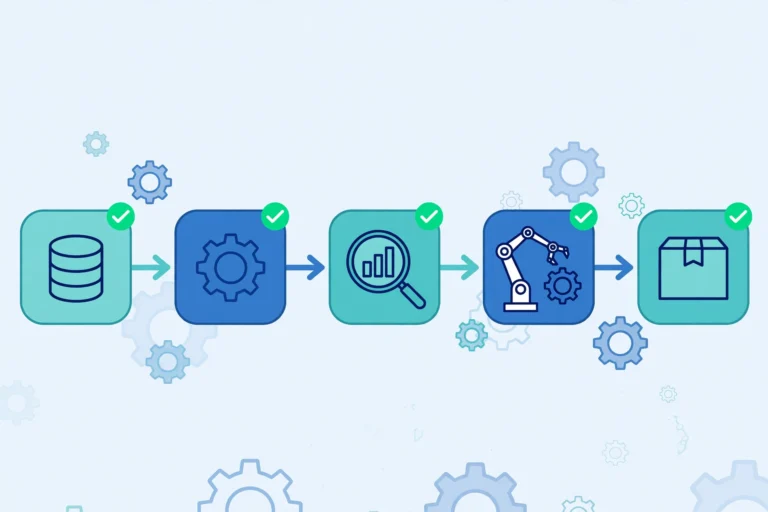
In practice, AI enterprise marketing runs on three layers. First, a customer data platform (CDP) pulls together records from the CRM, website, email, and ads into one profile per customer. Second, AI models work on that data: predicting who is likely to buy, scoring leads, and choosing the next best message for each person. Third, agents and automation act on those decisions — sending the email or adjusting the ad budget — often without a human touching each step. AI agents for business automation explain how that agent layer works beyond marketing.
How big companies use AI enterprise marketing
The most common uses fall into a few clear groups:
- Content at scale. AI drafts first versions of product descriptions, emails, ad copy, and landing pages, then human editors shape them. IAB Europe’s September 2025 research found 61% of companies using AI marketing tools use them for content generation.
- Personalization beyond first names. AI tailors messages to the whole buying group — the CFO sees cost-savings proof, the CTO sees security detail — because one enterprise deal can involve ten or more decision-makers.
- Predictive analytics. Models score accounts by intent signals, past behavior, and firmographic data, so teams spend their budget on the accounts most likely to close. AI-powered campaign analysis covers how those predictions feed back into measurement.
- AI agents. Salesforce’s Agentforce (launched 2024) runs marketing agents on its Data Cloud for lead qualification and follow-up; Adobe’s Experience Platform uses AI assistants for audience building and journeys; HubSpot’s Breeze embeds agents directly in its CRM.
Traditional marketing vs AI enterprise marketing
| Area | Traditional enterprise marketing | AI enterprise marketing |
|---|---|---|
| Targeting | Static segments, updated quarterly | Live account scores |
| Personalization | Industry or role-level messaging | Per-account, per-person messaging |
| Content | Manually written, one version per segment | AI first drafts, human-edited |
| Measurement | Last-click attribution, monthly reports | Multi-touch models, fast budget shifts |
| Speed | Campaigns planned in weekly or monthly cycles | Journeys adjust at each touchpoint |
What does AI enterprise marketing cost?
There is no single price, because the cost is the platform plus the work around it. Adobe’s Marketo Engage starts at $895 per month, while Adobe Experience Platform pricing is custom at enterprise scale. Salesforce prices Agentforce at roughly $2 per conversation, with bundles included in higher-tier plans. On top of that come data cleanup, integration, and staff time — the parts vendors rarely quote.
What the data actually shows
The headline numbers look like a success story. McKinsey’s State of AI survey, fielded June 25 to July 29, 2025 with 1,993 respondents across 105 countries, found that 88% of organizations now regularly use AI in at least one business function, up from 78% a year earlier. Marketing and sales was the function where revenue increases from AI were most commonly reported. IAB Europe found 85% of companies already deploy AI-based tools for marketing, with targeting (64%) and content generation (61%) leading adoption.
But the same data carries a warning. Only about one-third of McKinsey’s respondents had begun scaling AI programs, and only 39% attributed any EBIT impact to AI — most of them less than 5% of EBIT. Gartner predicted in June 2025 that over 40% of agentic AI projects will be canceled by the end of 2027, citing escalating costs, unclear business value, and weak risk controls. Adoption is nearly universal, but measurable impact is still rare.
What it takes to start
Three prerequisites decide whether an AI marketing program works. First, clean, consented customer data in one place — AI trained on duplicated, outdated CRM records produces confident mistakes. Second, one measurable use case, such as lead scoring, with a baseline number to beat. Third, governance: who approves AI-generated content, what data the models may touch, and how errors get caught.
Risks and limits of AI enterprise marketing
AI-generated content can drift off-brand, invent claims, or sound identical to every competitor using the same tools — buyers now spot generic AI copy quickly. Privacy rules limit what customer data can feed the models, and regulations differ by region. And agentic systems that act without approval can send the wrong message to the wrong account at scale. The practical rule is simple: automate the drafting and scoring, keep humans on approval and strategy. Automation and the workforce looks at how that balance is changing marketing jobs.
Our analysis
Analysis: The durable advantage is not the model — every vendor now sells a similar one. It is the data and the discipline around it: unified customer records, a clear definition of a good lead, and one metric the pilot must move. The companies reporting real revenue gains fixed those foundations before buying the platform, not after. For everyone else, the honest move is a single small pilot with a baseline.
Frequently asked questions
What is AI enterprise marketing?
AI enterprise marketing is the use of artificial intelligence across a large company’s marketing function, including campaign planning, content creation, personalization, lead scoring, and measurement. It differs from small-business AI marketing mainly in scale: it works across millions of customer records and many channels, inside strict data-privacy and brand rules.
How do large companies use AI in marketing?
Large companies use AI to draft content, personalize messages for whole buying groups, score leads and accounts by purchase intent, predict churn, and shift ad budgets based on multi-touch attribution. Salesforce Agentforce, Adobe Experience Platform, and HubSpot Breeze are among the platforms enterprises use to run these workflows.
How much does AI enterprise marketing cost?
Costs vary widely. Adobe Marketo Engage starts at $895 per month, Salesforce Agentforce costs roughly $2 per conversation, and Adobe Experience Platform pricing is custom. The larger cost is usually data cleanup, system integration, and staff time, so a realistic pilot budget runs into five figures per year before software alone.
Does AI marketing actually increase revenue?
Some companies report gains, but most do not yet. McKinsey’s 2025 survey found marketing and sales was the function where revenue increases from AI were most commonly reported, yet only 39% of organizations attributed any EBIT impact to AI, and most of those reported less than 5% of EBIT. Measurable impact usually follows data cleanup and scaling, not the purchase of a tool.
What are the risks of AI in enterprise marketing?
The main risks are off-brand or invented content, privacy violations from feeding regulated customer data into models, and agentic systems acting without approval. Gartner predicted in June 2025 that over 40% of agentic AI projects will be canceled by the end of 2027, mostly over cost, unclear value, and weak risk controls.
Sources
- McKinsey — The State of AI: How Organizations Are Rewiring to Capture Value
- PPC Land — Most Companies Still Pilot AI Programs Despite Widespread Adoption (McKinsey survey details, IAB Europe figures, and Gartner’s agentic AI cancellation prediction)
- Deployed Labs — 10 Best AI Marketing Agents & Automation Platforms in 2026 (Agentforce pricing, Marketo pricing)
- Darwin Apps — Agentic AI in Marketing Analytics: What Salesforce, HubSpot and Adobe Are Changing