Semi-Automation Explained: What It Is, How It Works, and Where It Pays Off (2026)
Key takeaway: Semi-automation is the middle ground between manual work and full automation: machines handle repetitive, precise, or hazardous steps, while people keep the decisions, quality checks, and exceptions. It is the most common form of automation in assembly lines and offices alike, because it raises output without removing the human judgment that catches what machines miss.
Automation is usually talked about as all or nothing — either people do the work, or machines do. In practice, most businesses land in the middle: a robot welds the same joint a thousand times a day, and a person inspects the result. That middle ground is semi-automation, and it is where most real-world automation actually happens.
What is semi-automation?
Semi-automation is a setup where machines and people split a process. Automated equipment handles the steps that are repetitive, precise, or dangerous, while human workers handle setup, decisions, quality checks, and anything unexpected. It is not fully automatic, where machines run without human involvement, and it is not manual, where people do everything by hand.
Trade publication Assembly Magazine calls semiautomatic systems “the broadest part of the assembly system spectrum”. The same idea applies in offices. In software, an attended RPA bot is semi-automation — the bot does the repetitive clicks and lookups while the person stays in control. IBM makes the same split for IT runbooks: a semi-automated runbook lets an operator run automated tasks on a target system, while a fully automated runbook runs with no operator at all.
How semi-automation works in practice
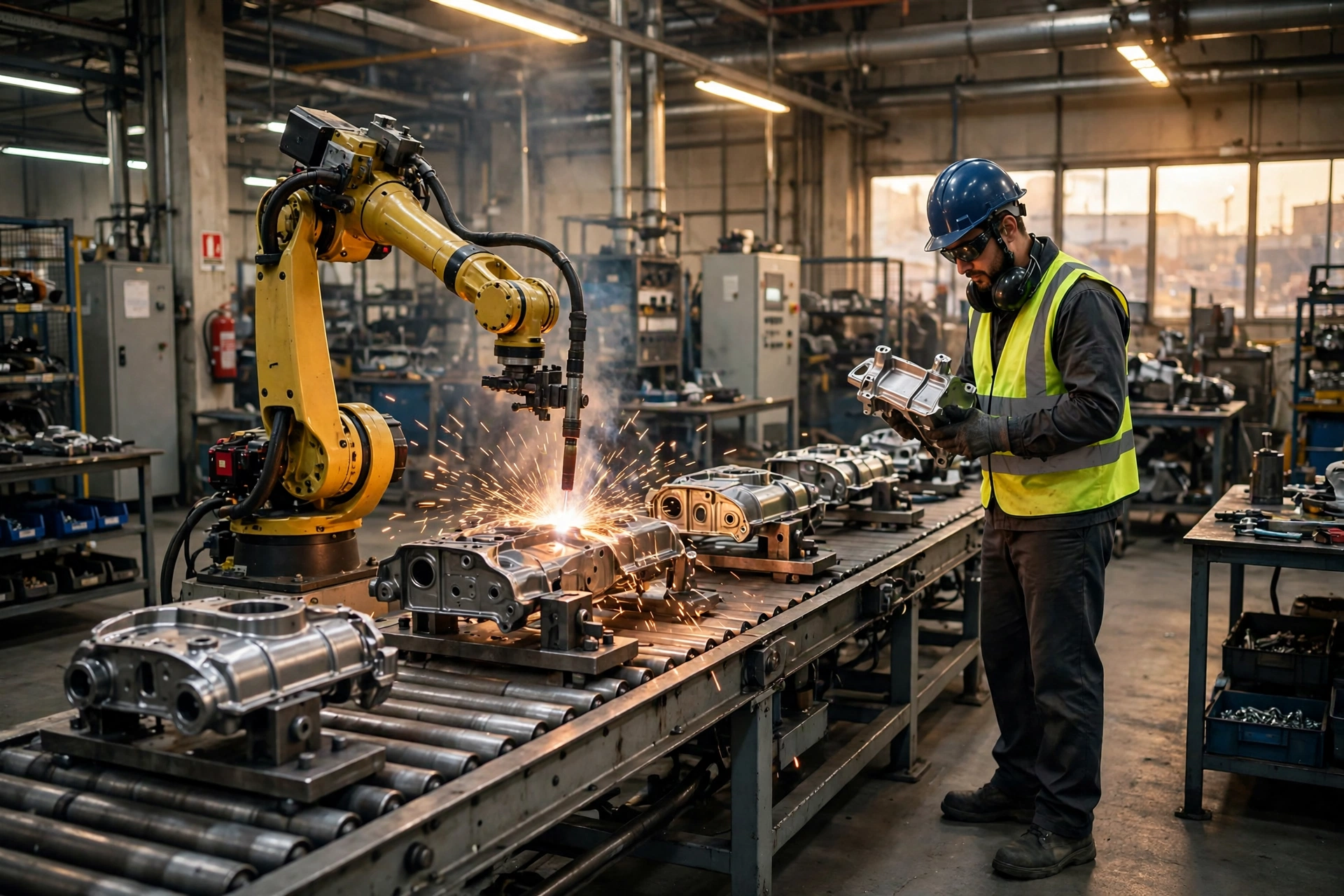
The pattern is the same across industries: the machine does the repeatable step, the person does the judgment step. In manufacturing, robots handle welding, painting, and fastening, while workers load parts, inspect finished goods, and fix problems the robot cannot judge. Automated guided vehicles move materials between workstations, but people still load and unload them.
In warehouses, robots retrieve items from shelves and carry them to a packing station, while humans verify the order, pack it, and label it. In offices, a support agent triggers a bot that pulls a caller’s records from three systems, then reads the summary and decides what to say. The machine fetches; the person thinks.
Semi-automation vs manual work vs full automation
| Approach | Who does the work | Best when | Main drawback |
|---|---|---|---|
| Manual | People do every step | Low volume, high variety, every job is different | Slow, tiring, and error-prone at scale |
| Semi-automation | Machines do repetitive steps; people decide, check, and handle exceptions | Volume is growing but jobs still vary or need judgment | Handoffs between people and machines can slow things down |
| Full automation | Machines run the whole process; people only maintain and supervise | High volume, identical output, stable process | Expensive to build, rigid, and hard to change |
What does semi-automation cost, and when does it pay off?
Semi-automation usually costs far less up front than full automation, because you automate one step at a time instead of rebuilding a whole line. A small manufacturer can start with one automated fixture or one attended bot, measure the result, and add more later. The trade-off is that per-unit costs stay higher than full automation at very large volumes, because people are still in the loop. It pays off when volume is too high for manual work but too variable — or too small — to justify full automation.
The limits and risks of semi-automation
Semi-automation is not a free win. Every handoff between a person and a machine is a place where work can stall: a robot waits for a part, a person waits for a robot, a bot waits for approval. Badly designed handoffs can make a semi-automated process slower than the manual one it replaced.
There is also an exception-handling trap. Semi-automation works because people catch what machines miss. If the exceptions are frequent or poorly defined, the person becomes a bottleneck instead of a safety net. Before automating a step, write down exactly which cases go to a human.
Analysis: why semi-automation is the default, not the compromise
Our take: semi-automation is often treated as a stepping stone to full automation, but for most businesses it is the destination. The processes worth automating are rarely the ones that are fully stable — they are the ones with a repetitive core and a variable edge, and that edge is where human judgment earns its keep.
For readers weighing a first step, the practical question is not “how much can we automate?” but “which step, if automated, frees the most human time without creating a new bottleneck?” Answer that for one process and semi-automation starts paying for itself. Our guide to unattended automation covers the other end of the spectrum, and our automation implementation guide walks through planning a first project.
Frequently asked questions
What is semi-automation in simple terms?
Semi-automation means machines and people share a job. Machines handle the repetitive, precise, or hazardous steps — like welding, moving materials, or copying data between systems — while people handle setup, decisions, and quality checks. It sits between fully manual work and full automation.
What is the difference between semi-automation and full automation?
In semi-automation, people stay in the loop: they load parts, check quality, make decisions, and handle exceptions. In full automation, machines run the whole process with no human involvement except maintenance and clearing jams. Full automation is faster at very high volumes, but it costs more to build and cannot adapt when the work changes.
What are examples of semi-automation?
Common examples include assembly lines where robots weld and humans inspect, warehouses where robots fetch items and humans pack and verify orders, pharmacies where robots dispense medication and pharmacists check it, and offices where attended RPA bots gather data while a person decides what to do with it.
Is semi-automation better than full automation?
It depends on the work. Semi-automation is usually better when volume is moderate, products vary, or judgment matters — it costs less up front, is easier to change, and keeps human oversight where it counts. Full automation is better when output is identical, volume is very high, and the process rarely changes.
Sources
- Assembly Magazine — Manual, Semiautomatic or Fully Automatic?
- Automation Anywhere — How Attended and Unattended Bots Differ
- RNA Automation — Semi-Automated vs Fully Automated
- IBM — Runbook types (manual, semi-automated, fully automated)
- USABite — What Is Process Automation?
- USABite — Types of Process Automation Explained