
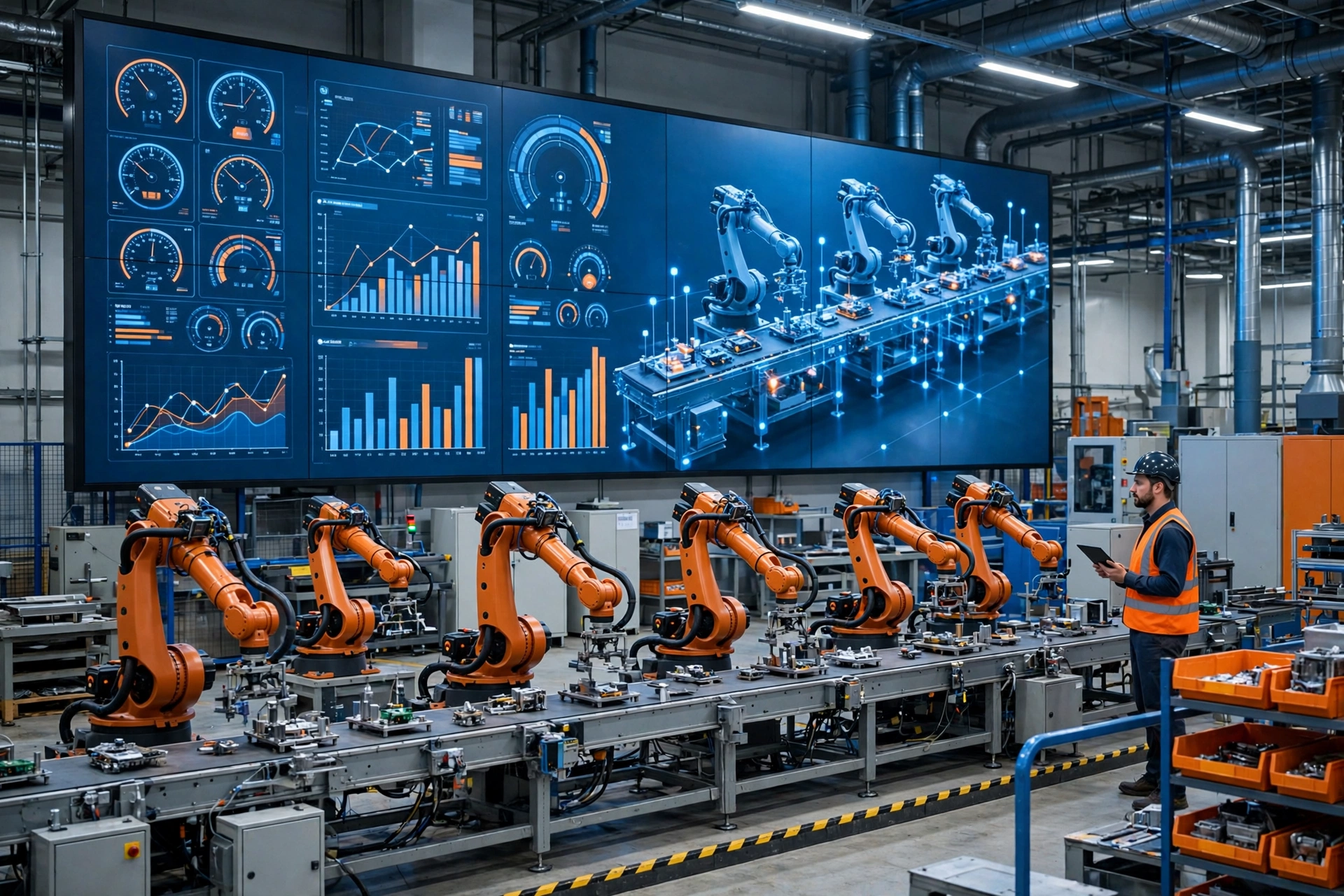
Factory AI Applications in Manufacturing 2026: What AI Actually Does on the Factory Floor
Key takeaway: Factory AI applications in manufacturing now cover predictive maintenance, computer-vision quality inspection, production planning, digital twins, and AI-guided robotics. McKinsey research finds predictive maintenance alone can cut unplanned downtime by up to 50% and maintenance costs by 10–40%. The market was worth about $7.1 billion in 2025 and is forecast to reach $172.4 billion by 2033.
Factory AI applications in manufacturing have moved past pilot projects. In 2026, the technology is running on real production lines — watching machines for signs of failure, inspecting parts faster than any human, and simulating entire plants before a single machine is installed. Yet adoption is still early: only 29% of manufacturers use AI or machine learning at the facility level, according to a Deloitte and Manufacturing Institute survey, even though 78% are spending around a fifth of their budgets on smart manufacturing.
That gap is the story of factory AI in 2026. The tools work, the returns are documented, and most plants have not started yet. Here is what the applications actually do, what they cost, and where a factory should begin.
What are the main factory AI applications in manufacturing?
Five applications account for most factory AI spending in 2026. Each solves a different production problem, and each has measured results behind it.
| Application | What it does | Documented result |
|---|---|---|
| Predictive maintenance | Sensor data predicts machine failure before it happens | Up to 50% less unplanned downtime (McKinsey) |
| Quality inspection | Computer vision spots defects on the line | Inspection trained before first build (Siemens/NVIDIA, 2026) |
| Production planning | AI agents model schedules and test plans in simulation | 40% faster time-to-market targeted at Siemens Erlangen |
| Digital twins | Live virtual copy of the plant for planning and testing | BMW simulated ~1,000 robots before building its Debrecen plant |
| AI-guided robotics | Robots adapt to changing parts and tasks | 100+ AI algorithms running at Siemens Erlangen |
How does predictive maintenance work in factories?
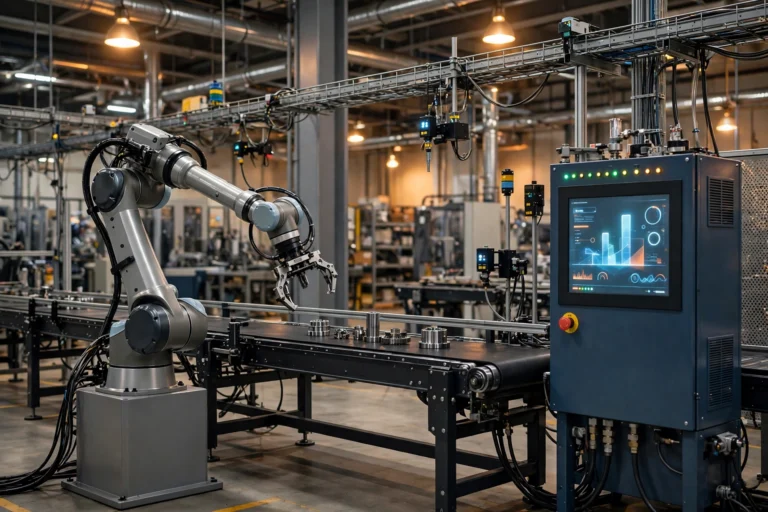
Predictive maintenance is the most mature factory AI application, and the usual starting point. Sensors on motors, pumps, and spindles stream vibration, temperature, sound, and power-draw data. Machine-learning models learn each machine’s normal pattern and flag the small changes that precede a breakdown — a bearing running slightly hotter, a vibration signature drifting off baseline.
The payoff is measured, not promised. McKinsey’s manufacturing analytics research finds predictive maintenance can reduce unplanned downtime by up to 50% and cut maintenance costs by 10–40%. Deloitte puts the stakes in context: unplanned downtime costs industrial manufacturers an estimated $50 billion a year. At BMW’s Regensburg plant, AI-supported predictive maintenance saves more than 500 minutes of production disruption a year from a single system.
It is also the cheapest place to start. Most plants already collect the sensor data; the AI layer sits on top of it. That is why consultants consistently rank predictive maintenance first for factories new to AI — it needs no new hardware on the line, just data the plant is probably already logging.
How does AI quality inspection beat human eyes?
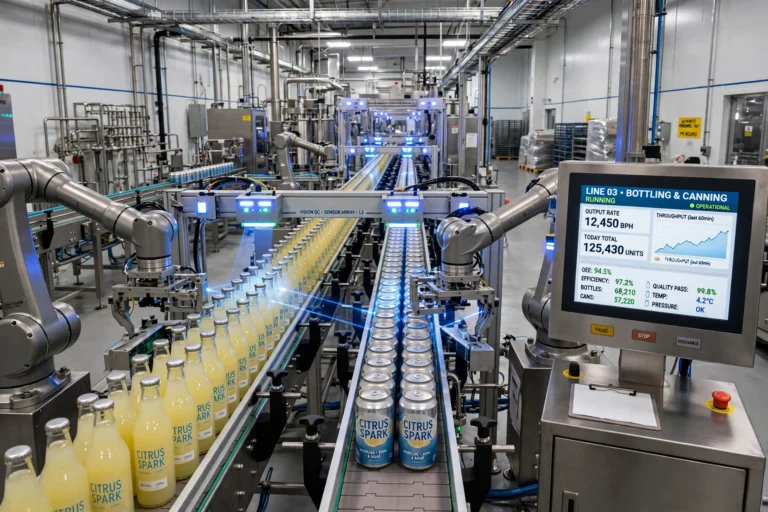
AI quality inspection uses cameras and computer-vision models to check every part on the line, at full production speed, without fatigue. Where human inspectors sample a fraction of output, vision systems examine each item and flag surface defects, wrong dimensions, and assembly errors in milliseconds.
The most concrete 2026 example comes from Siemens and NVIDIA. Announced on October 21, 2026, their collaboration at the Siemens Electronics Factory in Erlangen, Germany, trains optical inspection systems on AI-generated images before the first physical circuit board exists. A digital twin of the board supplies the “golden board” reference, and NVIDIA’s Cosmos models generate photorealistic images of good and defective boards to calibrate the inspection machines in advance.
The partners target up to 85% less manual engineering effort in inspection setup, 40% fewer false calls, and a first-pass yield improvement of more than 5%. Those are targets, not measured results — the Erlangen plant is Siemens’ own test site, and the numbers describe one high-mix electronics plant, not a guarantee for every factory. But the direction is clear: inspection is moving from “train on real defects” to “train on simulated ones.”
What are factory digital twins?
A factory digital twin is a live, physically accurate 3D model of a plant, built from engineering data, simulation, and real operating data. Planners change the twin first — move a robot, reroute a conveyor, test a new layout — and see the consequences before touching the real line.
BMW offers the clearest example at scale. Its plant in Debrecen, Hungary, which opened on September 29, 2025, was built virtually first: the placement and processes of nearly 1,000 industrial robots in the body shop were simulated in detail before construction. Foxconn used the same approach to design a 242,287-square-foot facility in Houston, Texas, that will manufacture NVIDIA AI systems.
Siemens and NVIDIA deepened the partnership in January 2026 with Digital Twin Composer, software that lets engineers place a product, process, or plant in a 3D scene and move through time to see the effect of a change. The two companies are also building an “Industrial AI Operating System” for designing and running physical systems, starting with the Erlangen factory as the blueprint.
What does factory AI cost, and where should a plant start?
Factory AI costs vary widely, from a predictive-maintenance pilot using existing sensors to a full digital-twin build that runs into the millions. Siemens alone plans to invest about $559 million in its Erlangen site through 2030. For most plants, the realistic entry point is far smaller: a single production line, one use case, and a 3–6 month pilot with a clear metric — downtime hours, scrap rate, or inspection accuracy.
McKinsey estimates generative AI could add $275–460 billion a year to global manufacturing, but that value concentrates in plants that get the basics right first. The prerequisites are unglamorous: reliable sensor data, connected machines, and clean maintenance records. Plants without those foundations spend their AI budget on data plumbing, not on AI.
A practical sequence is: start with predictive maintenance on the most expensive machine, add vision-based quality inspection on the highest-scrap line, and only then invest in digital twins and AI agents for planning. Each step pays for the next one — which matters, because the Deloitte survey shows most manufacturers are still at the spending stage, not yet at the returns stage.
What are the risks and limits of factory AI in 2026?
Factory AI has real limits, and the honest vendors say so. The Erlangen savings figures are targets from a Siemens-owned plant, and analysts quoted in the coverage note that scaling the same results across older, multi-vendor “brownfield” factories is unproven. Models trained on one line’s data do not always transfer to another line, and poor sensor data produces confident wrong predictions.
There is also a workforce question. Automation is already changing factory jobs, and AI adds a new layer: maintenance teams need data skills, and quality roles shift from inspecting parts to supervising inspection systems. Plants that budget for the software but not the training get the worst of both worlds — expensive tools and nobody able to use them.
Finally, market forecasts disagree wildly. Grand View Research puts the AI-in-manufacturing market at $7.1 billion in 2025 and $172.4 billion by 2033; Fact.MR estimates $6.48 billion in 2025 and $140.1 billion by 2036. The direction is consistent — rapid growth — but the exact numbers depend on what each firm counts. Treat any single market-size figure as an estimate, not a fact.
Analysis: the factory AI story in 2026 is about proof, not promise
Analysis: The notable shift in 2026 is that factory AI vendors are proving their claims on their own production lines before selling them. Siemens runs its inspection and planning AI at Erlangen first; BMW built Debrecen virtually first. That “customer zero” pattern is the strongest signal in the sector — it means the numbers quoted in press releases are at least being tested against real output, even when they are still targets rather than results.
The risk for buyers is mistaking a showcase plant for a typical one. Erlangen is a high-mix electronics facility with Siemens’ own engineers on site. A 30-year-old plant with mixed-vendor equipment will not reproduce those numbers on the same timeline. The smart move for most manufacturers is the boring one: pick the single most expensive failure mode, prove the return on one line, and expand only after the numbers hold up for a full quarter.
Frequently asked questions
What is the biggest AI application in factories?
Predictive maintenance is the biggest and most mature factory AI application. It uses sensor data to predict equipment failures before they happen, and McKinsey research finds it can cut unplanned downtime by up to 50% and maintenance costs by 10–40%. It is also the most common starting point because most plants already collect the sensor data it needs.
How is AI used in manufacturing in 2026?
AI in manufacturing in 2026 is used for predictive maintenance, computer-vision quality inspection, production planning, factory digital twins, and AI-guided robotics. The newest development is inspection systems trained on AI-generated images before the first physical product is built, as Siemens and NVIDIA demonstrated at Erlangen in October 2026.
How much is the AI in manufacturing market worth?
Estimates vary by research firm. Grand View Research values the AI in manufacturing market at $7.1 billion in 2025 and $9.7 billion in 2026, projecting $172.4 billion by 2033. Fact.MR estimates $6.48 billion in 2025 and $8.57 billion in 2026, reaching $140.1 billion by 2036. All major forecasts agree on rapid growth, but the exact figures depend on what each firm counts.
What is a factory digital twin?
A factory digital twin is a live, physically accurate 3D model of a plant that combines engineering data, simulation, and real operating data. Engineers test changes in the twin — moving robots, rerouting lines, trying new layouts — before making them in the real factory. BMW simulated nearly 1,000 robots in its Debrecen plant’s body shop before the plant opened in 2025.
Is AI replacing factory workers?
AI is changing factory jobs more than eliminating them. Maintenance roles shift toward data monitoring and supervising AI systems, while inspection work moves from checking parts by hand to managing vision systems. Deloitte projects US manufacturers could need as many as 3.8 million new workers between 2024 and 2033, so the constraint is skilled people, not a lack of work. See our guide to how automation is changing the workforce.
Sources
- Grand View Research — Artificial Intelligence in Manufacturing Market Report
- Fact.MR — Artificial Intelligence in Manufacturing Market
- Xicom — AI in Manufacturing: Real Use Cases, ROI, and Implementation (McKinsey and Deloitte figures)
- Manufacturing Digital — How 100 AI Agents Run Siemens & NVIDIA’s German Plant
- TechTarget — Siemens, Nvidia Deploy Industrial AI to Reduce Engineering Effort
- Enterprise Innovation Center — Build It Twice: How Digital Twins Help Factories Launch Faster



One Comment
Comments are closed.