Automation Tooling Equipment Applications: Types, Industries, and How to Choose
Key takeaway: Automation tooling equipment applications cover the machines and tools that run factory work with little human help: robots, programmable controllers, sensors, grippers, conveyors, and the software that coordinates them. They weld, assemble, inspect, pack, and move goods across automotive, electronics, food, and metalworking plants — and adoption is still climbing fast.
What automation tooling and equipment means
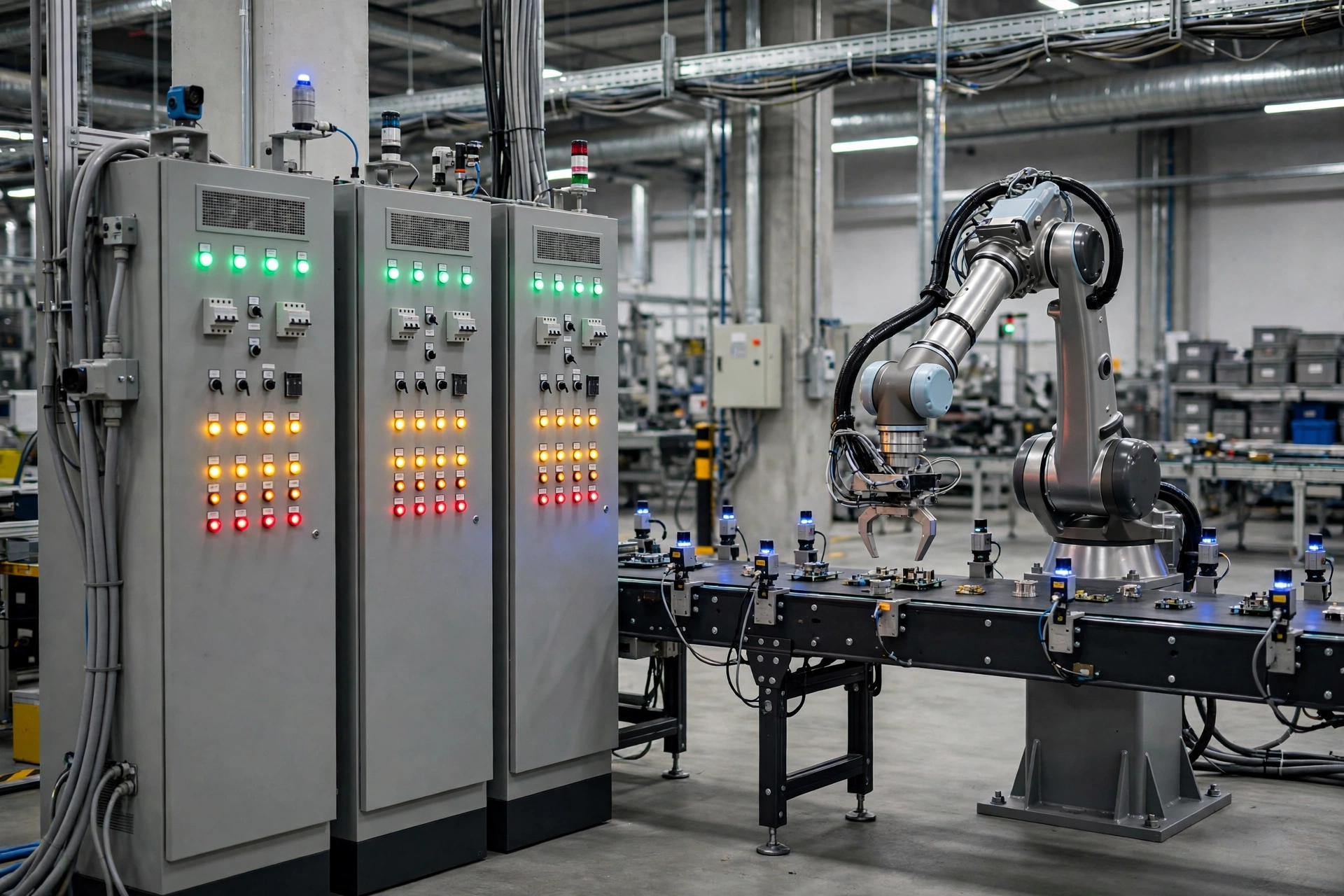
Automation tooling equipment applications is a broad term for a simple idea: the physical hardware and software that lets a factory step run itself. Rockwell Automation defines industrial automation as the use of devices and software that automate traditional manual tasks, with sensors and control systems monitoring and controlling machinery with little or no human intervention. Within that, “tooling” usually means the job-specific hardware that touches the product — grippers, fixtures, jigs, weld guns, and dispensing heads — while “equipment” means the machines that move, decide, and control: robots, controllers, conveyors, and drives.
The distinction matters when you buy. A robot arm is equipment; the gripper bolted to its wrist is tooling, and it is the tooling that decides whether the same arm can handle a fragile circuit board on Monday and a steel bracket on Tuesday. If you are scoping a first project, our guide to industrial automation design services explains how engineers turn a manual step into an automated cell.
Types of automation tooling and equipment
Almost every automated cell is built from the same groups of parts, combined differently for each job. The table below covers the main ones.
| Type | What it does | Typical application |
|---|---|---|
| Industrial robots | Repeat programmed movements precisely | Welding, assembly, palletising |
| Collaborative robots (cobots) | Work beside people with built-in safety limits | Small-batch assembly, machine tending |
| PLCs and controllers | Run the sequence: read inputs, fire outputs | Machine control, line coordination |
| Sensors and machine vision | Measure position, temperature, pressure, or defects | Inspection, sorting, quality checks |
| Actuators and drives | Turn signals into motion or force | Motors, valves, pneumatic cylinders |
| Tooling and end-of-arm parts | Grip, hold, weld, or dispense on the product | Grippers, fixtures, weld guns |
| Conveyors and handling | Move parts between stations | Packaging lines, warehouses |
| HMI, SCADA, and MES software | Show status, log data, and schedule work | Plant monitoring, traceability |
Sensors are the cell’s senses: a proximity sensor confirms a part is present, a vision camera checks a label, and a force sensor stops a gripper from crushing a delicate item. The programmable logic controller (PLC) is the decision-maker, running the programmed sequence and its safety interlocks. Actuators do the physical work, and the software layer — operator screens (HMI), plant-wide supervision (SCADA), and production scheduling (MES) — is what turns one machine into a connected line.
Where automation tooling equipment applications are growing
Demand for this equipment is still rising. The International Federation of Robotics (IFR) reported that factories installed a record 603,000 industrial robots in 2025, up 11% on the year, taking the global operating stock past 5 million units to 5.079 million. China remained by far the largest market with 354,000 installations, about 59% of the world total, while the United States grew 12% to become the second-largest market. Collaborative robots reached 66,000 new installations, 11% of all industrial robots installed.
By industry, electronics and automotive installations each grew 10%, and the metal and machinery sector grew 22%. The IFR expects installations to rise again to 655,000 units in 2026. The pattern behind those numbers is practical: the strongest growth sits where volumes are high or labour is scarce — car body welding, electronics assembly, food packaging, metalworking, and warehouse picking. For the connected side of these lines, see our explainer on IoT-enabled industrial automation.
Automation tooling vs fixed machinery: which fits which job?
Fixed, dedicated machinery does one job at very high speed and is hard to change; programmable equipment such as a robot cell or CNC machine is reprogrammed and retooled between batches; flexible automation switches between product variants with little downtime. Choose fixed machinery when one product will run unchanged for years at huge volume. Choose programmable or flexible tooling when products change, batches are smaller, or you need the same line to handle several variants. The deciding question is changeover: if retooling takes a day, flexibility is theoretical; if a gripper swap and a recipe change take minutes, it is real. Our overview of automation machinery manufacturing compares these approaches in more depth.
What does automation tooling equipment cost?
There is no single price for automation tooling equipment, because the hardware is only part of the bill. Budget for five buckets: the equipment itself (robot, controller, sensors), the tooling (grippers, fixtures, vision setup), integration and programming (getting the cell to run reliably with your existing line), safety (guarding, light curtains, risk assessment), and ongoing costs (maintenance, spares, software, and staff training). Integration and tooling often rival the headline hardware cost, and changeover tooling is a recurring cost whenever products change. The cheapest honest way to start is a single pilot cell on one bottleneck step, measured against a clear target such as defects, throughput, or overtime hours, before committing to a full line.
What you need before you automate
Automation rewards a stable process and punishes a messy one, so four prerequisites come first. First, a process that already works manually — automating an unstable step just produces defects faster. Second, real numbers: volumes, product variants, cycle times, and defect rates, so the cell can be sized correctly. Third, a safety assessment covering how people interact with the equipment, including cobot speed and force limits where humans work nearby. Fourth, basics that are easy to forget: power, compressed air, network connectivity for data collection, floor space for guarding, and someone trained to maintain the cell. Suppliers can fill gaps, but they cannot fix a process nobody has measured.
Risks and limits to watch
The main risks are over-automation, integration trouble, and neglect after installation. Automating a step with frequent product changes or fragile parts can cost more in retooling than it saves in labour. Connected cells also add cybersecurity exposure: a networked controller or camera is a computer on the factory network and needs the same patching and access controls as any other. Vendor lock-in is another trap — proprietary tooling or software can make later changes expensive, so prefer standard interfaces where possible. Finally, an automated cell still needs maintenance: sensors drift, grippers wear, and software needs updates. A cell nobody owns will quietly degrade until it stops.
Analysis: buy the tooling for the changeover, not the demo
Analysis: The IFR numbers point to the real buying lesson. Cobots are now 11% of new industrial robots, and the fastest industry growth came from metal and machinery — both signs that automation is spreading beyond giant car plants into smaller, higher-mix shops. In that world, the winning purchase is rarely the fastest robot; it is the tooling package that changes over quickly, the gripper set that covers the next three products, and the software that a plant’s own technicians can adjust. Judge any automation proposal by its worst day — a product change at short notice — not by its demo video.
Frequently asked questions
What is automation tooling?
Automation tooling is the job-specific hardware that lets automated equipment handle a product: grippers, fixtures, jigs, weld guns, and dispensing heads. The robot or machine is the equipment; the tooling is what adapts it to a particular part, and changing the tooling is often how a cell switches from one product to another.
What equipment is used most in automation tooling applications?
The most common equipment is industrial robots, programmable logic controllers (PLCs), sensors and machine vision cameras, actuators and motor drives, conveyors, and HMI, SCADA, or MES software. Most cells combine several of these: sensors measure, the PLC decides, actuators move, and software monitors and records the work.
Which industries use automation tooling equipment the most?
Automotive, electronics, metal and machinery, food and beverage, pharmaceuticals, and warehousing are the heaviest users. The International Federation of Robotics reported that electronics and automotive robot installations each grew 10% in 2025, while metal and machinery grew 22%, reflecting strong demand across both high-volume and high-mix manufacturing.
How much does automation tooling equipment cost?
Costs vary too widely for a single figure, since they depend on the equipment, custom tooling, integration and programming, safety systems, and ongoing maintenance. As a rule, budget for integration and tooling on top of the hardware price, and start with a pilot cell on one bottleneck step so the return is measured before a full line is funded.
Is automation tooling only for large factories?
No. Collaborative robots, modular conveyors, and off-the-shelf grippers and vision kits have lowered the entry point for smaller plants. The IFR’s 2025 data shows cobots at 11% of new industrial robot installations, a sign of adoption in smaller and higher-mix operations, though a stable process and realistic volumes still matter more than factory size.
Sources
- International Federation of Robotics — President’s Report by Jane Heffner (September 24, 2026)
- The Robot Report — 5 million robots are now at work in factories worldwide, reports the IFR (September 24, 2026)
- Rockwell Automation — Industrial Automation and Control Systems