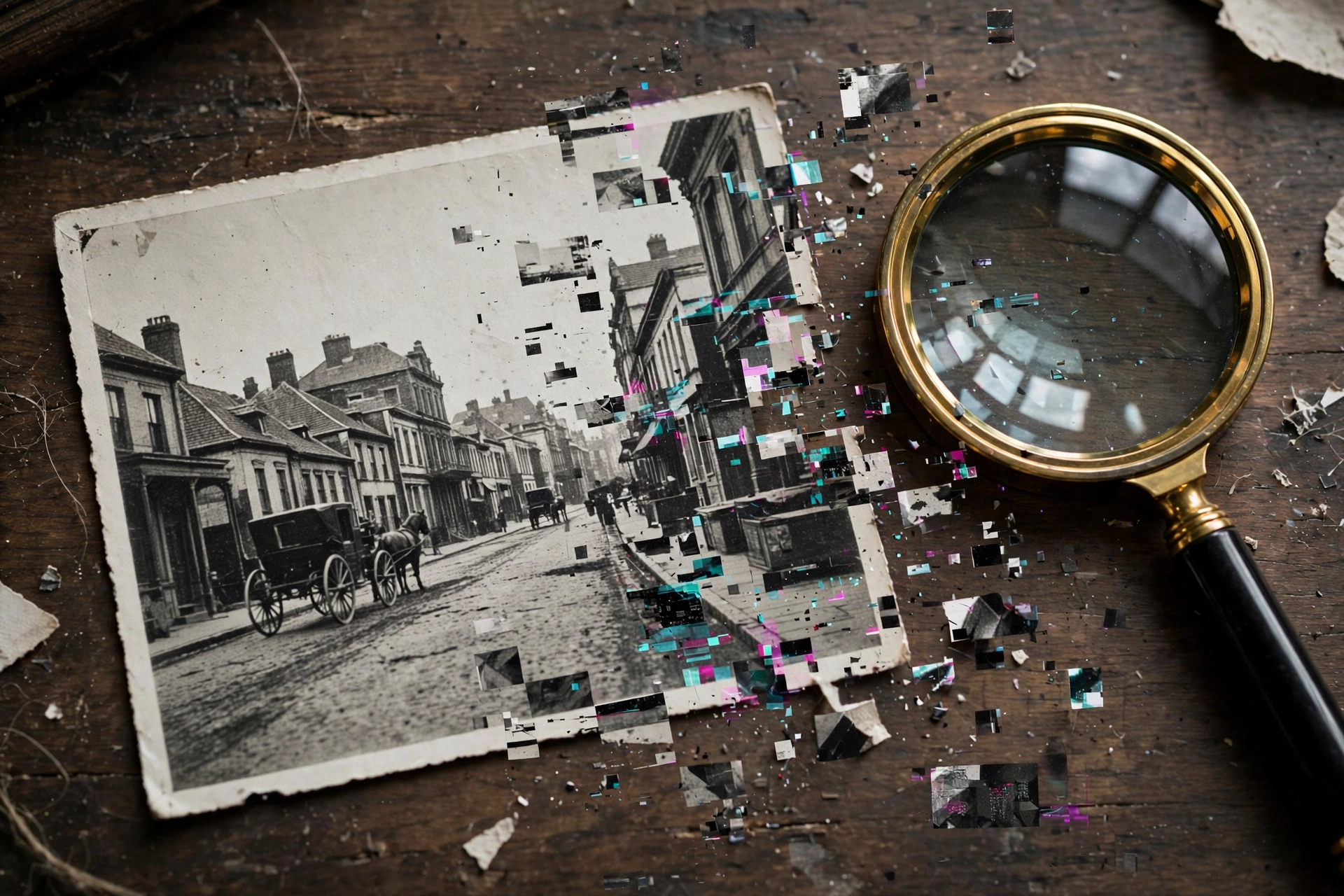
AI Generated Historical Photos Explained: Real History or Convincing Fake?
Key takeaway: AI generated historical photos are synthetic images made to look like old photographs, not recovered archive pictures. They can show events that were never photographed, or never happened at all. Before you trust or share one, check its source, look for provenance signals, and treat a missing label as inconclusive, not as proof that the photo is real.
Scroll through social media and you may meet a striking black-and-white “photograph” of an event you half-remember from a history book. The uniforms look right, the film grain looks right, and the caption sounds confident. But AI generated historical photos are often invented from scratch: a text prompt, not a camera, produced the scene. That distinction matters, because a photo still carries a special authority in most people’s minds — we treat it as evidence, even when it is only an illustration.
What are AI generated historical photos?
AI generated historical photos are images created or heavily altered by generative AI tools to resemble photographs from the past. Some imitate a specific era’s film stock, clothing, and architecture. Others take a real old photograph and change it: colorizing it, sharpening faces, or filling in damaged areas. The first kind invents a scene; the second kind edits a real record. Both can mislead if they are shared without a clear label.
The problem is not new, but the quality is. Fabricated images have circulated claiming to show events such as the atomic bombing of Hiroshima in 1945 and the Soviet invasion of Prague in 1968, according to AFP reporting on fake AI history photos. Artists interviewed in that report warned that such images risk distorting how people understand history, because they often focus on events that were poorly documented or never photographed at all.
Why fake history photos spread so easily
Three things work in their favour. First, most viewers do not check an image before sharing it; a dramatic picture travels faster than a correction. Second, old photographs are hard to verify from memory alone — few people know what a 1940s uniform, camera, or street scene should look like in detail. Third, AI tools have improved so much that the old visual giveaways, such as extra fingers or garbled text, are no longer reliable. Experts quoted by AFP said they could still spot many fakes for now, but judged it only a matter of time before that stops being true.
This is also why AI answers and search results need the same caution. As we explained in our guide to Google AI Mode and SEO strategy, a cited answer is not automatically a verified one — the source behind the claim still has to be checked.
AI-generated vs colorized vs real archive photos
Not every altered old image is a fake. The table below separates the three cases readers most often confuse.
| Type | What it is | How to treat it |
|---|---|---|
| Fully AI-generated | A synthetic scene invented by an AI model | Illustration only; never evidence of an event |
| AI-colorized or restored | A real photograph with added colour or repaired damage | Useful, but colours and filled-in details are estimates, not facts |
| Real archive photograph | A photograph taken at the time, held by an archive or agency | Check the archive, date, and caption before citing it |
The middle row deserves care. AI can estimate colours from pixels and learned patterns, but it cannot prove what colour a uniform or a building actually was. Guides on verifying colorized images stress that uncertain hues should be labelled as approximations and the original black-and-white scan kept alongside the colour version, as explained in this verification guide for AI-colorized historical images. Some archives have gone further: the Digital Jewish Monument now refuses new AI-modified photographs, preferring the authentic original, as stated on its colorized photographs policy page.
How to check a historical photo in 4 steps
1. Ask who posted it first. A named archive, museum, news agency, or the photographer’s estate is a strong start. An anonymous account posting a “never-before-seen” image is a warning sign.
2. Reverse-image search it. Search by image in Google Lens or another reverse-image tool. A real archive photo usually has an earlier trail; a synthetic image often appears only in recent reposts, or in a fact-check that already debunked it.
3. Check for provenance signals. Look for platform “AI info” labels, then check the file itself at the official Content Credentials verify page, which reads C2PA metadata recording the creating tool and edit history. Google’s SynthID watermark, embedded invisibly in pixels, can also survive screenshots and re-saves where metadata is stripped. OpenAI announced in May 2026 that it was joining the C2PA steering committee and adding SynthID to supported generated images, as reported in this report on OpenAI’s C2PA and SynthID adoption.
4. Check the history, not just the pixels. Do the uniforms, vehicles, signs, and architecture fit the claimed year and place? An anachronism — the wrong technology, the wrong flag, a building completed years later — is often more decisive than any pixel-level clue.
What does it cost to verify or restore a historical photo?
Checking a historical photo costs nothing in money: reverse-image search, platform AI labels, and the Content Credentials verify page are free. Professional help is a different matter. Published 2026 market ranges put simple AI-assisted or manual colorization at roughly $20–$150 per image, with researched publication work higher, according to this 2026 colorization verification guide. Those are market ranges, not regulated prices, and they buy careful review and documentation — not a guarantee that a guessed colour is historically correct.
What you need before you share a historical photo
Before you share a historical photo, you need three things: a credible original source, a label that says whether the image is real, colorized, or AI-generated, and a caption that does not claim more than the evidence supports. If any of the three is missing, do not present the image as a historical record. Sharing it as “an AI recreation” or “an artist’s impression” is honest; sharing it unlabelled as a photograph is not.
Risks and limits: what checks cannot prove
No single check proves an image is real. C2PA metadata can be stripped when a file is screenshotted or re-encoded, and not every AI tool attaches it. Detectors can misfire on low-resolution or heavily compressed images. And a clean provenance record only covers the file you checked — a re-uploaded copy may have a different history. The safe rule is therefore a negative one: a missing label or a missing archive trail never proves authenticity, it only means the image is unverified.
Analysis: why this matters beyond one viral image
Analysis, not verified fact: the deeper risk is cumulative. Each unlabelled synthetic “historical” photo slightly lowers trust in real photographs, and each correction that arrives too late teaches audiences to doubt the next genuine archive image too. Labels, provenance standards, and the habit of checking before sharing are not just etiquette — they are the infrastructure that keeps photographic evidence usable. Sites that want to be cited by AI answers, as discussed in our emerging technology trends guide, will increasingly be judged on exactly this kind of verifiable sourcing.
Frequently asked questions
Are AI generated historical photos always fake?
No. An AI generated historical photo can be a legitimate illustration, a teaching aid, or an artistic recreation — but only when it is clearly labelled as such. It becomes misleading when it is presented, captioned, or shared as if it were a genuine photograph of a real event.
Can AI colorization prove what colours a historical scene had?
No. AI colorization estimates colours from patterns in the image and its training data; it cannot recover colours that were never recorded. Uncertain colours should be described as approximations, and the original black-and-white photograph should be kept and shown alongside the colorized version.
How can I tell if a historical photo is AI-generated?
Start with the source and a reverse-image search, then check for platform AI labels and C2PA Content Credentials. Visual clues such as warped hands, garbled text, or inconsistent lighting can help, but they are no longer reliable on their own because newer models have fixed many of them.
What is C2PA and SynthID?
C2PA Content Credentials are metadata attached to a file that record which tool created it and how it was edited; they can be stripped by screenshots or re-encoding. SynthID is an invisible watermark embedded in the pixels that is designed to survive common edits such as resizing and compression. Together they give a stronger provenance signal than either one alone.
Should I share an AI historical photo if I am not sure it is real?
No, not as a historical photograph. If you want to discuss it, share it with a clear label such as “unverified” or “AI-generated illustration” and explain what is uncertain. Do not let an ambiguous image stand as evidence of an event.
Sources
- AFP via TechXplore — Fake AI history photos cloud the past
- Mathrubhumi — Are AI-generated photos distorting our understanding of historical events?
- PhotographyTalk — How to tell if an image is AI generated in 2026
- LetsDataScience — OpenAI adopts C2PA and SynthID for image verification
- ColorizeThis — Verifying AI-colorized historical images
- Digital Jewish Monument — Colorized and enhanced photographs policy
Note: the featured image for this article is an AI-generated illustration of a vintage-style photograph under a magnifying glass. It is not a historical photograph.