Automation Machinery Manufacturing: What It Is, How It Works, and Where It Pays Off
Key takeaway: Automation machinery manufacturing means building and using machines that run production tasks with little human help. Sensors collect data, controllers make decisions, and robots or actuators do the physical work. The result is faster, more consistent production — but only when the task is repetitive, precise, or high-volume enough to justify the cost.
What Is Automation Machinery Manufacturing?
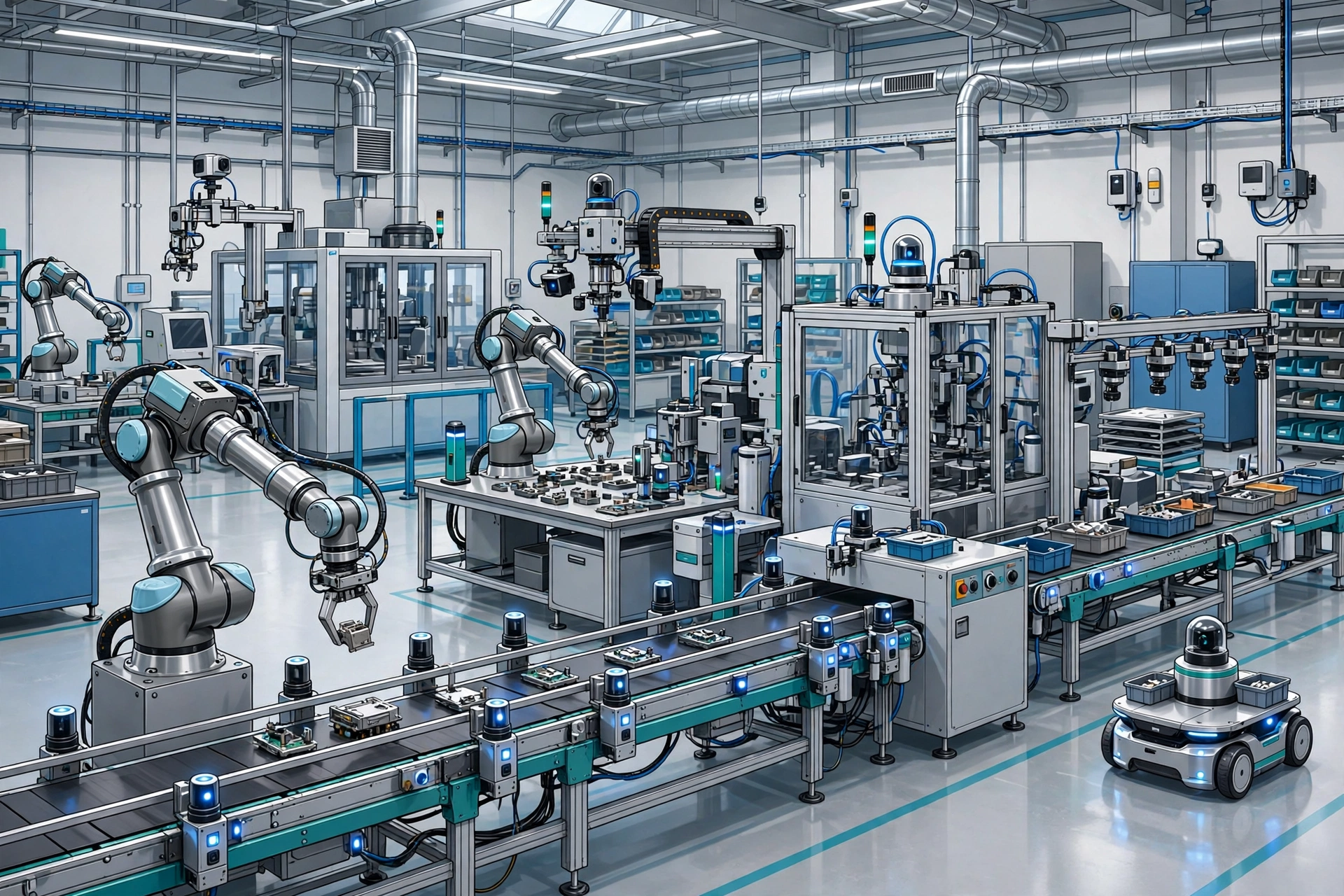
Automation machinery manufacturing covers two connected ideas. First, it is the industry that designs and builds automated machines: robotic arms, CNC machines, conveyor systems, packaging lines, and inspection equipment. Second, it is the way factories use those machines to make products with less manual intervention at each step.
In plain terms, a human still designs the product, sets up the line, and checks the output. The machine carries out the routine actions: cutting material, moving parts between stations, tightening fasteners, measuring dimensions, or sorting finished goods. That division of labour is the whole point. People handle judgment and exceptions; machines handle repetition and precision.
This matters because modern manufacturing competes on consistency as much as on price. A part that is a fraction of a millimetre off can fail inspection, jam an assembly line, or reach a customer as a defect. Automated systems, guided by sensors and feedback loops, can catch that drift far faster than a person watching a line.
How Automation Machinery Works
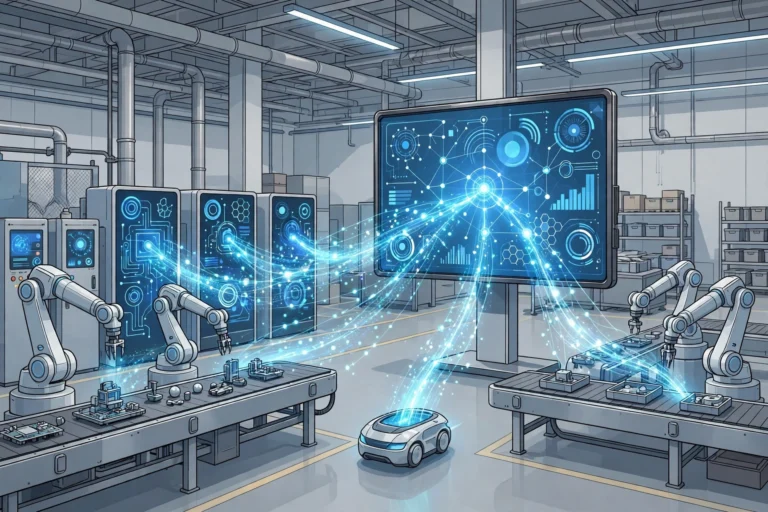
Most automated manufacturing systems follow the same loop: sense, decide, act. Sensors measure position, temperature, pressure, speed, or part quality. A controller — often a programmable logic controller (PLC) or an industrial computer — processes that information against programmed logic. Actuators then perform the physical action: a motor moves, a valve opens, a robotic arm picks up a part.
Supervisory systems sit above that loop. SCADA (supervisory control and data acquisition) software lets operators monitor a whole line, see alarms, and review production data. MES (manufacturing execution systems) track orders, materials, and quality records across the factory. Together, they turn a collection of machines into one coordinated operation rather than a set of isolated tools.
Feedback is what makes the system genuinely useful. If a sensor reports a part slightly out of tolerance, the controller can adjust the machine in real time instead of waiting for a human inspection at the end of the shift. That is why automation is so effective for repeatable work and quality control, and why it also supports predictive maintenance: machines that report their own vibration, temperature, or wear give engineers a warning before a breakdown stops production.
The Main Types of Automation Machinery
Manufacturing automation is usually grouped into three classic types, plus a fourth, integrated form that connects them all. The right choice depends on product variety and production volume — a point stressed in the standard manufacturing-engineering framework for automation production systems.
| Type | How it works | Best for |
|---|---|---|
| Fixed automation | Specialised equipment built for one set of tasks | High-volume, standardised products such as bottling or automotive assembly |
| Programmable automation | Machinery reprogrammed between batches | Medium-volume batch production with product variations |
| Flexible automation | Systems reconfigured quickly with little downtime | Low-volume, high-variety production |
| Integrated automation | Machines, sensors, and software linked into one operation | Smart factories and connected production environments |
Fixed automation is the most efficient for a single product but the least adaptable: changing the product often means changing the equipment. Programmable automation trades some speed for flexibility, accepting reprogramming downtime between batches. Flexible automation goes further, using advanced robotics and software to switch products with minimal downtime. Integrated automation is less a machine type than an architecture — it links the other types through shared data, so a change in one part of the line is visible everywhere else.
For a closer look at how factories choose between these approaches, see our guides to high-speed automation machines and industrial automation project management.
Where Automation Machinery Pays Off — and Where It Does Not
Automation pays off most clearly in three situations: high-volume production, dangerous or repetitive work, and tasks that demand precision a human cannot sustain shift after shift. Automotive assembly, electronics manufacturing, food packaging, and pharmaceutical production all fit that pattern, which is why they were early adopters.
The market reflects that breadth. Research and Markets, reported by GlobeNewswire in January 2026, put the industrial automation and control systems market at $231.3 billion in 2025, rising to an expected $257.73 billion in 2026, driven by programmable logic controllers, SCADA systems, and rising industrial robotics demand. That growth is not just about buying robots; it is about smart-manufacturing investment, real-time monitoring, and predictive maintenance.
But automation is not automatically the right answer. Setup cost, programming, maintenance, and workforce training are real expenses, and a simple hand process can be cheaper for a one-off job. The honest test is straightforward: is the task repetitive, precise, dangerous, or high-volume enough that a machine does it better, more safely, or more cheaply over its lifetime? If the answer is no, manual work — or a simpler, semi-automated step — may be the better choice. Our explainer on electronics manufacturing automation shows how that trade-off plays out in a sector where precision matters most.
Analysis: What to Watch Next
Analysis — not a verified fact: the next shift in automation machinery manufacturing looks less like faster robots and more like smarter connections. AI-assisted quality inspection, digital twins that simulate a line before it is built, and energy optimisation are already appearing in vendor roadmaps, and the market data above points the same way: growth is being driven by monitoring and analytics, not just by mechanical speed.
That does not mean every factory needs an AI upgrade tomorrow. It does mean buyers should ask a new question when they evaluate machinery: not only “how fast does it run?” but “what data does it produce, and can that data feed maintenance, quality, and planning?” Machines that answer the second question well are the ones most likely to stay useful as production changes.
For readers weighing a purchase or a career move into this field, the practical angle is simple. Understand the sense-decide-act loop, learn which automation type fits your volume and variety, and judge any system on its lifetime cost — including maintenance and training — not just its headline speed.
Frequently Asked Questions
What is automation machinery manufacturing?
It is the design, building, and use of machines that run manufacturing tasks with little human help, such as robotic arms, CNC machines, conveyors, and inspection systems.
How does automation machinery work?
Sensors collect data about the process, a controller such as a PLC processes it against programmed logic, and actuators carry out the physical action, while SCADA and MES software monitor and coordinate the whole line.
What are the main types of manufacturing automation?
The classic types are fixed automation for high-volume standard products, programmable automation for batch production, and flexible automation for low-volume high-variety work, plus integrated automation that links systems into one connected operation.
When is automation machinery worth the investment?
It is usually worth it for high-volume, repetitive, dangerous, or highly precise work, where consistency and uptime outweigh setup, programming, and maintenance costs over the machine’s lifetime.
Is automation machinery only for large factories?
No. Smaller manufacturers increasingly use programmable and flexible systems, including collaborative robots, for batch work, though the business case still depends on volume, precision, and how often the product changes.
Sources
Luvina — What Is Factory Automation? Complete Beginner’s Guide; GlobeNewswire / Research and Markets — Industrial Automation and Control Systems Industry Research, January 2026; Fiveable — Automated Manufacturing Processes.