
Commercial Automation Services: What They Are and How to Choose One
Key takeaway: Commercial automation services are professional services that design, install, integrate, and maintain automated systems for businesses — spanning smart-building controls (HVAC, lighting, security, energy) and business-process automation (workflows, document processing, AI agents). With the services segment of building automation growing fastest at a projected 13.4% annual rate, providers are shifting from selling hardware to selling outcomes.
Commercial automation services are the professional side of the automation industry: the consultants, integrators, and managed-service providers that help commercial buildings and companies automate their operations. They assess your needs, design the system, connect it to what you already have, and keep it running — covering everything from smart-building controls to AI-driven workflow automation.
What commercial automation services actually cover
The label is broad, and that causes confusion. In practice, a commercial automation services provider works in some combination of these areas:
- Building systems automation. Design and integration of building management systems that control HVAC, lighting and shading, security and access, fire and life safety, and energy use. Mordor Intelligence defines the US market around these systems, with services split into consulting, integration, and maintenance.
- Business process automation. Automating workflows — approvals, data entry, invoice processing, onboarding — with RPA, document processing, and AI agents. Everest Group describes this segment shifting from rules-based automation to “agentic,” outcome-driven automation combining RPA, process mining, conversational AI, and generative AI.
- Managed automation (automation as a service). Running automation for you on subscription, with no big upfront infrastructure. Industry research projects this market growing from $4.28 billion in 2025 to $12.66 billion by 2031 — a 19.8% annual rate.
The two main branches of commercial automation services
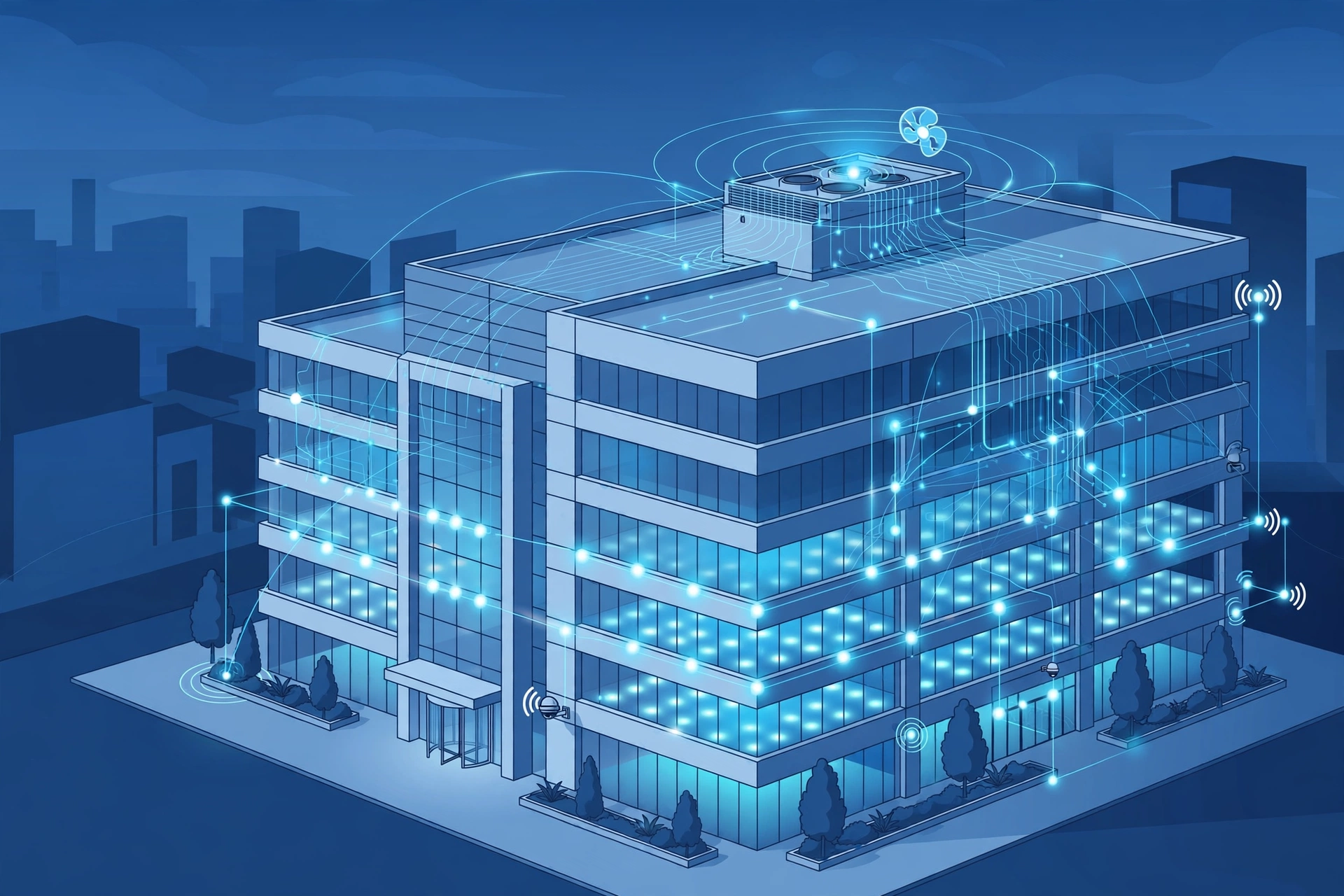
Building automation services handle the physical plant: sensors, controllers, and software platforms for offices, hospitals, retail spaces, and data centers. The 2026 trends are integrated multi-system platforms (one dashboard for HVAC, lighting, and security), remote monitoring, and predictive maintenance, per a 2026 Research and Markets report. Established providers include Honeywell, Siemens, Schneider Electric, Johnson Controls, and ABB.
Process automation services handle digital work: mapping and automating workflows with RPA, document processing, and AI agents, typically delivered by consultants integrating platforms like UiPath, Microsoft, or ServiceNow. The two branches increasingly overlap as AI-based building optimization and agentic workflow tools mature.
The commercial automation services market in 2026
Several independent estimates put the scale of the opportunity:
- MarketsandMarkets puts the intelligent building automation technologies market at $122.49 billion in 2026, rising to $191.14 billion by 2030 (11.8% CAGR) — with the services segment growing fastest at 13.4%, and commercial buildings accounting for 46.2% of the market in 2026.
- A Research and Markets report estimates the building automation system market at $124.73 billion in 2026, up 12.6% from 2025, reaching $204.14 billion by 2030.
- Regulation is forcing the issue: the EU’s recast Energy Performance of Buildings Directive obliges non-residential buildings above 290 kW rated output to install building automation and control systems by the end of the decade, while the US Inflation Reduction Act’s Section 179D deduction pays up to $5.81 per square foot for qualifying efficiency retrofits, per Market Research Future.
How to evaluate a commercial automation services provider
Use this checklist before signing anything:
- Scope clarity. Does the proposal cover design, integration, training, and ongoing maintenance — or just installation? The integration and support work is where most projects fail.
- Open standards. For buildings, ask about BACnet and IP-native architectures; proprietary protocols lock you to one vendor. Open protocols are becoming the specification standard in major projects, according to a September 2026 market report.
- Legacy compatibility. Most facilities run a mix of old and new equipment. Ask for specific examples of integrations with your existing systems — this is the most commonly cited barrier to automation projects.
- Outcome-based pricing. Leading providers increasingly tie fees to measured outcomes (energy saved, hours reduced) rather than hours billed. Get the baseline and the measurement method in writing.
- Cybersecurity. Connected building systems and workflow automations are attack surfaces. Ask how the provider segments networks and handles data security.
Analysis (our read): the big shift in commercial automation services is from one-off hardware projects to ongoing intelligence contracts — vendors becoming the IT department for your building and back office. That makes vendor choice more important than product choice.
Frequently asked questions
What do commercial automation services include?
They cover consulting, system design, installation and integration, and ongoing maintenance for automation in commercial settings. This spans building automation services (HVAC, lighting, security, energy controls) and business process automation services (workflow automation, RPA, AI agents), plus managed automation delivered as a subscription.
How much does commercial building automation cost?
Costs vary widely by building size and scope, but the market signals strong ROI pressure: falling sensor costs and regulatory incentives such as the US Section 179D deduction of up to $5.81 per square foot for efficiency retrofits are pushing automation from discretionary upgrade to compliance requirement. Get multiple quotes with outcome-based pricing terms.
Who are the main commercial automation service providers?
In building automation, established providers include Honeywell, Siemens, Schneider Electric, Johnson Controls, ABB, Delta Controls, and Trane. In process automation, key platforms include Microsoft, UiPath, Automation Anywhere, ServiceNow, and Appian, typically delivered through consulting and implementation partners.
Is commercial automation worth it for small businesses?
Often yes, if you start narrow. Cloud-based building controls and automation-as-a-service subscriptions lower the entry cost — no on-premise infrastructure needed. Target one high-payoff use case first, such as energy optimization or invoice processing, then expand.
Sources
- MarketsandMarkets via ADVFN — Intelligent Building Automation Technologies Market (Feb 2026)
- Research and Markets via GlobeNewswire — Building Automation System Research Report 2026
- Mordor Intelligence — US Commercial Building Automation Market
- Everest Group — Agentic Process Automation State of the Market 2026
- Market Research Future via EINPresswire — Building Automation System Market (Aug 2026)
- GlobeNewswire — Automation as a Service Industry Research 2026
- Market Minds Advisory via GlobeNewswire — Building Automation System Market (Sep 2026)

One Comment
Comments are closed.