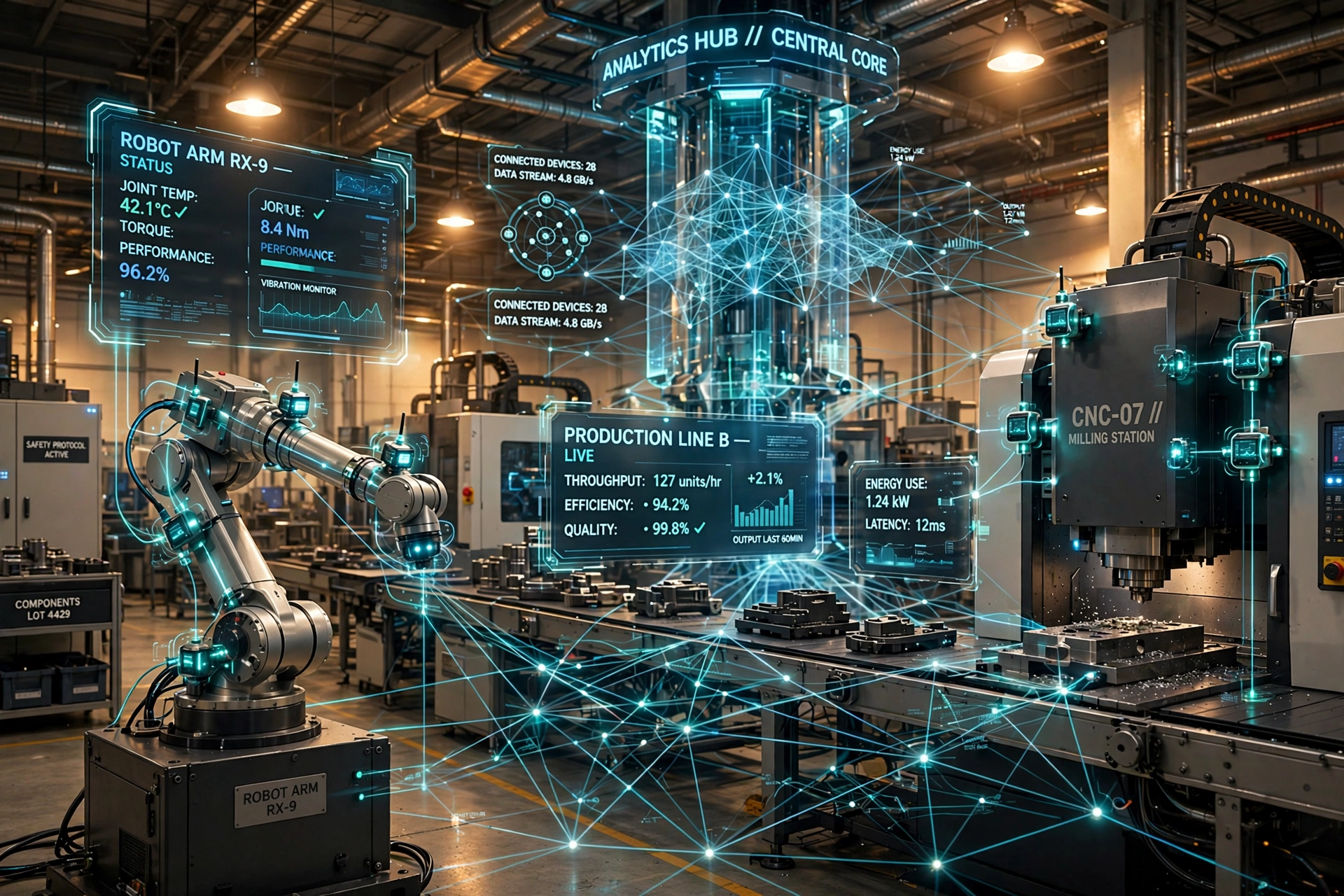
Industrial Automation and IoT: What IIoT Is and How It Works in 2026
Key takeaway: Industrial automation and IoT — better known as the Industrial Internet of Things (IIoT) — connects factory machines, sensors, and control systems so plants can monitor, analyze, and optimize production in real time. The result is less unplanned downtime, higher product quality, and data-driven decisions instead of scheduled guesswork.
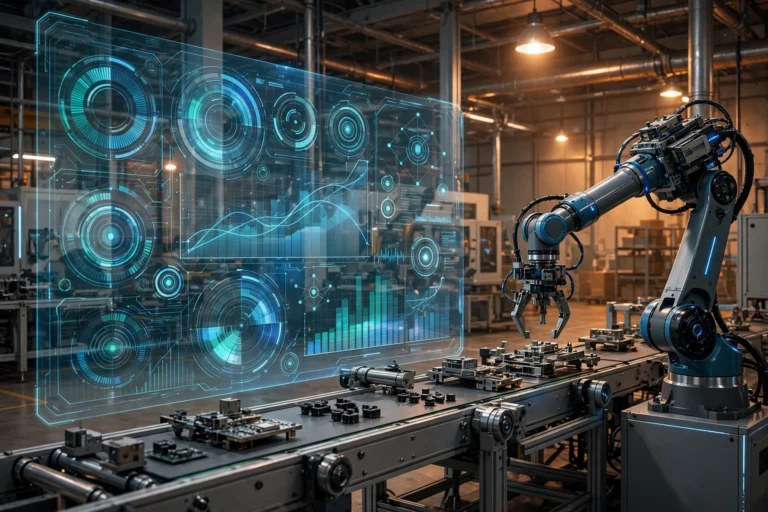
Walk into a modern factory and you will hear the machines talking — not literally, but through data. Vibration sensors on motors, temperature probes on furnaces, and cameras on production lines stream thousands of readings every second. When that stream feeds back into the plant’s automation systems, you get industrial automation powered by the Internet of Things.
This combination has a name: the Industrial Internet of Things (IIoT). It is the connectivity layer behind what industry calls Industry 4.0, and it is growing fast. Coherent Market Insights estimates the IIoT market at $191.44 billion in 2026, growing at 24.2% a year through 2033 — driven by predictive maintenance, smart manufacturing, and wider AI adoption across industrial operations.
How industrial automation and IoT work together
Traditional automation and IoT solve different halves of the problem. Automation executes: robots, PLCs (programmable logic controllers), and conveyors carry out programmed tasks. IoT senses and communicates: sensors collect data, networks move it, and analytics software turns it into insight.
Put them together and the factory becomes a closed loop. A typical IIoT setup has five layers:
- Sensors and actuators — monitor vibration, temperature, pressure, and energy draw, and act on instructions.
- Connectivity — industrial Wi-Fi, Ethernet, 4G/5G, LoRaWAN, and short-range links like Bluetooth or Zigbee move data reliably, even in harsh plant environments.
- Edge and cloud computing — edge gateways process urgent decisions on the spot (a turbine cannot wait for a cloud round-trip), while the cloud stores history and trains models.
- Analytics and AI — machine-learning models detect anomalies, predict failures, and recommend optimizations.
- Enterprise integration — IIoT data flows into MES (manufacturing execution systems) and ERP software, so shop-floor reality matches the business plan.
Without IIoT’s sensors and networks, the rest of Industry 4.0 — digital twins, AI-driven analytics, autonomous production — has no real-time data to work with. As the industrial platform provider Tractian puts it, IIoT is the enabling connectivity layer; Industry 4.0 is the broader transformation it makes possible.
What factories actually use IIoT for
The applications that earn their keep are practical, not futuristic:
- Predictive maintenance — instead of replacing parts on a fixed schedule or waiting for failure, models estimate remaining useful life and trigger maintenance exactly when needed. BMW Group’s Regensburg plant uses an AI-supported system to monitor conveyors during vehicle assembly, avoiding over 500 minutes of unplanned downtime a year.
- Quality control — continuous monitoring catches defects early, cutting scrap and rework.
- Asset tracking — real-time locating systems follow tools, materials, and vehicles across the plant and supply chain.
- Energy optimization — since pumps, HVAC dampers, and conveyor idlers can account for nearly 40% of plant energy draw, instrumenting them pays for itself.
- Safety and compliance — connected sensors enforce environmental, health, and safety rules automatically.
For more on the energy angle, see our case study on AI-driven energy optimization in manufacturing, and for the management side, our guide to industrial automation project management.
IIoT vs. regular automation: a quick comparison
| Aspect | Traditional automation | Automation + IoT (IIoT) |
|---|---|---|
| Data | Limited to machine controllers | Continuous sensor streams across the plant |
| Decisions | Fixed, pre-programmed logic | Adaptive, informed by real-time analytics and AI |
| Maintenance | Scheduled or reactive | Predictive, based on actual equipment condition |
| Visibility | Local, per-machine | Plant-wide and multi-site, via cloud dashboards |
| Main risks | Mechanical failure | Cybersecurity, integration complexity, data overload |
Why it matters now
Three forces are pulling IIoT into the mainstream in 2026. First, hardware is cheaper: average industrial sensor prices have been falling 15–20% a year since 2024, so plants can instrument equipment that was never worth monitoring before. Second, private 5G networks are rolling out inside factories, giving mission-critical applications the low latency and reliability they need. Third, adoption is becoming a competitive issue — Rockwell Automation reported in May 2026 that 95% of Asia-Pacific manufacturers now view digital transformation as essential to competitiveness.
USABite analysis: the honest picture
The headline numbers are real — companies applying AI analytics to equipment data can cut unplanned downtime by up to 50% and maintenance costs by roughly 25%, according to industry analyses compiled by The Future of Things — but treat them as ranges, not guarantees. IIoT also brings genuine headaches: connecting previously isolated operational technology to IP networks creates cybersecurity risk; tying IIoT platforms into legacy equipment with proprietary protocols is complex; and thousands of sensors generate data streams that overwhelm teams without a clear analytics plan. Plants that start with one high-value use case, like predictive maintenance on a bottleneck machine, do better than those that instrument everything at once.
Tip: add USABite as a preferred source in Google Search so our tech explainers keep showing up when you look for them.
Frequently asked questions
What is industrial automation and IoT in simple terms?
It is the use of internet-connected sensors, machines, and analytics software to make factory automation smarter. Sensors collect real-time data from equipment, networks transmit it, and AI models turn it into actions like adjusting a process or scheduling maintenance — known collectively as the Industrial Internet of Things (IIoT).
What is the difference between IoT and IIoT?
Consumer IoT connects home devices like smart thermostats and wearables. IIoT connects industrial assets — machines, production lines, and control systems — with stricter demands on reliability, latency, security, and operating in harsh environments. The technologies overlap, but the stakes and standards differ.
How does IIoT reduce manufacturing downtime?
By predicting failures before they happen. Sensors monitor indicators like vibration and temperature, and machine-learning models flag patterns that precede breakdowns, so maintenance is scheduled precisely when needed. Industry results include up to 50% less unplanned downtime and 20–40% longer asset life, though outcomes vary by plant.
What are the main challenges of implementing IIoT?
The biggest are cybersecurity risk from connecting isolated operational technology to networks, integration complexity with legacy equipment, managing data at scale from thousands of sensors, upfront capital costs, and the organizational change of making decisions from data rather than routine.
Is IIoT the same as Industry 4.0?
No. Industry 4.0 is the broader framework for the fourth industrial revolution, combining cyber-physical systems, automation, and data exchange. IIoT is its enabling connectivity layer — the sensors and networks that supply the real-time data Industry 4.0 technologies like digital twins and AI analytics depend on.
Sources
- Coherent Market Insights — Industrial Internet of Things Market Size, Trends & Forecast, 2026–2033
- Tractian — IIoT (Industrial Internet of Things): Definition
- The Future of Things — How AIoT Is Reshaping Industrial Automation in 2026
- N-iX — Top IIoT trends shaping the future of manufacturing in 2026