
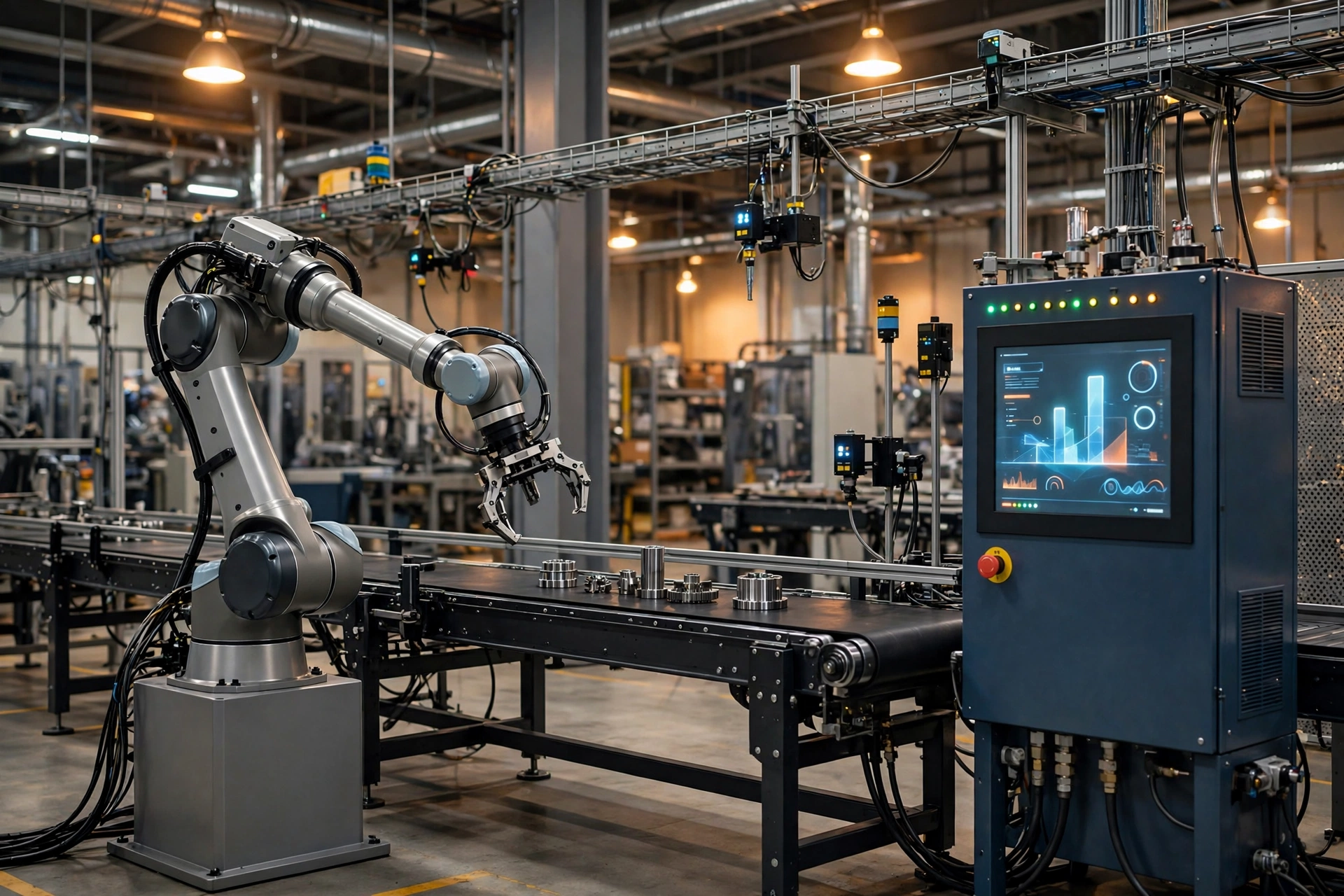
Custom Industrial Automation: What It Is, How It Works, and When It’s Worth It
Key takeaway: Custom industrial automation is the design and build of automation systems — robots, PLCs, sensors, and control software — tailored to one factory’s exact product, process, and constraints, rather than buying standard off-the-shelf equipment. It costs more upfront, but it delivers higher throughput, better quality, and long-term savings for operations that standard automation simply can’t fit.
What custom industrial automation means
Industrial automation is the use of control systems — computers, robotics, sensors, and information technology — to run machinery and processes with minimal human intervention. It replaces manual labor with automated systems to improve efficiency, consistency, and safety (AX Control; Trugem Tech).
Custom industrial automation applies that idea, but with a critical twist: instead of buying a standard, one-size-fits-all system, a manufacturer works with an integrator or engineering team to design automation around its exact needs. As automation builder Nexus Automation puts it, custom automation “streamlines industrial processes” so that “each manufacturing function is tailored to the user’s exact needs,” combining automation process design, skilled engineering, and purpose-built equipment.
In practice, that might mean a robotic cell built to fit a cramped existing line, a vision-inspection setup trained on one product’s unique defects, or a control system that talks to decades-old machinery no modern plug-and-play system supports. The result of switching from manual to custom-automated processes, per Nexus Automation, is “higher-quality production, more extensive yields, and lower manufacturing costs in the long term.”
The building blocks of a custom industrial automation system
Whether standard or custom, industrial automation systems are assembled from the same core components (Trugem Tech):
- Programmable logic controllers (PLCs): rugged digital computers that run the logic for machinery and production lines, reading sensor inputs and sending commands to actuators.
- Robotics: articulated arms, SCARA robots, and collaborative robots (cobots) that handle assembly, welding, packing, and material handling.
- Sensors and actuators: devices that detect conditions (position, temperature, pressure, presence) and carry out physical actions.
- SCADA systems: Supervisory Control and Data Acquisition software that monitors and manages the whole process in real time.
- HMIs: Human-machine interfaces — touchscreens and panels that let operators monitor, control, and override the system.
What makes a system “custom” is not exotic hardware — it’s the engineering: the layout, programming, safety systems, and integration are designed for one operation rather than a catalog. For a deeper look at the robots side of this, see our guide to custom robotics automation.
Custom vs. off-the-shelf automation
The choice isn’t really between “custom” and “standard” as categories — most factories use a mix. But understanding the tradeoffs helps:
| Factor | Custom automation | Off-the-shelf automation |
|---|---|---|
| Fit | Engineered around your exact product, line layout, and constraints | Standard specs; you adapt your process to the machine |
| Upfront cost | Higher — includes design, engineering, and commissioning | Lower — buy, install, run |
| Deployment time | Longer — weeks to months of design and build | Faster — often days to weeks |
| Flexibility | Can be built modular so it adapts to product changes | Limited to what the manufacturer designed for |
| Legacy integration | Can interface with old or unusual equipment | May not connect to proprietary or legacy systems |
| Long-term cost | Lower per unit once running — higher yield, less waste | Can plateau if the fit is imperfect |
Analysis: the pattern across the industry is clear — standard automation wins on speed and upfront price, while custom automation wins when the product, space, or legacy equipment is unusual enough that standard gear forces compromises. That tradeoff is why custom work keeps growing: flexible and modular automation is among the fastest-growing segments in the industry, projected at a 12.5% compound annual growth rate through 2035, according to MarketResearchFuture, and a 13.7% CAGR through 2031 per Mordor Intelligence.
When custom industrial automation is worth the investment
Custom automation is rarely the answer for a small, stable, high-volume job that standard equipment already handles well. It pays off when at least one of these is true:
- Your process is unusual. Oddly shaped parts, tight tolerances, or multi-step handling that no catalog machine was designed for.
- Your floor is constrained. Existing lines, low ceilings, or hazardous zones that standard cells can’t fit into.
- You run many product variants. High-mix production benefits from systems built to be reconfigured, not fixed tooling.
- Legacy equipment must stay. A PLC-and-sensor retrofit designed around 20-year-old machinery is cheaper than replacing the whole line.
- Labor or quality costs are rising. If rework, scrap, or turnover is eating margin, custom automation’s long-term savings justify the engineering spend.
The broader market context supports the trend: the global industrial automation market was valued at roughly $209 billion in 2025 and is projected to grow at an 8.6% annual rate through 2035 (Expert Market Research), with manufacturers increasingly choosing reconfigurable, tailored systems over fixed lines. If you’re planning a project, our industrial automation project management guide covers how to run the implementation side.
FAQ
What is custom industrial automation?
Custom industrial automation is the design and construction of automation systems — robots, PLCs, sensors, conveyors, and control software — engineered for one manufacturer’s specific process, product, and floor layout, rather than bought as standard off-the-shelf equipment. It delivers a tighter fit, higher yields, and lower long-term costs, at the price of a longer, more expensive engineering phase.
How is custom automation different from standard automation?
Standard automation is a catalog product: you buy it, install it, and adapt your process to it. Custom automation reverses that — the system is designed around your process, constraints, and legacy equipment. Custom costs more upfront and takes longer to deploy, but it fits unusual products, tight spaces, and high-mix production that standard machines can’t handle well.
What are the main components of a custom industrial automation system?
The core components are programmable logic controllers (PLCs) that run the control logic, robots for physical tasks, sensors and actuators that read conditions and act on them, SCADA software for real-time monitoring and management, and human-machine interfaces (HMIs) for operator control. What makes a system custom is the engineering that integrates these parts around one specific operation.
How long does a custom automation project take?
Timelines vary widely by scope. A single automated work cell can take a few months from design to commissioning, while full production-line automation can take six months to over a year. The design, engineering, and programming phases — the parts that don’t exist for off-the-shelf equipment — account for most of the difference.
When is custom industrial automation worth the investment?
It pays off when standard equipment forces expensive compromises: unusual parts or tight tolerances, constrained floor space, many product variants, legacy machinery that must be kept, or rising labor, scrap, and rework costs. If none of those apply and a catalog machine fits your process well, off-the-shelf automation is usually the better buy.
Sources
- Nexus Automation — What is Custom Automation?
- Expert Market Research — Industrial Automation Market Size & Forecast
- MarketResearchFuture — Industrial Automation Market Report
- Mordor Intelligence — Industrial Automation Market Analysis
- AX Control — Industrial Automation Defined
- Trugem Tech — What is Industrial Automation?




2 Comments
Comments are closed.