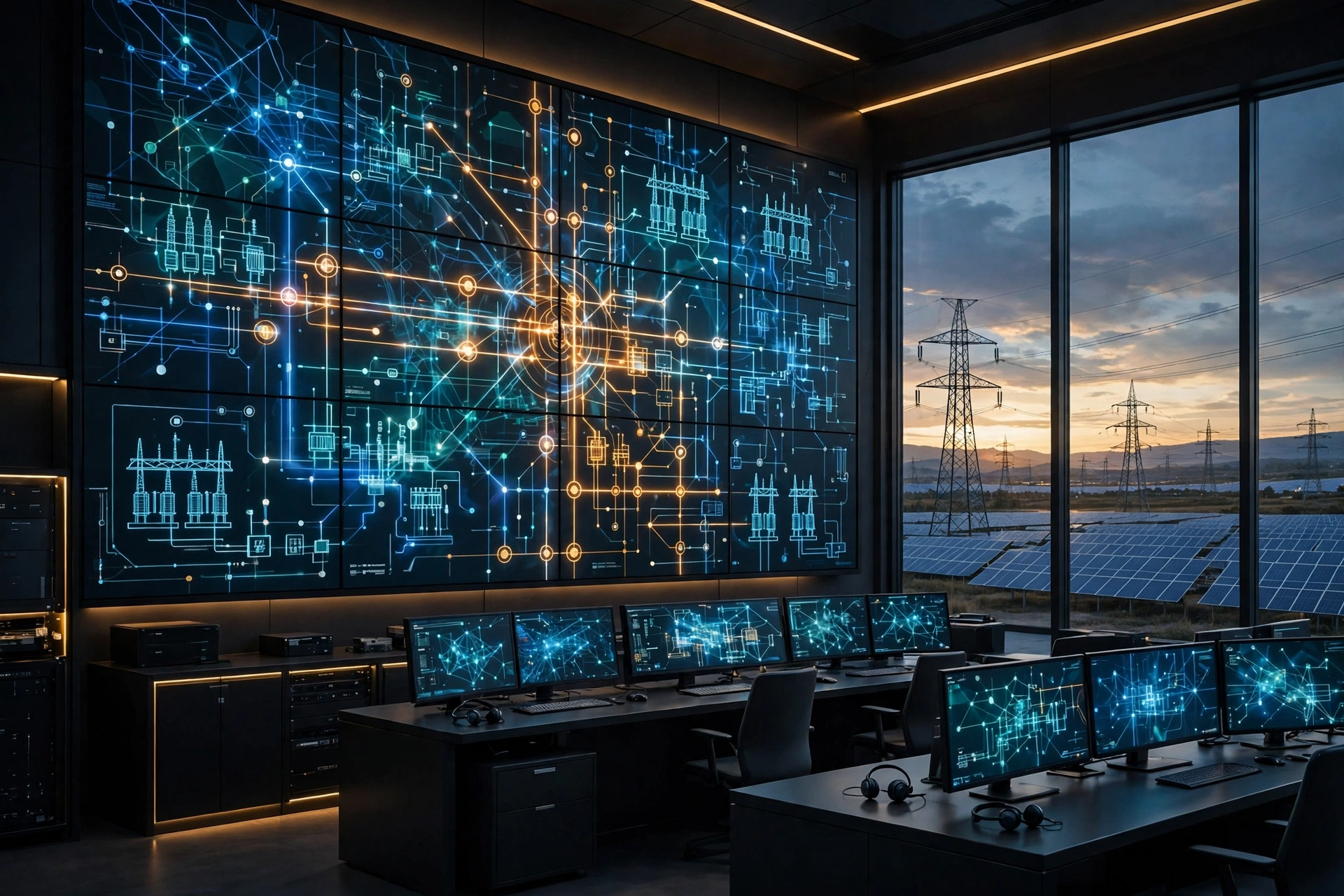
Automation Systems for Utilities Explained: How SCADA, ADMS, AMI, and DERMS Run the Modern Grid
Key takeaway: Automation systems for utilities are the layered software and hardware — SCADA, smart meters (AMI), ADMS, and DERMS — that let electric utilities monitor the grid in real time, restore power automatically after faults, and manage rooftop solar, batteries, and EV chargers. Together they replace manual switching and phone-reported outages with control-room software that acts in seconds.
What automation systems for utilities are
An automation system for a utility is not one product. It is a stack of systems that work together: sensors and smart meters in the field, a communications network, and control-room software that turns measurements into action. When a tree falls on a power line, the system can detect the fault, isolate the damaged section, and restore power to everyone else — often before a single customer phones in.
Electric utilities run three networks at once: the physical grid, the communications network, and the data systems behind billing and planning. Automation links them, so a measurement taken by a meter or a sensor can trigger a switching decision without a person in the loop. The U.S. Energy Information Administration (EIA) reported about 119 million smart-meter (AMI) installations in the United States in 2022, roughly 72% of all electric meters — the sensor layer is already most of the way built.
The four layers of utility automation
| Layer | What it does | Key systems |
|---|---|---|
| SCADA | Monitors and controls substations and field equipment remotely | Master stations, RTUs, IEDs |
| AMI | Collects interval usage data and outage signals from smart meters | Smart meters, communications network, MDMS |
| ADMS | Coordinates the whole distribution grid and automates restoration | Fault location (FLISR), Volt/VAR optimization, outage management |
| DERMS | Dispatches rooftop solar, batteries, EVs, and demand response | DER aggregation, virtual power plants |
SCADA: the control room’s eyes and hands
SCADA — Supervisory Control and Data Acquisition — is the oldest layer. It has run transmission grids for decades: remote terminal units (RTUs) and intelligent electronic devices (IEDs) in substations send telemetry to a control-room master station, and operators can open or close breakers remotely. SCADA is reliable and proven, but most legacy SCADA was built for one-way monitoring of a grid where power flowed from big plants to passive customers. It was never designed to coordinate millions of small devices on the distribution grid.
AMI: smart meters as the grid’s sensors
Advanced Metering Infrastructure replaces manually read meters with communicating meters that report consumption in 15-minute or hourly intervals, plus voltage and outage alarms. The meter data flows through a head-end system into a Meter Data Management System (MDMS), which validates the reads and feeds billing, load research, and outage management. The two dominant AMI meter vendors in North America are Itron and Landis+Gyr. AMI on its own is not a smart grid — it is the data-collection layer that makes the rest possible.
ADMS: the brain of the distribution grid
The Advanced Distribution Management System is the software platform that coordinates distribution automation: switching devices, sensors, and communications equipment installed on feeders and substations. It ingests SCADA telemetry, holds a real-time model of the network built from the utility’s GIS data, and runs automated functions including Fault Location, Isolation and Restoration (FLISR), Volt/VAR optimization, and restoration switching. The main platforms with the broadest North American and European deployments are GE Vernova GridOS, Schneider Electric EcoStruxure ADMS, and Oracle Utilities Network Management. An ADMS typically costs millions of dollars and takes 2–5 years to deploy, largely because it depends on an accurate grid model to run power-flow analysis.
DERMS: managing solar, batteries, and EVs
Rooftop solar, home batteries, EV chargers, and enrolled demand-response customers are not owned or operated by the distribution utility — but they now affect the grid as much as anything the utility owns. Coordinating them is the job of the Distributed Energy Resource Management System (DERMS), which aggregates the available flexibility across enrolled devices and dispatches it for peak shaving, frequency response, or voltage support. AutoGrid is among the most deployed DERMS platforms. The push accelerated after FERC Order 2222 (2020), which opened wholesale electricity markets to aggregated distributed energy resources. For the broader picture of how utilities automate across power, water, and gas, see our earlier explainer on utility company automation.
How the layers work together
Take a storm fault on a feeder. Smart meters send “last gasp” outage signals the moment they lose power. SCADA telemetry pinpoints the faulted section. The ADMS runs FLISR: it isolates the damaged segment and reroutes power around it, restoring most customers in seconds to minutes, while the outage management system dispatches the nearest crew to the exact location. Meanwhile the DERMS can call on enrolled home batteries to cover the gap. Each layer does one job; the value comes from the handoffs between them. That same pattern — sensors feeding control software that acts on its own — is now spreading through factories too, as we covered in AI for industrial process control.
What does utility automation cost?
There is no single price, because utilities buy in layers. AMI was the big capital wave: billions of dollars were spent on metering infrastructure between roughly 2005 and 2020. An ADMS is the expensive software step — typically millions of dollars and 2–5 years to deploy, including the grid-model cleanup it requires. DERMS and virtual power plant platforms are the fastest-growing spend, driven by FERC Order 2222 and capacity shortfalls. Smaller utilities often start with SCADA plus AMI and add ADMS later, rather than buying the whole stack at once.
What a utility needs before it can automate
Three prerequisites decide whether the stack works. First, an accurate network model: the ADMS is only as good as the GIS record of feeder topology, asset locations, and connectivity, typically held in Esri ArcGIS. Second, communications — RF mesh, cellular, or power-line carrier reaching every meter and field device. Third, standards-based integration: IEC 61850 inside substations, DNP3 to field devices, IEEE 2030.5 to inverters, OpenADR for demand response, and the Common Information Model (CIM) between control systems. Without these, each system becomes another silo.
Risks and limits
Automation brings new failure modes. Connecting operational technology to IT networks widens the cybersecurity attack surface, so utilities segment control networks and monitor them separately. Data volume is a second limit: millions of meters reporting every 15 minutes generates far more data than legacy systems were built to store or analyze. And an ADMS running on a stale or inaccurate network model will make confident wrong decisions — model accuracy is a maintenance job, not a one-time project. The current bottleneck, as grid engineers describe it, is integration across siloed systems, not a shortage of sensors.
Analysis: the grid, not the meter, is the bottleneck
Analysis: The meter rollout is largely done — about 72% of U.S. electric meters were smart by 2022. The hard part now is orchestration: making SCADA, AMI, ADMS, and DERMS act as one system when they were bought in different decades from different vendors. Utilities that treat automation as a software-integration project, with the network model as the foundation, get the outage and flexibility benefits; utilities that buy boxes and skip the model work get expensive dashboards. Expect the next wave of spending to be integration and AI-assisted operations on top of the ADMS, not more meters.
Frequently asked questions
What are automation systems for utilities?
They are the layered systems — SCADA, smart meters (AMI), ADMS, and DERMS — that let electric utilities monitor the grid in real time, restore power automatically after faults, and manage distributed energy like rooftop solar and batteries. Each layer does one job, and the value comes from the handoffs between them.
What is the difference between SCADA and ADMS?
SCADA monitors and controls individual substations and field equipment, and it has run transmission grids for decades. An ADMS sits above SCADA: it holds a real-time model of the whole distribution network and automates grid-wide functions such as fault restoration, Volt/VAR optimization, and switching, using SCADA data as one of its inputs.
How do smart meters fit into utility automation?
Smart meters are the sensor layer. They report consumption in 15-minute or hourly intervals, send voltage and outage alarms, and confirm restoration. In 2022 the U.S. had about 119 million AMI installations, roughly 72% of all electric meters, according to the EIA.
What is a DERMS and why do utilities need one now?
A Distributed Energy Resource Management System coordinates rooftop solar, home batteries, EV chargers, and demand response that the utility does not own. Utilities need one because these devices now affect grid conditions as much as utility-owned equipment, and FERC Order 2222 (2020) opened wholesale markets to aggregated distributed resources.
How much does an ADMS cost and how long does it take to deploy?
An ADMS typically costs millions of dollars and takes 2–5 years to deploy. Much of the time and cost goes into building and validating the accurate grid model the system needs to run power-flow analysis, not into the software license itself.
Sources
- U.S. Energy Information Administration — How many smart meters are installed in the United States?
- Camus Energy — Alphabet Soup: A Glossary of Electric Utility Software Systems
- Utilities Labs — Smart Grids Explained: AMI, ADMS, and DERMS in Utility Operations
- ElectronsX — Grid Control and Automation: SCADA, EMS, ADMS, DERMS and Synchrophasors