
Manufacturing Automation Integration Explained: How ERP, MES, and Machines Work as One System
Key takeaway: Manufacturing automation integration connects a factory’s business software, production systems, and shop-floor machines so they share data in real time. ERP plans the work, MES runs and tracks it, and PLCs and sensors execute it — and the ISA-95 standard gives each layer a common language.
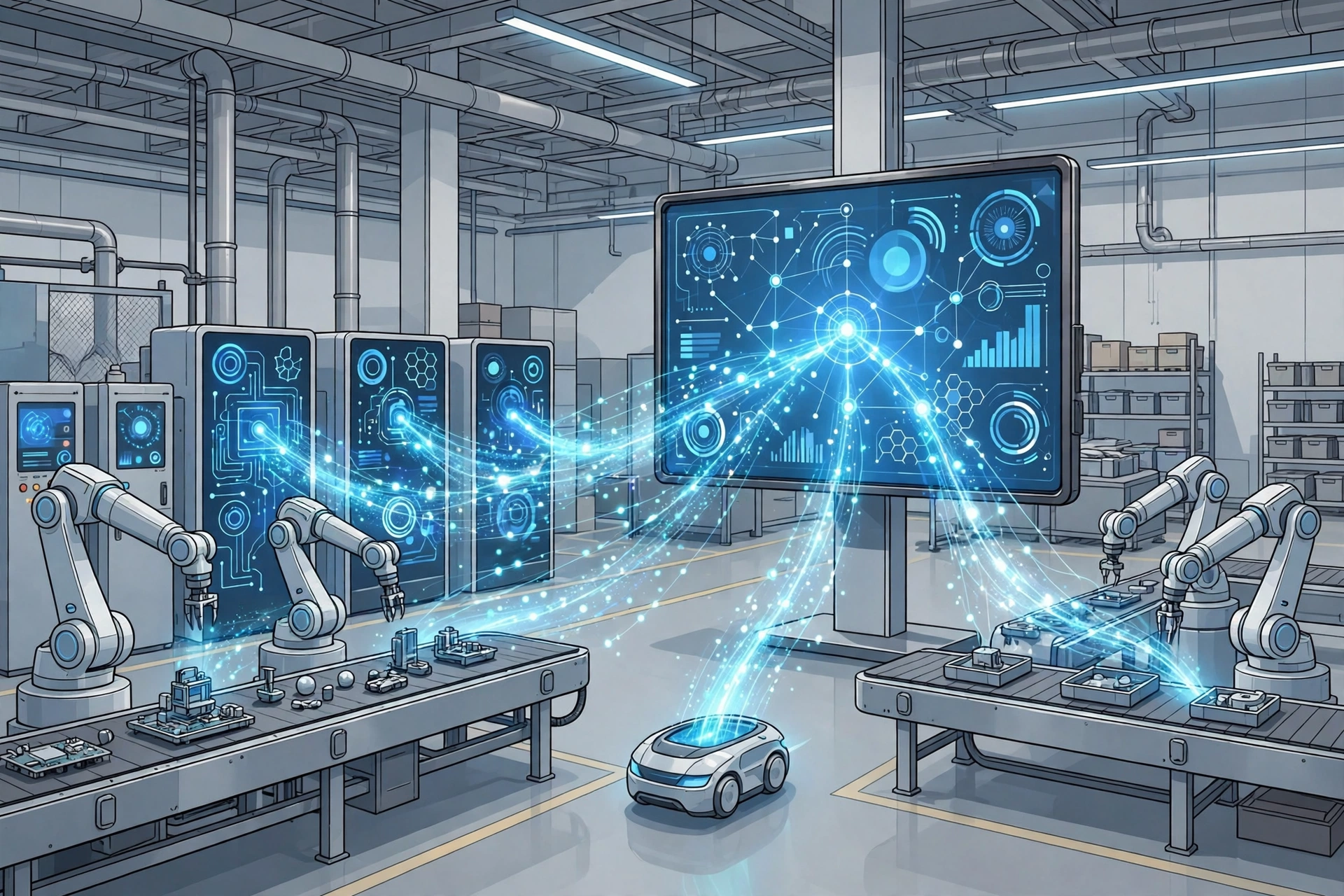
Manufacturing automation integration is the work of connecting the systems that run a factory into one coordinated whole. On their own, an enterprise resource planning (ERP) system, a manufacturing execution system (MES), and the programmable logic controllers (PLCs) on the machines each do a useful job. Integrated, they stop being separate islands and start acting like a single operation: an order placed in the ERP becomes a scheduled job in the MES, instructions reach the machines, and production and quality data flow back up in real time.
That connection matters because most factory problems are information problems. When systems cannot talk to each other, people re-enter data by hand, managers learn about problems hours late, and quality records live in three different places. Integration removes those gaps.
What manufacturing automation integration actually includes
Integration in manufacturing means linking machines, control systems, MES and ERP software, and data sources so they communicate seamlessly, enabling real-time monitoring, automated workflows, and unified reporting. In practice, a typical integrated setup has three layers:
- Business layer (ERP): plans orders, manages inventory, purchasing, and logistics.
- Operations layer (MES): schedules and dispatches work, tracks production and genealogy, records quality data, and reports performance.
- Control layer (PLCs, SCADA, sensors): runs the machines, supervises processes, and collects real-time machine data.
The MES sits in the middle. It acts as the bridge between enterprise-level systems and the shop floor, turning ERP orders into executable tasks and turning machine data into information managers can act on. Without that middle layer, the business system and the machines have no shared view of what is actually happening.
How ERP, MES, and PLC systems work together
A simple data flow shows the idea. First, the ERP sends a production order to the MES. The MES breaks that order into tasks, schedules operations, and dispatches instructions to operators or machines. PLCs and SCADA systems execute the work and report status and results back to the MES. The MES then analyses the data, logs it, and returns exceptions or completed quantities to the ERP.
Two kinds of integration are at play. Vertical integration links shop-floor controls upward to enterprise software, while horizontal integration connects systems across departments, such as MES to ERP or quality to maintenance. End-to-end integration goes further, joining design, production, and supply-chain systems for full lifecycle visibility.
| System | Main job | Typical data it handles |
|---|---|---|
| ERP | Business planning | Orders, inventory, purchasing, costing |
| MES | Production execution | Schedules, work instructions, quality, genealogy |
| PLC / SCADA | Machine control and supervision | Sensor readings, machine states, alarms |
Why ISA-95 matters for manufacturing automation integration
Factories buy equipment and software from many vendors, so integration needs agreed rules rather than one-off connections for every pair of systems. That is what ISA-95 provides. Developed by the International Society of Automation (ISA) with ANSI, ISA-95 is the standard for exchanging information between enterprise and control systems, and it is published internationally as IEC 62264.
ISA-95 organises manufacturing IT into five levels: Level 0 is the physical process, Level 1 covers sensors and actuators, Level 2 covers supervision and control (PLCs and SCADA), Level 3 covers manufacturing operations (MES), and Level 4 covers business planning and logistics (ERP). Two widely used technologies implement the handshakes between layers: OPC UA carries real-time machine data from the control layer upward, and B2MML provides a standard XML format for ERP-to-MES exchanges.
The practical payoff is lower integration friction. When equipment, materials, processes, and events use shared models and names, a new machine, a new software tool, or a future analytics project plugs in with less custom rework. That is also why many guides recommend starting with a bounded use case — such as production-order exchange or track-and-trace — rather than trying to rebuild the whole stack at once.
Benefits, challenges, and where to start
Done well, integration delivers real-time visibility into production, faster decisions, fewer manual errors, better traceability for audits, and a single source of truth for operations. Traceability is especially valuable in regulated industries such as pharmaceuticals, aerospace, and food processing, where quality audits without integrated records can drag on for weeks.
It is not free of challenges. Legacy machines may lack modern connectivity, different vendors use different data formats, and IT/OT teams must agree on ownership and security for shared data. Brownfield plants usually do best by evolving: adding standards-based interfaces around new projects rather than ripping out working equipment.
Analysis: For a small or mid-sized manufacturer, the sensible first step is not the biggest platform purchase. It is picking one painful, well-defined flow — for example, getting real production counts from machines into the MES automatically instead of on paper — and proving it on one line. If that flow works, the same pattern can be repeated line by line, and the factory gains integration value without betting the business on a single project.
Readers weighing related automation choices may also find our explainers on automation examples in industry, custom automation for life sciences, and IT support vs IT automation useful.
Frequently asked questions
What is manufacturing automation integration?
It is the process of connecting a factory’s machines, control systems, MES, and ERP software so they exchange data automatically. Instead of separate systems and manual data entry, orders, production status, and quality data flow between layers in real time.
What is the difference between ERP, MES, and PLC systems?
ERP handles business planning such as orders and inventory. MES manages production execution, including scheduling, work instructions, and quality tracking. PLCs and SCADA supervise and control the machines themselves. MES sits between ERP and the shop floor, translating business orders into executable work and machine data into management information.
What is ISA-95?
ISA-95, published internationally as IEC 62264, is the standard for integrating enterprise and control systems. It defines a five-level model from the physical process (Level 0) up to business planning (Level 4), along with standard data models for exchanging information between ERP and MES.
What are OPC UA and B2MML used for?
OPC UA is the standard for carrying real-time machine data from PLCs and control systems up to the operations layer. B2MML is the XML implementation of the ISA-95 data model for standardised exchanges between MES and ERP. Together they cover the two main handshakes in an integrated factory.
Where should a manufacturer start with automation integration?
Start with one bounded, high-value use case, such as automatic production-order exchange or track-and-trace on a single line. Prove the data flow, agree on data ownership between IT and operations teams, and then extend the same pattern to other lines rather than replacing the whole system at once.
Sources
- Wootz — Manufacturing System Integration: ERP, MES and Automation
- Pinpoint — MES Architecture: How Manufacturing Systems Are Built for Smart Factories
- Tulip — MES, ISA-95, MESA-11, cMES, NAMUR: Why So Many Standards?
- ANSI Blog — ANSI/ISA 95.00.05-2018 Enterprise-Control System Integration



2 Comments
Comments are closed.