Automation Examples in Industry: How Factories and Plants Actually Use It
Key takeaway: Industrial automation examples show up in almost every sector: robotic arms weld and paint cars in automotive plants, pick-and-place machines build circuit boards in electronics, automated lines fill and package food and drinks, vision systems inspect pharmaceutical products, and warehouses run on conveyors and mobile robots. Each case uses sensors, controllers, and software to replace repetitive manual work with faster, more consistent machine output.
What industrial automation means in practice
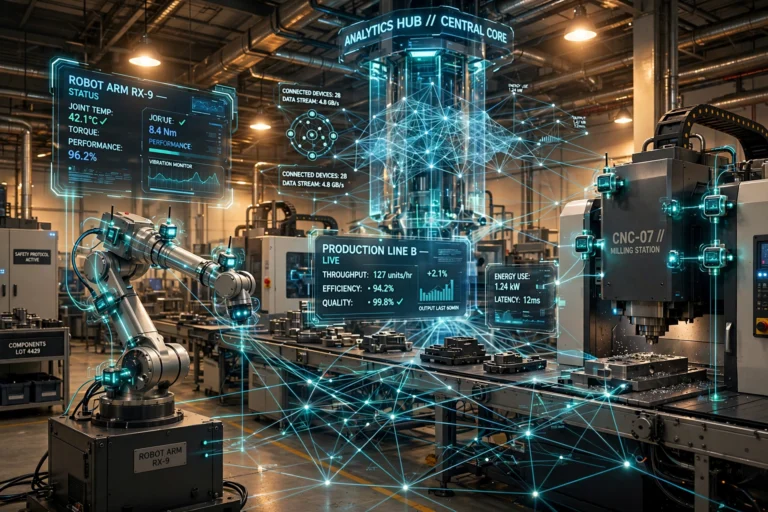
Industrial automation is the use of control systems, robots, sensors, and software to run manufacturing and production processes with minimal human involvement. The goal is straightforward: do repetitive or precise work faster, more consistently, and more safely than people can do it by hand. Automation projects typically deliver faster cycle times, less scrap, longer equipment life, and fewer unplanned shutdowns, according to industrial automation providers like Sure Controls.
Automation systems are usually organized in layers, sometimes called the automation pyramid: sensors and actuators at the field level, PLCs (programmable logic controllers) controlling machines directly, SCADA systems supervising whole plants, MES (manufacturing execution systems) managing workflow and quality, and ERP systems handling business planning above it all (described in detail in this industrial automation overview). Each example below maps to one or more of these layers.
Automation examples in industry, sector by sector
Automotive: the most automated industry
Car factories are the classic automation example. Robotic arms weld car bodies, spray-paint them with a uniform finish, and assemble components like engines and dashboards with high precision and speed. Automated guided vehicles (AGVs) move parts around the plant, and machine-vision systems inspect parts for defects. As Sure Controls notes, this cuts human labor and error on the assembly line while keeping production moving at speeds no manual crew could match.
Electronics: high-speed precision
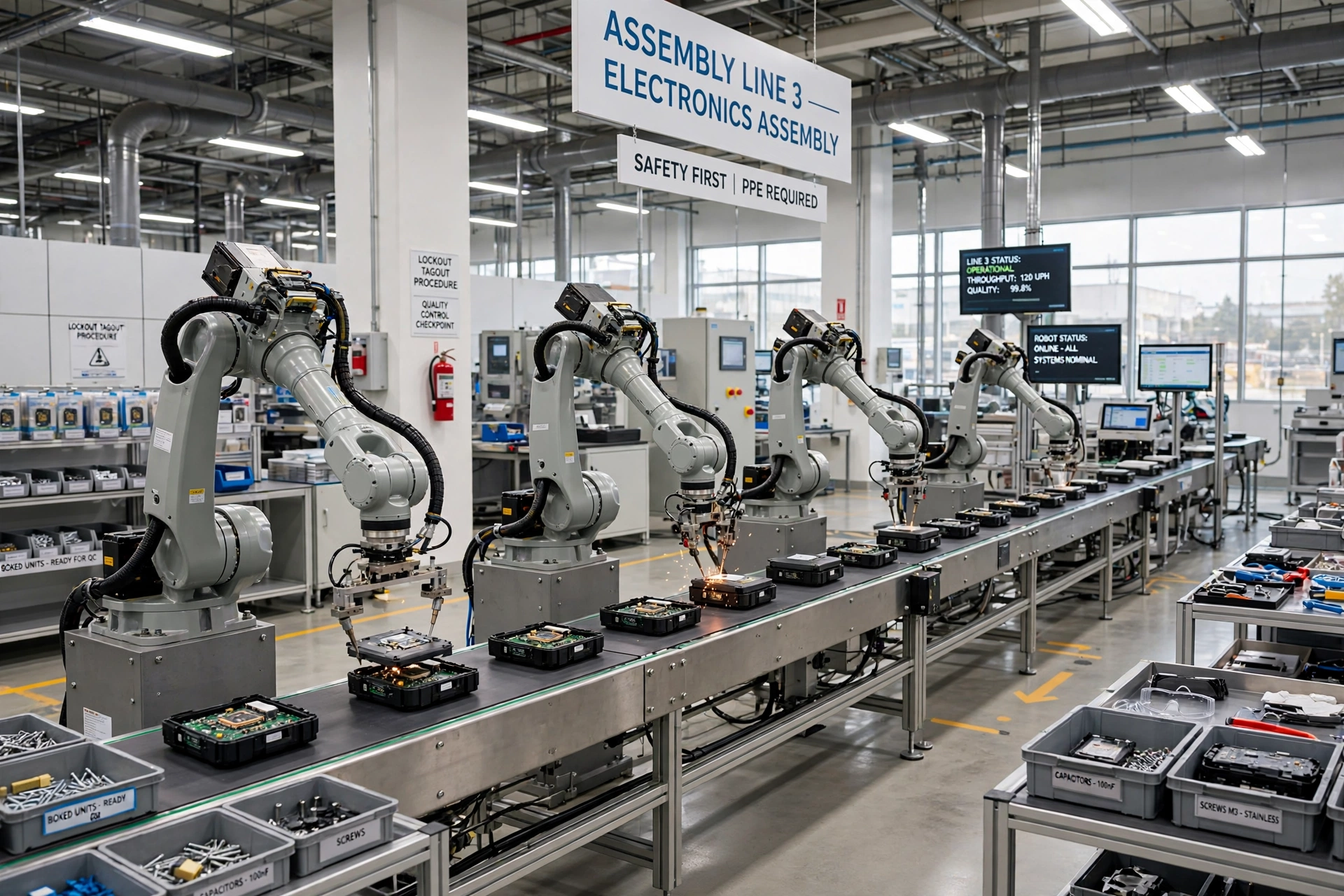
Electronics manufacturers rely on high-speed pick-and-place machines and robotic arms to mount tiny components onto circuit boards far faster and more accurately than humans could, enabling mass production of complex devices with consistent quality (Sure Controls). Automated assembly, testing, and packaging of components round out the picture.
Food and beverage: consistency and hygiene
Food and beverage plants use computerized control systems and sensors for mixing, filling, and packaging. Automated filling machines can fill and cap thousands of bottles or cans consistently, so each unit meets quality standards while minimizing waste. Vision systems check for contaminants, and robotic pickers handle delicate items.
Pharmaceuticals: precision under regulation
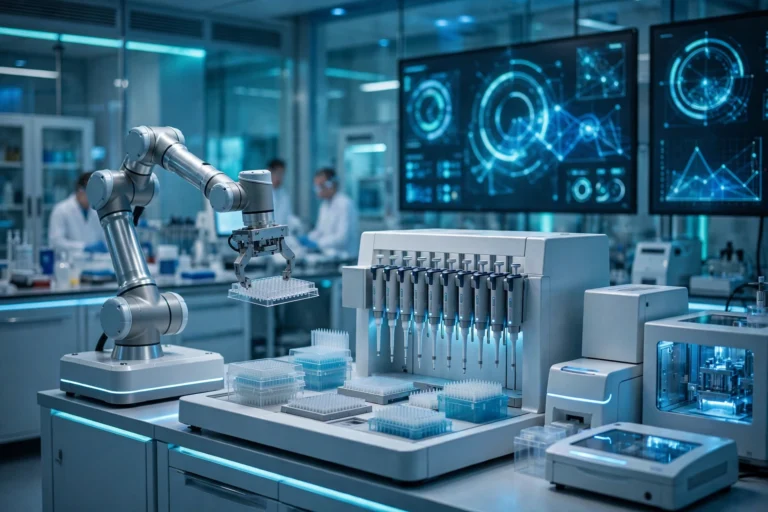
Pharma automation focuses on sterile, repeatable processes: automated batch processing controls chemical reactions and mixing, automated sterilization systems clean equipment and packaging, and tablet lines press, coat, and package pills. Precise liquid-filling systems dose vials and syringes, and automated testing analyzes drug products for quality.
Warehouses and logistics
Distribution centers run on automation: autonomous mobile robots, conveyors, and smart sorting systems move and sort products with minimal human supervision. The systems reduce manual lifting, speed up order processing, and improve safety in logistics operations (Sure Controls).
Energy, oil and gas, and utilities
Beyond factories, automation monitors and controls power plants, grids, and water treatment with SCADA systems and remote terminal units. Oil and gas use pipeline monitoring and refinery process control, and mining deploys automated drilling rigs and material-transport systems (JLC).
At-a-glance: which automation fits which industry
| Industry | Common automation examples | Core components |
|---|---|---|
| Automotive | Welding, painting, assembly, part inspection | Robots, PLCs, vision systems |
| Electronics | Pick-and-place, testing, packaging | Robots, machine vision, CNC |
| Food & beverage | Filling, packaging, labeling, quality inspection | SCADA, conveyors, vision cameras |
| Pharmaceutical | Batch processing, sterilization, liquid filling | DCS, sensors, automated testing |
| Logistics | Sorting, conveying, inventory flow | Mobile robots, conveyors, WMS software |
| Energy & utilities | Plant monitoring, grid control, predictive maintenance | SCADA, RTUs, smart sensors |
Why these examples matter for your business
The pattern across industries is consistent: automation pays off where work is repetitive, precise, hazardous, or data-heavy. Computer-vision quality inspection catches defects on the line and triggers rework automatically; sensor-driven predictive maintenance forecasts equipment failures and schedules repairs before breakdowns happen, cutting maintenance costs and downtime (MakeItFuture). If you are evaluating automation, start by listing processes with the highest labor cost, defect rate, or safety risk — those are usually the best first targets.
Analysis: what separates successful automation projects
Analysis (our take, not a verified fact): the projects that work best pair shop-floor integration with enterprise workflows, so decisions flow from sensor to ERP to supplier. Standalone robots without connected data tend to stall, while lines instrumented with sensors, vision, and scheduling software compound their returns over time. Vendors matter less than integration: pick systems that talk to your existing machinery and software, scale with demand, and come with reliable support.
Frequently asked questions
What is the most common example of industrial automation?
Robotic arms in automotive manufacturing are the most cited example: they weld car bodies, spray paint, and assemble components on production lines. They are common because the work is repetitive, demands precision, and runs at high volume.
Which industries use automation the most?
Automotive, electronics and semiconductors, food and beverage, pharmaceuticals, aerospace, chemicals, metal fabrication, and logistics are the heaviest users. Energy, oil and gas, utilities, and mining also rely on automation for monitoring and process control.
What are PLCs and SCADA in industrial automation?
PLCs (programmable logic controllers) are devices that directly control machinery, such as a robot’s movements or a conveyor’s speed. SCADA (supervisory control and data acquisition) sits above the PLCs, monitoring and supervising an entire plant and collecting data for operators and engineers.
Does automation eliminate jobs?
Automation reduces the need for repetitive manual labor, but it does not eliminate the need for people. Engineers, operators, technicians, programmers, safety specialists, and maintenance staff remain essential for planning, supervision, troubleshooting, and system improvement (GetInfoData).
How do companies decide what to automate first?
Good starting points are processes with high labor costs, frequent defects, safety hazards, or tight precision requirements. Companies typically weigh operational needs, compatibility with existing equipment, flexibility for future demand, budget and ROI, and vendor support before choosing a system (JLC).
Sources
- Sure Controls — What Is Industrial Automation? Definition, Examples & How It Works
- MakeItFuture — Examples of Process Automation Transforming Industries
- JLC — Industrial Automation Systems: Definition and Benefits
- GetInfoData — Industrial Automation Machinery Guide