Life Sciences Workflow Automation: What It Is, How It Works, and Where It Pays Off
Key takeaway
Life sciences workflow automation links lab instruments, robotic handlers, and software into one connected process so experiments and production runs continue without manual handoffs. Teams use it to run thousands of assays faster, cut human error, and keep complete data records for regulators. It works best when the underlying process is standardized first — automating a broken process only makes it fail faster.
What life sciences workflow automation means
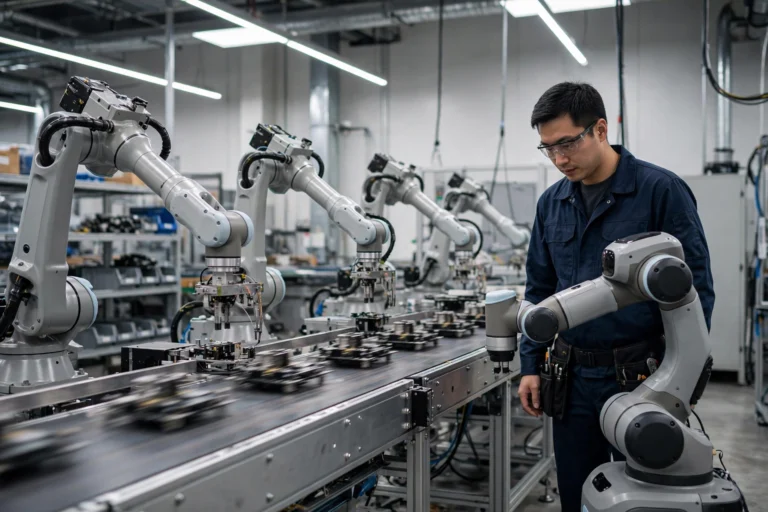
In a research lab, it means liquid handlers, plate movers, and robotic workcells that automate entire drug discovery workflows, from sample preparation to analysis. Vendors such as Beckman Coulter Life Sciences, Thermo Fisher Scientific, PerkinElmer, and SPT Labtech supply the workstations and integrated systems behind high-throughput screening and compound management (Robotics & Automation News).
Beyond the research bench, the same idea applies to regulated production: electronic batch records, automated deviation handling, and release workflows that move a product from manufacturing through quality approval. It also covers the data layer — laboratory information management systems (LIMS) that track each sample from collection to disposal, giving teams traceability that paper notebooks never could (American Healthcare Leader).
How it works in practice
A typical automated workflow follows a loop: instruments execute an experimental step, software captures and analyzes the results, and the next step is scheduled automatically. The newest version of this loop is sometimes called “lab-in-the-loop”: a laboratory control plane connects instruments, robotics, and software so the result of one experiment feeds straight into the next decision, with AI agents planning and adjusting the workflow while a scientist sets the direction and signs off (Technology Networks).
This matters most for complex workflows like biologics, antibody-drug conjugates, mRNA, and cell and gene therapies, where experiments run on a steadier rhythm — overnight and across shifts — with every completed run feeding back into how the next one gets designed (Technology Networks).
Where it’s being used now
Drug discovery is the flagship use case. In October 2026, Danaher announced its first AI-powered autonomous lab, based at Abcam, that uses AI to design affinity reagents including antibodies, then builds and tests each one, feeding every result back into the model to improve the next design. The company claims up to 8x faster discovery of affinity reagents and a tenfold increase in annual reagent generation, from tens to hundreds of reagents per year, with Beckman Coulter Life Sciences, Cytiva, Genedata, Integrated DNA Technologies, and Molecular Devices contributing to one connected workflow (Danaher via PR Newswire).
Public programs are pushing the same direction: in April 2026, India’s DBT-ICGEB Biofoundry added bio-automation and AI for high-throughput strain development, and in July 2026 the U.S. Department of Energy funded 278 projects for AI-enabled scientific workflows (Coherent Market Insights).
Why it matters: the practical payoff
Automation compresses months of manual synthesis work into roughly a week, letting scientists analyze the most promising candidates instead of doing repetitive bench work. It also lets labs work through thousands to millions of compounds at speed, so promising leads surface sooner. The benefits stack: faster screening produces more data, and cleaner, traceable data supports stronger go-or-no-go decisions (American Healthcare Leader).
On the regulated side, documented cases are striking: one organization that automated its GMP release workflows saved 67,200 hours per year — about 2,100 hours per site across 32 global sites — while another cut a compliance workflow’s cycle time by 75% and eliminated duplicate records entirely (Sakara Digital).
Analysis: the process must come before the robots
This section is analysis, not verified fact. Automation projects usually fail on the process, not the technology. One pharma company piloted batch-release automation across sites without standardizing the underlying workflow first and saw zero cycle-time improvement, plus new deviation opportunities. After pausing to map and reengineer the process, the redeployment succeeded (Sakara Digital). Between 2020 and 2025, over 60% of FDA warning letters to pharma manufacturers included observations tied to electronic records, data integrity, or computer system validation — in most cases a process gap, not a technology failure. Map the workflow, standardize it, then automate it.
Related reading
- Manufacturing Automation for Life Sciences: What It Is and Where It’s Used
- Life Science Marketing Automation: What It Is and How Teams Use It
- AI in Safety Management: The Shift From Reactive to Predictive Workplace Safety
Frequently asked questions
What is life sciences workflow automation?
It is the practice of connecting laboratory instruments, robotic equipment, and software so that experiments, sample handling, and production processes run continuously without manual handoffs. It spans research labs, clinical diagnostics, and regulated pharmaceutical manufacturing.
How is it different from regular lab automation?
Regular lab automation often targets a single instrument or task, like automated pipetting. Workflow automation connects multiple instruments and systems into one orchestrated process, so data and samples move automatically between steps — including scheduling, data capture, and regulatory documentation.
What are the main benefits for pharma and biotech teams?
The main benefits are faster screening throughput, better data quality and traceability, improved reproducibility, stronger worker safety through reduced exposure, and shorter paths from discovery to the clinic. Regulated teams also gain cleaner audit trails, which matters for FDA and EMA compliance.
What does it cost to implement?
Costs vary widely: a single automated workstation can run into tens of thousands of dollars, while fully integrated robotic workcells or autonomous lab platforms are enterprise-scale investments. Most teams start by automating one bottleneck workflow and expanding from there.
Sources
- American Healthcare Leader — Benefits of automated laboratory equipment
- Technology Networks — Lab-in-the-Loop: The Future of Life Science R&D?
- Danaher via PR Newswire — Danaher’s AI-powered autonomous lab
- Robotics & Automation News — Lab automation and AI in drug discovery
- Sakara Digital — Process discipline before AI in pharma
- Coherent Market Insights — AI Laboratory Automation Market