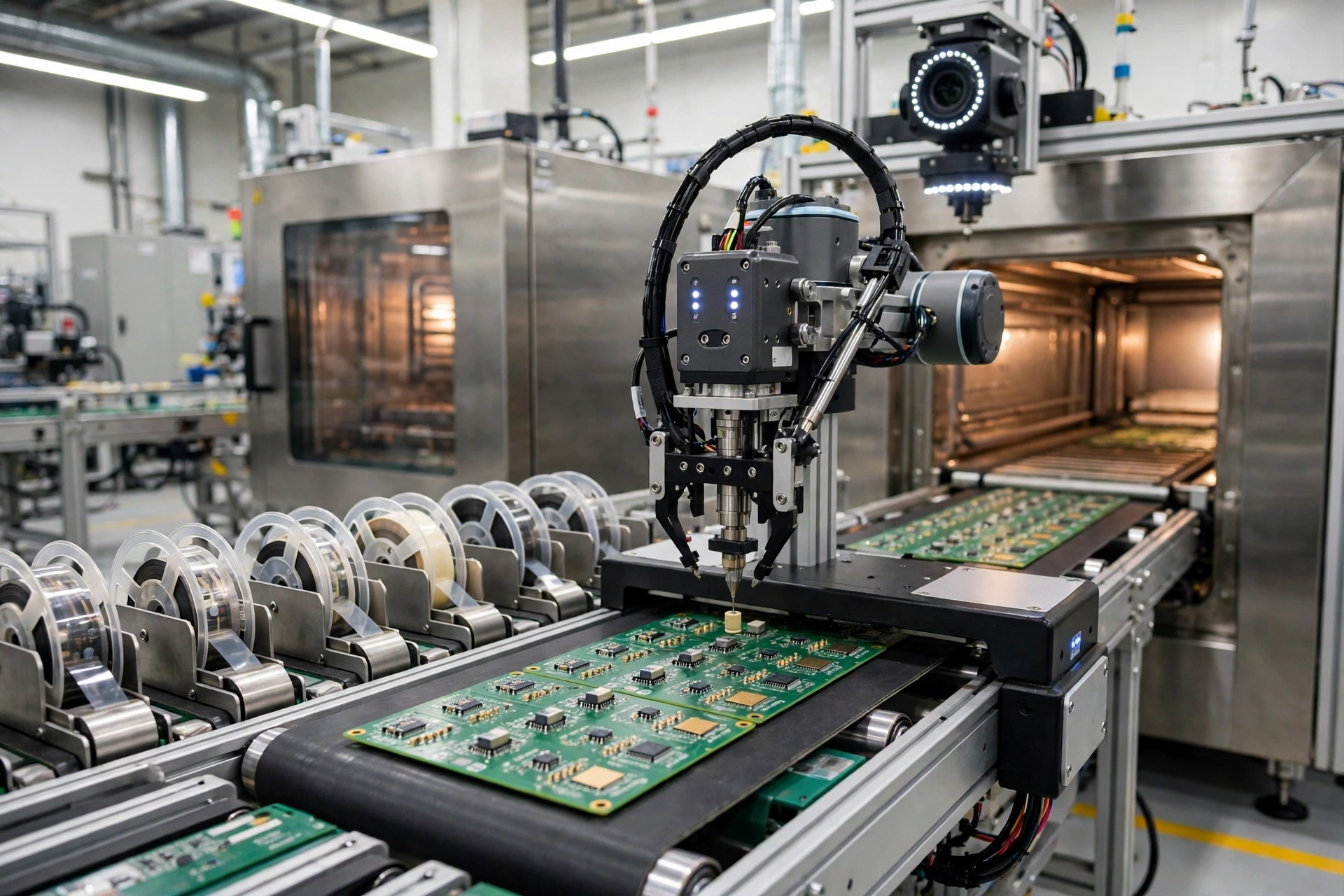
Electronics Assembly Automation Explained: How SMT Lines Build the Devices We Use
Key takeaway: Electronics assembly automation is the machine-driven process that turns a bare printed circuit board into a working device. On a surface-mount technology (SMT) line, machines print solder paste, place components, melt the solder in a reflow oven, and inspect every board — at speeds no hand assembly can match.
Almost every device you own passed through an automated assembly line. Electronics assembly automation is what makes it possible to build millions of identical, reliable circuit boards without soldering each tiny part by hand.
What Is Electronics Assembly Automation?
Electronics assembly automation uses machines to place electronic components onto a printed circuit board (PCB) and join them with solder. The dominant method is surface-mount technology (SMT), in which components sit directly on the board’s surface rather than having their leads pushed through drilled holes.
A typical SMT line is a conveyor that carries boards through a fixed sequence of machines. Each machine does one job, and inspection stations between steps catch mistakes before they become expensive failures. According to an SMT line process overview, the standard flow runs: PCB loading, solder paste printing, solder paste inspection (SPI), component placement, reflow soldering, automated optical inspection (AOI), and optional testing and rework (BestPCBs).
How an SMT Assembly Line Works, Step by Step
1. Solder paste printing. A stencil printer pushes solder paste through a laser-cut stencil onto the board’s pads. Paste volume and alignment matter enormously here: too little paste makes weak joints, too much causes solder bridges between pads.
2. Solder paste inspection (SPI). An SPI machine measures paste volume, height, and alignment before any component is placed. Catching a printing error here is cheap; catching it after soldering is not.
3. Pick-and-place. High-speed placement machines pick components from reels and tapes and set them onto the paste with vision-guided accuracy. Modern lines place tens of thousands of components per hour, with placement accuracy commonly around ±0.05 mm for consumer electronics (PCBBUY).
4. Reflow soldering. The board passes through a multi-zone reflow oven with a carefully controlled temperature profile. The paste melts, forms solder joints, and solidifies again as the board cools. A wrong profile causes tombstoning — where a small component stands on one end — or voids inside solder balls.
5. Automated optical inspection (AOI). Cameras compare every component and joint against the board’s design data, flagging missing parts, wrong polarity, shifted components, and visible solder defects (ACE PCB).
6. X-ray and electrical testing. Hidden joints, such as those under ball grid array (BGA) chips, cannot be seen by cameras, so lines add X-ray inspection for those packages. In-circuit testing (ICT) and functional testing then confirm the board actually works. A detailed SMT process guide lists these as the final quality gates before cleaning, coating, and packaging (DX Circuit).
How Does Electronics Assembly Automation Compare With Through-Hole Assembly?
Through-hole assembly inserts component leads through drilled holes and solders them from the other side, usually with wave soldering. It still has a place, but for most modern electronics SMT automation wins on speed, size, and density.
| Factor | SMT automation | Through-hole assembly |
|---|---|---|
| Component size and density | Tiny parts, very high density, both sides of the board usable | Larger parts, lower density, holes take board space |
| Speed | Tens of thousands of placements per hour | Slower, more manual handling |
| Mechanical strength | Good for most uses, weaker under heavy stress | Stronger joints, better for connectors and heavy parts |
| Best for | Phones, laptops, wearables, sensors, most consumer and industrial boards | Power supplies, large connectors, transformers, high-vibration parts |
Most real factories use mixed technology: SMT for the bulk of components, through-hole for the handful of parts that need mechanical strength. If you are weighing automation more broadly, our explainers on manufacturing automation integration and general industries automation show how assembly lines fit into the wider factory picture.
When Does Automation Pay Off? The Cost Question
An SMT line is a major investment: stencil printers, placement machines, reflow ovens, and inspection systems, plus feeders, stencils, and programming for each board design. That cost only makes sense at volume, or where quality and repeatability matter more than the upfront price.
Automation pays off when production runs repeat the same board design many times, when boards are dense or use tiny components that hands cannot place reliably, or when defect costs are high — for example in medical or automotive electronics. For one-off prototypes or very small batches, hand assembly or a small-batch assembly service is usually cheaper, because programming and setup dominate the cost of a short run.
What Do You Need Before Automating? Prerequisites
Automation starts before the first machine runs. You need a finished board design with accurate component footprints, a bill of materials with parts available on reels or trays, and machine programs generated from the design files — placement coordinates, rotation, and feeder assignments for every part.
You also need the right environment: solder paste is sensitive to temperature and humidity, stencils must be cleaned regularly, and operators must know how to read inspection results and adjust the line. A line without trained operators and a maintenance plan will produce defects faster than a manual bench, not fewer.
What Can Go Wrong? Risks and Limits
Automation does not remove defects; it moves them earlier and makes them repeatable. A wrong feeder setup, a stale paste batch, or a bad reflow profile will ruin hundreds of boards the same way before anyone notices, unless inspection gates and first-article checks stop the line.
The most common SMT defects are solder bridging (solder joining two pads that should stay separate), tombstoning, solder balls, and voids inside joints. X-ray catches hidden voids that AOI cannot see, which is why high-reliability boards get both. Automation also struggles with unusual parts — very large, heavy, or oddly shaped components often still need selective soldering or hand placement.
Analysis: the direction of travel is toward more closed-loop lines, where inspection data feeds back into printer and placement settings automatically. But the fundamentals have not changed: print well, place accurately, control the oven, and inspect at every gate. A factory that skips inspection to save money is buying defects in bulk.
Why It Matters to You
If you buy electronics, assembly automation is why devices keep getting smaller, cheaper, and more reliable at the same time. If you design or build hardware, understanding the SMT flow helps you design boards that are actually manufacturable: standard footprints, sensible component spacing, and test points that ICT can reach. And if you work in manufacturing, the same inspection-first discipline — catch errors at the step that creates them — applies far beyond electronics, as our guide to automation machinery manufacturing shows.
Sources
- BestPCBs — What is the SMT Line? SMT Line Process Flow
- DX Circuit — 10-Step SMT Assembly Process
- ACE PCB — Why AOI Isn’t Enough for Your PCB Assembly
- PGF Technology — SMT Assembly Process
Frequently Asked Questions
What is electronics assembly automation?
Electronics assembly automation is the use of machines to place components onto printed circuit boards and solder them in place. Most automated lines use surface-mount technology, where machines print solder paste, place parts, reflow the solder, and inspect each board on a conveyor.
How does an SMT assembly line work?
An SMT line follows a fixed sequence: solder paste printing, solder paste inspection, high-speed pick-and-place, reflow soldering in a controlled oven, automated optical inspection, and then X-ray or electrical testing. Each inspection gate catches defects from the previous step before they become costly failures.
Is SMT better than through-hole assembly?
For most modern electronics, yes: SMT allows smaller components, higher density, and much faster production. Through-hole remains better for parts that need mechanical strength, such as large connectors and transformers, so many factories use both methods on the same board.
How much does electronics assembly automation cost?
A full SMT line is a major capital investment in printers, placement machines, ovens, and inspection systems, plus setup costs per board design. It pays off at volume or where defect costs are high; for prototypes and tiny batches, hand assembly or a small-batch service is usually cheaper.
What are the most common defects in automated electronics assembly?
The most common defects are solder bridging, tombstoning, solder balls, and voids inside solder joints. They usually trace back to paste printing, placement accuracy, or the reflow temperature profile, which is why lines inspect after printing, placement, and reflow.