
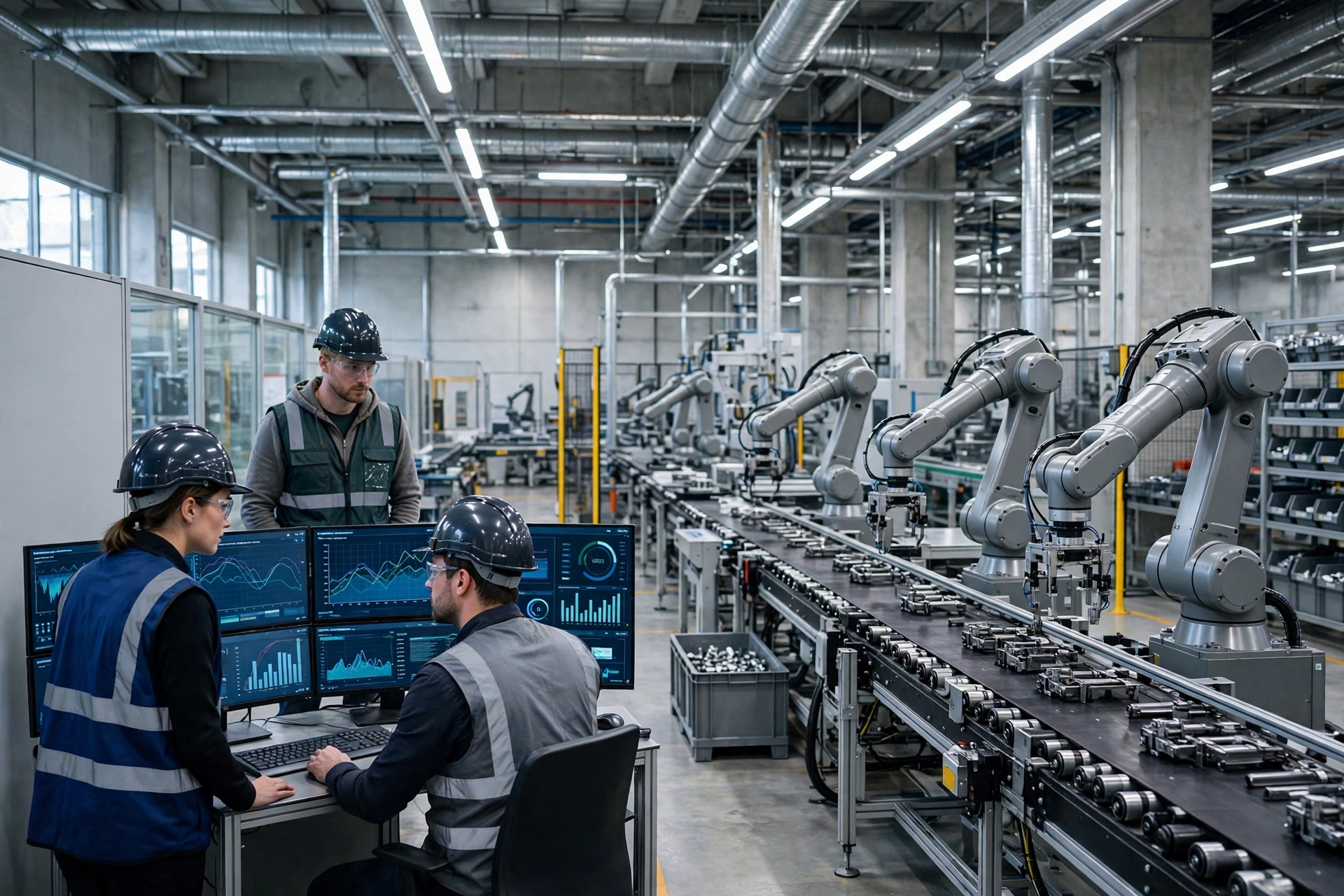
General Industries Automation Explained: How Machines, Robots, and Software Run Modern Industry
Key takeaway: General industries automation means using machines, robots, and software to run routine work across many sectors — from factory lines to warehouses and utilities — instead of doing each step by hand. It raises output and consistency, but it works best when a business automates one clear bottleneck at a time, not its whole operation at once.
General industries automation is not one machine or one industry. It is the umbrella term for the control systems, robots, and software that let factories, warehouses, energy plants, and food processors run repetitive, precise, or hazardous work with less direct human handling. The same building blocks appear in a car plant, a parcel warehouse, and a water treatment works — only the mix changes.
What general industries automation actually includes
At the machine level, sensors measure what is happening — temperature, pressure, position, or speed. A controller decides what to do next, and actuators carry it out by moving a motor, opening a valve, or guiding a robot arm. Above that sits supervisory software that shows operators the whole process, logs data, and raises alarms.
The three control-system names you will meet most often are programmable logic controllers (PLCs), which run fast, local machine logic; distributed control systems (DCS), which coordinate continuous processes across a whole plant; and supervisory control and data acquisition (SCADA) systems, which monitor and control equipment spread over a wide area, such as pipelines or substations. Robots, conveyors, machine vision cameras, and industrial software sit on top of these layers. Our guide to automation implementation explains how businesses plan, pilot, and scale these systems in practice.
General industries automation by sector
Automation looks different depending on what the work is. The table below compares the most common setups.
| Sector | Typical automation | What it improves most |
|---|---|---|
| Manufacturing | Robot welding and assembly cells, CNC machines, automated inspection | Output, repeatability, and defect detection |
| Logistics and warehousing | Conveyors, automated mobile robots, sorting and palletizing systems | Throughput and order accuracy |
| Energy and utilities | SCADA monitoring, remote pumping and substation control | Reliability and response to faults |
| Food and drink | Filling and packaging lines, hygienic handling, labelling and traceability | Consistency and food safety |
| Pharmaceuticals | Controlled filling, inspection, and batch record-keeping | Traceability and compliance |
Two related explainers go deeper on specific pieces: robotic process automation architecture covers how software robots and orchestrators work together, and manufacturing automation integration shows how ERP, MES, and machines connect into one system.
How big is general industries automation now?
The scale is already large. The International Federation of Robotics (IFR) reported 542,000 industrial robots installed worldwide in 2024 — more than double the number a decade earlier, and the fourth straight year above 500,000 units. Asia accounted for 74% of new deployments in 2024, Europe 16%, and the Americas 9%, according to IFR’s World Robotics 2025 report as covered by Xinhua. Source: Xinhua/IFR World Robotics 2025 coverage
McKinsey’s analysis of automation potential puts the share of automatable activities at roughly 60% in production and manufacturing and 57% in transport and storage, with wide variation inside each sector — predictable physical tasks score far higher than work built on human interaction. McKinsey also estimates automation could add around 0.8 to 1.4 percentage points to annual global productivity growth. Source: McKinsey automation-potential study summary
Fixed, programmable, flexible, or integrated: which type fits?
Automation systems are usually grouped by how easily they adapt when the product changes. Fixed automation is dedicated equipment for one product at very high volume, such as a bottling line. Programmable automation, such as CNC machines, is reprogrammed for different batches. Flexible automation switches between products with little or no changeover time, such as a robot cell. Integrated automation coordinates many systems with software from design through production and logistics. Source: industrial automation systems overview
Analysis: most real plants mix several types. A factory might run a fixed line for its best-selling product, programmable machines for custom batches, and one flexible robot cell for work that changes often. The mistake is buying flexibility you never use, or fixed capacity for a product that changes every month.
What does general industries automation cost?
There is no single price, and that is the point to understand before budgeting. A single robot cell can cost far less than a full line, while integrating software, safety systems, and training can cost as much as the hardware itself. Costs to plan for include the equipment, installation and safety guarding, software licences, integration with existing systems, maintenance, and staff training.
Analysis: the cheapest first project is usually the one with a measurable payback — a bottleneck step, a hazardous manual task, or an inspection job where defects are expensive. Businesses that automate in phases, proving value at each step, can fund later phases from earlier savings, which is the approach McKinsey’s manufacturing research recommends.
What do you need before you automate?
Three prerequisites decide whether a project succeeds. First, a stable process: automating a messy, undefined workflow just produces errors faster. Second, data and connectivity: machines need reliable networks and clean production data to be monitored properly. Third, people: operators and maintenance staff need training, and safety assessments must cover the new equipment before it runs at full speed.
Cybersecurity belongs on the same list. Connected machines are exposed to network risks that isolated machines never faced, so access controls and network segmentation should be part of the design, not added afterwards.
Risks and limits of general industries automation
Automation does not remove risk; it changes it. Equipment can fail, software can carry bugs, and a highly automated line can stop entirely when one link breaks. Jobs also change: repetitive manual roles shrink while demand grows for robotics technicians, data analysts, and maintenance engineers — which means retraining is part of the cost, not an optional extra.
Analysis: the honest test for any automation project is whether it still makes sense if demand falls, the product changes, or a key supplier disappears. Systems that only pay off at maximum volume, with one product, are fragile. Flexible cells and phased rollouts survive those changes better.
What to watch next
Watch for automation spreading beyond large factories into smaller workshops, driven by easier programming, machine vision, and AI-assisted inspection. Also watch how energy costs and labour availability shape adoption: where skilled workers are hardest to hire, automation usually moves fastest. The IFR expects installations to keep growing, projecting around 575,000 units in 2025.
Frequently asked questions
What is general industries automation?
General industries automation is the use of machines, robots, control systems, and software to run routine industrial work across many sectors, including manufacturing, logistics, energy, and food processing. It covers everything from a single robot cell to a fully connected plant.
What is the difference between fixed, programmable, and flexible automation?
Fixed automation is built for one product at high volume, programmable automation is reprogrammed for different batches, and flexible automation switches between products with little or no changeover time. Most plants use a mix of all three.
How much does industrial automation cost?
Costs vary widely, from a single robot cell to a full integrated line, and integration, safety systems, software, and training can add as much as the hardware itself. The safest approach is to start with one measurable bottleneck and expand in phases.
Does automation replace workers?
Automation mainly replaces specific repetitive tasks rather than whole jobs, and it creates demand for technicians, engineers, and analysts who install and maintain the systems. Retraining is therefore a normal part of any automation programme.
Which industries benefit most from automation?
Manufacturing, logistics, and warehousing benefit most where work is repetitive, precise, or hazardous, while energy and utilities gain from remote monitoring and reliability. McKinsey’s analysis puts automatable activity at about 60% in manufacturing and 57% in transport and storage.
Sources
- Xinhua: China leads global industrial robot market with record installations (IFR World Robotics 2025)
- McKinsey study: potential of automation by sector
- Industrial automation systems: types and real examples



One Comment
Comments are closed.