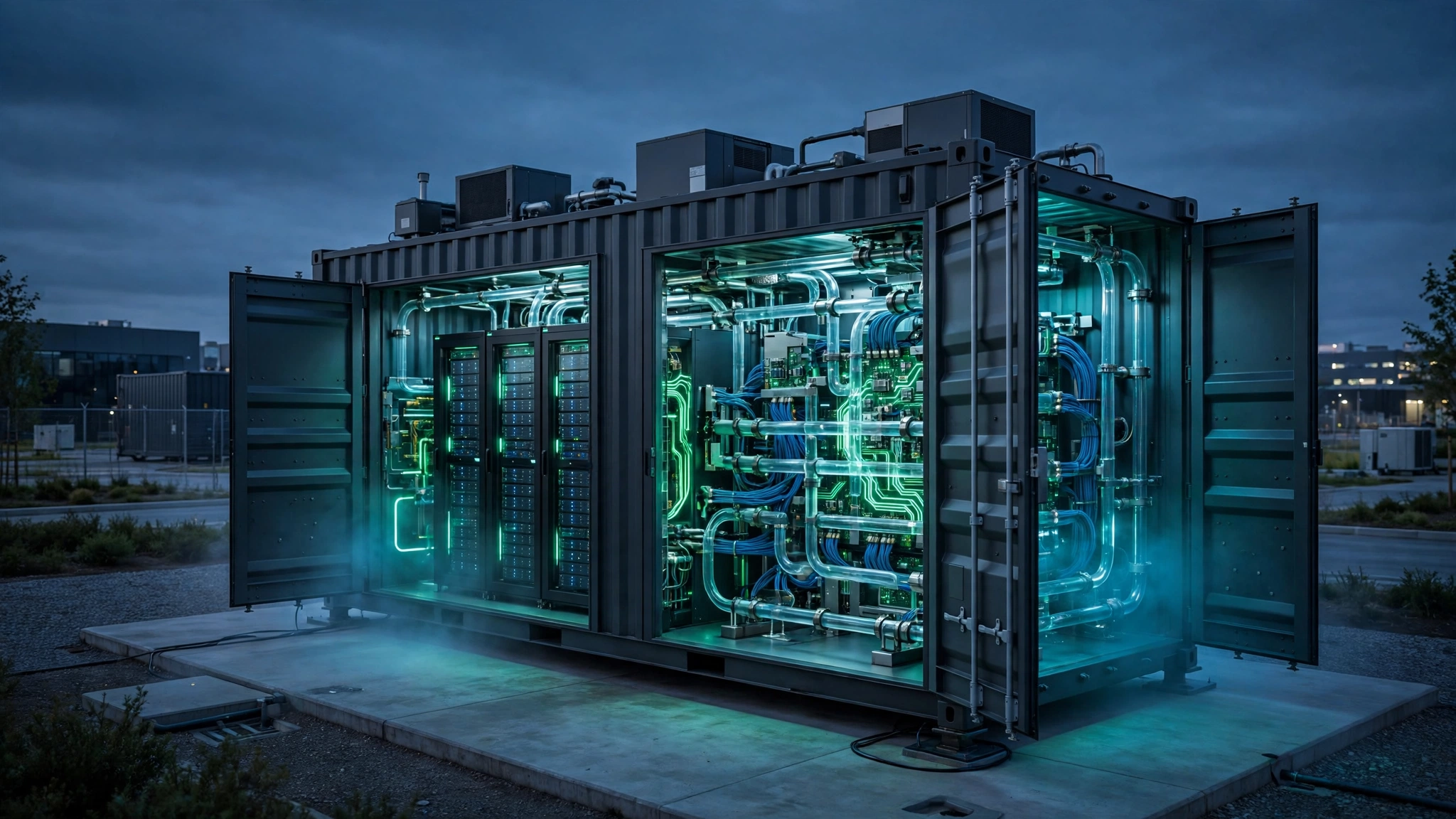
Nvidia Unveils DSX POD: A Container-Size AI Data Center That Deploys in 14 Days
Key takeaway: On October 21, 2026, Nvidia CEO Jensen Huang unveiled DSX POD at GTC Berlin: a complete Vera Rubin AI data center built inside a shipping-container-size module by partners like Dell and HPE. Once site power, cooling, and networking are ready, on-site installation shrinks from six months to as little as 14 days.
What Nvidia announced at GTC Berlin
Nvidia on Wednesday introduced DSX POD, a reference design for complete Vera Rubin AI factories that partners build inside modular containers, integrate, and validate before delivery. Huang showed off the system during his keynote at the company’s GTC conference in Berlin, framing it as “a complete transformation of the world supply chain” that “will change the way that people install and build data centers.” [Nvidia blog]
The pitch is simple: AI data centers are taking too long to come online for the demand of the AI boom. DSX POD packs a complete Vera Rubin AI factory into a box about the size of a standard shipping container, arrives ready to connect to prepared site power, cooling, networking, and supporting infrastructure — and can start producing tokens in as little as 14 days instead of six months. [Investor’s Business Daily]
Nvidia’s hardware partners expect to begin delivering the systems worldwide in early 2027. Partners named so far include Dell Technologies, Hewlett Packard Enterprise, Vertiv, Schneider Electric, Eaton, and Siemens. [Investor’s Business Daily; The Register]
What’s inside a DSX POD
According to technical coverage of the keynote, each containerized unit starts with seven liquid-cooled Vera Rubin NVL72 computing racks — 504 GPUs and 252 Vera CPUs — connected by 17 kilometers of Spectrum-X networking cables. The design uses dry cooling rather than traditional evaporative cooling, and 800V DC for efficient power delivery. [The Next Platform]
The ~28 metric ton containers come fully cabled, integrated, and factory-tested, so problems get caught at the factory rather than after a customer has wired everything up on site. Like a trailer home, the pods are customizable — HPE or Dell, Eaton or Schneider — and capacity grows by simply adding another container. [The Register]
Nvidia also says the DSX AI Factory Platform can reduce water consumption for cooling by up to 100% and generate the same AI output with up to 30% less power. [Nvidia blog]
Why 14 days matters: the economics of AI factories
“An AI factory creates value when it starts producing tokens — not when construction is complete,” Huang said at the keynote. To make the point, he offered an illustrative example: a 1-gigawatt AI data center costs about $50 billion to build, and assuming $40 billion in annual revenue, a three-month delay in going live wipes out $10 billion in revenue opportunity. [The Hindu (via Reuters)]
That logic is easy to understand and use: for operators, faster deployment means earlier commercial operations and revenue; for Nvidia, it means customers can scale capacity faster and its partners start shipping revenue-generating systems sooner. Nvidia stock climbed nearly 2% to $220.50 in midday trading on the news. [Investor’s Business Daily]
The Berlin setting carried its own message. Huang’s keynote was heavily aimed at Europe’s AI ambitions, telling the audience: “We could do all of that here in Europe, and in fact, we’ve already started” — part of a broader push to position Nvidia’s full stack, from hardware to CUDA-X libraries and models, as the foundation for European AI infrastructure. [Nvidia blog]
Analysis: the knowns, the unknowns, and what to watch
Known: DSX POD is a real, announced reference design with named hardware partners and a delivery window of early 2027. The engineering is an evolution of Nvidia’s standard DSX architecture — containerized rather than fundamentally new silicon — which makes the timeline credible. The economic argument Huang presented is directionally solid: in a capacity-constrained AI boom, deployment speed directly pulls forward revenue.
Unknown: Nvidia has not disclosed per-pod pricing, and the headline 14-day figure assumes site utilities — power, cooling, networking — are already prepared, which is often the hard part of a data center build. Whether factory validation truly eliminates on-site delays at scale is a claim only real deployments can prove. No customers have been named yet.
What to watch: the first partner-built pods rolling off production lines in early 2027; whether operators publicly report deployment times close to the 14-day target; how modular data-center competitors respond; and whether the containerized approach becomes a default procurement option for European sovereign-AI projects that Huang was courting in Berlin.
Separately at the same keynote, Huang also unveiled the OpenShell Reference Architecture — a hardware-and-software recipe for containing and monitoring AI agents, built on Vera Rubin systems, Vera CPUs, and BlueField-4 chips. SpaceX’s AI unit is among the companies reportedly working with it, alongside Anthropic, AWS, Google Cloud, Meta, Microsoft, OpenAI, Perplexity, and SAP. [Tesla Newswire]
How this fits the bigger picture
DSX POD lands in the middle of a global scramble for AI computing capacity. Custom AI chips are in an arms race — see Microsoft’s Maia 300 reveal from earlier this month — and analysts are already warning about the scale of AI infrastructure spending: Gartner recently estimated $3.5 trillion in AI infrastructure investment could be impaired by 2030. [Gartner warning on USABite] Speed of deployment is becoming a competitive lever in its own right, and Nvidia just made it a product.
FAQ
What is Nvidia DSX POD?
DSX POD is a reference design announced by Nvidia at GTC Berlin on October 21, 2026: a complete Vera Rubin AI data center built by partners inside a modular shipping-container-size unit. Each pod is integrated, cabled, and factory-tested before delivery, then connected to prepared site utilities on arrival.
How does DSX POD cut deployment time from six months to 14 days?
By moving assembly, integration, cabling, and testing from the customer site to the factory. The container arrives as a complete, validated system — the on-site work is reduced to hooking up power, cooling, and networking. The 14-day figure assumes those site utilities are already prepared.
What hardware is inside each DSX POD?
Each container holds seven liquid-cooled Vera Rubin NVL72 racks with 504 GPUs and 252 Vera CPUs, connected by 17 kilometers of Spectrum-X networking cables. It uses dry cooling instead of evaporative cooling and 800V DC power delivery. The container itself weighs about 28 metric tons.
When will Nvidia DSX POD be available?
Nvidia’s hardware partners — including Dell, HPE, Vertiv, Schneider Electric, and Eaton — expect to begin delivering DSX POD systems worldwide in early 2027.
Why is faster AI data center deployment so valuable?
Because an AI factory only earns money once it starts producing tokens. Nvidia illustrated the point: on a $40-billion-annual-revenue data center, a three-month delay in going live equals roughly $10 billion in lost revenue opportunity. Faster deployment pulls investment payback forward.
Sources
- Nvidia blog — GTC Berlin 2026 keynote live updates (October 21, 2026)
- The Hindu — “NVIDIA targets 14-day AI data centre deployment with modular system” (Reuters photo, October 21, 2026)
- Investor’s Business Daily — “Nvidia Aims To Speed Deployment Of AI Factories” (October 21, 2026)
- The Register — “Nvidia’s grand plan for speeding up datacenter deployments” (October 21, 2026)
- The Next Platform — “Huang shrugs off protestors to kick off GTC Berlin with DSX Pods, Robots” (October 21, 2026)
Like USABite’s explainers? Add USABite as a Preferred Source in Google Search so our coverage shows up in your results.