AI-Powered Full-Stack Marketing Explained: How AI Runs the Whole Marketing Stack
Key takeaway: AI-powered full-stack marketing means using artificial intelligence across every layer of marketing — strategy, content, SEO, ads, email, social media and analytics — instead of treating each channel as a separate job. One shared data picture connects the layers, so AI can plan, create, target, spend and measure as one system, while humans keep control of strategy, brand voice and final decisions.
What AI-powered full-stack marketing actually means
“Full-stack marketing” borrows an idea from software: one person or team covers the whole stack, from strategy down to measurement, instead of handing each channel to a different specialist. Add AI to that model and the tools do much of the heavy lifting at every step — researching keywords, drafting content, targeting ads, scoring leads and spotting what is working.
The key word is connected. AI-powered full-stack marketing is not just “using AI tools.” It is using AI across channels that share data, so a lesson learned in paid ads can shape the next blog post, and an email that converts can inform the next ad audience. As one marketing guide puts it, a full-stack marketer manages strategy, content creation, analytics, optimisation and measurement across all channels — and AI makes that breadth realistic for smaller teams too (Syntactics).
That breadth is becoming normal. McKinsey’s State of AI 2025 survey found that 88% of organisations now use AI in at least one business function, up from 78% the year before, with marketing and sales among the functions where adoption is most common (Libertify summary of McKinsey’s report). The shift is not about one clever tool. It is about AI becoming part of the everyday marketing workflow.
The five layers of the AI-powered full-stack marketing stack
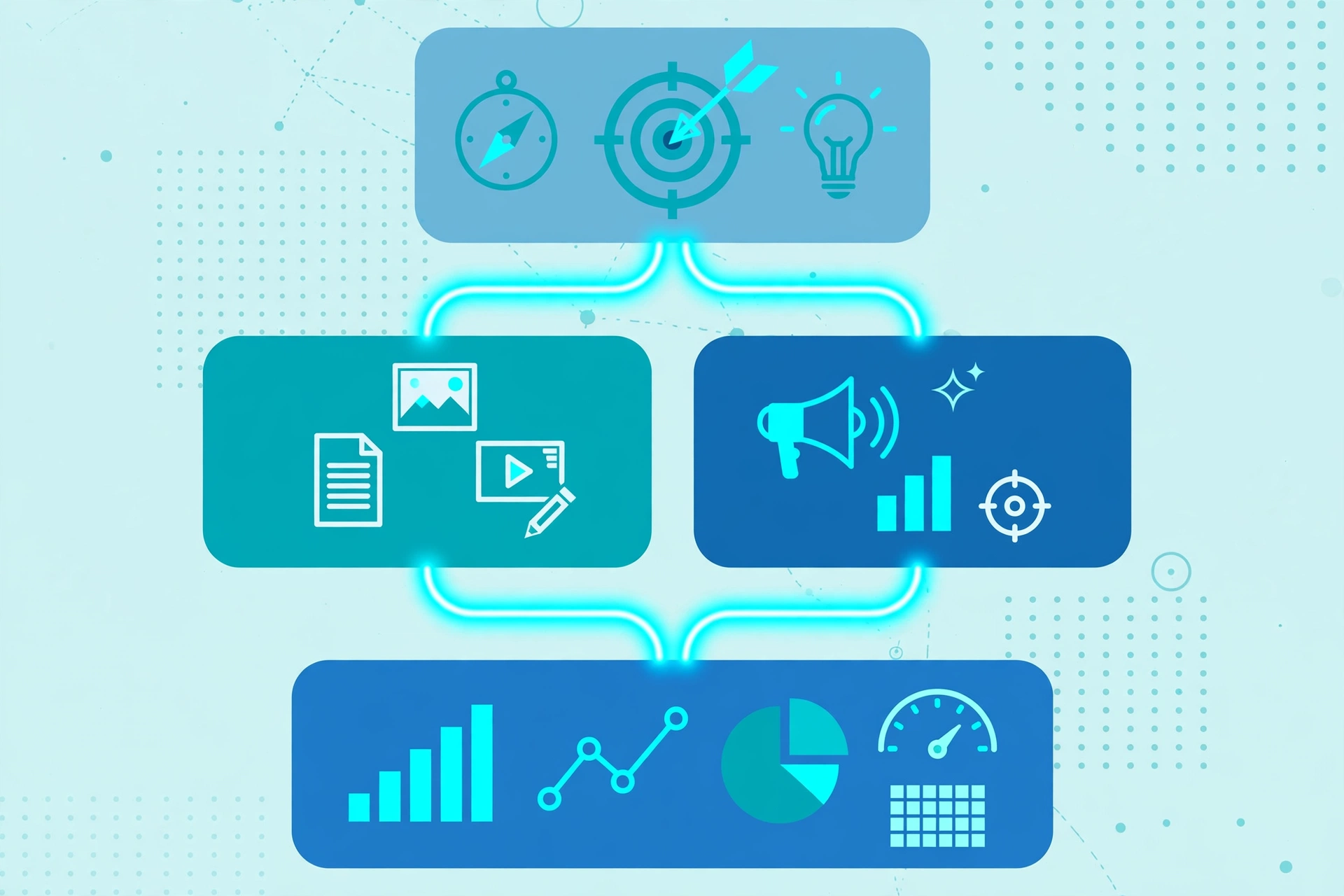
A useful way to picture the stack is in layers. Each layer has a job, and AI speeds up that job while feeding results back to the others:
| Layer | What it does | Where AI helps |
|---|---|---|
| Strategy and research | Decide who you serve, what you say and where you show up | Audience analysis, keyword intelligence, competitor research |
| Content and SEO | Attract people searching for answers | Topic ideas, outlines, drafts, on-page optimisation |
| Paid ads and social | Reach people who are not searching yet | Audience targeting, ad creative variations, budget shifts |
| Email and nurturing | Turn interest into sales over time | Send-time optimisation, personalisation, lead scoring |
| Analytics and measurement | Prove what worked and what to do next | Anomaly detection, reporting summaries, next-best-action suggestions |
An AI marketing stack is simply the collection of tools that covers these jobs — including AI features already built into CRMs, analytics platforms and ad platforms, not just standalone AI apps. As Brafton’s guide to the AI marketing stack notes, a working stack gives every tool a defined role, lets important systems exchange data, and avoids duplicate capabilities (Brafton).
Why teams are moving to this model
Three practical reasons explain the appeal. First, speed: AI drafts, tests and reports far faster than manual work, so a small team can run campaigns that once needed several specialists. Second, consistency: when one shared brief and one data picture feed every channel, the brand stops saying different things in ads, emails and blog posts. Third, learning: because results flow back into one system, each campaign starts smarter than the last.
There is a related point about people, not just tools. AI has made it easier for one capable marketer to cover more ground — keyword research, first-draft copy, basic design and data analysis can all move faster with the right toolkit. The catch, as one guide to the full-stack marketer role warns, is that AI cannot judge whether content sounds like your brand or whether the strategy behind it makes sense. That judgment is still a human job (Bradlee Bartlett).
Traditional marketing vs AI-powered full-stack marketing
| Traditional, channel-by-channel marketing | AI-powered full-stack marketing | |
|---|---|---|
| Team shape | Separate specialists per channel | One small team or marketer across the stack, AI-assisted |
| Data | Siloed in each platform | Shared picture across channels |
| Content production | One piece at a time, longer cycles | AI drafts at scale; humans edit for voice and accuracy |
| Optimisation | Weekly or monthly manual reviews | Continuous testing and budget shifts, reviewed by humans |
| Main risk | Slow, inconsistent messaging | Over-automation and generic, off-brand output |
How to start without overhauling everything
You do not need to rebuild your marketing to try this approach. Start with the bottleneck:
- Pick one funnel, not every channel. Choose a single journey — for example, search visit to email signup to sale — and connect AI across just that journey first.
- Fix the data before adding tools. If ad, email and website data cannot be compared, AI will optimise each channel in isolation. A shared dashboard or CRM comes before a new AI app.
- Give AI the repetitive work. Drafts, variations, reporting summaries and lead scoring are strong starting points. Strategy, positioning and final approvals stay human.
- Run a 30-day pilot with one metric. Measure time saved or cost per lead, not a dozen vanity metrics. Only expand the stack if the pilot earns it.
- Write the guardrails down. Which claims AI may never make, which audiences it may not target, and who signs off before anything goes live.
Our earlier guide to automation implementation makes the same point in a wider context: pilot small, prove value, then scale. The same discipline applies here.
Analysis: where AI helps most — and where it does not
Analysis, not a verified fact: the strongest version of this model treats AI as infrastructure, not as the marketer. Teams that win with it tend to be the ones with the clearest positioning and the strictest editing, because AI multiplies whatever it is given — sharp strategy becomes sharper output, and vague strategy becomes generic output at high volume. The most common failure is not a bad tool. It is buying five overlapping tools, connecting none of them, and calling the result a stack.
That is also why the “full-stack” part matters as much as the “AI-powered” part. A single clever ad tool does not change how a business grows. A connected system — where targeting lessons from ads improve content, and content performance refines email — does, because every part of marketing gets smarter from the same evidence. Readers interested in the targeting side can see how that piece works in our explainer on what smart targeting is.
Frequently asked questions
What is AI-powered full-stack marketing?
AI-powered full-stack marketing means using artificial intelligence across the whole marketing function — strategy, content, SEO, paid ads, email, social media and analytics — as one connected system rather than separate channel jobs. AI handles repetitive work like research, drafting, targeting and reporting, while humans own strategy, brand voice and final decisions.
How is it different from hiring separate marketing specialists?
Separate specialists go deep in one channel each, which suits large teams with established channels. A full-stack approach covers the whole journey with a smaller team, using AI to handle breadth. The trade-off is depth: a full-stack team may need outside help for highly specialised work, such as complex technical SEO or large-scale media buying.
What tools make up an AI marketing stack?
A typical stack covers content creation, SEO, social media, email automation, ads and analytics, often with AI features already built into existing platforms like a CRM or ad manager. The exact tools matter less than the rules: each tool should have one clear job, share data with the others, and not duplicate another tool’s work.
Can a small business use AI-powered full-stack marketing?
Yes, and small teams often benefit most, because AI lets one or two people run campaigns that once needed several specialists. The practical path is to start with one funnel, fix the shared data first, and add tools only where there is a clear bottleneck, rather than buying a full suite on day one.
What are the risks of letting AI run marketing?
The main risks are generic off-brand content, inaccurate claims published without review, and over-automation that optimises for clicks instead of real customers. Guardrails help: human approval before publishing, a list of claims AI may never make, and regular checks that results are measured in sales or leads, not just traffic.
Sources: Syntactics — How AI-First Full-Stack Marketers Dominate Modern Marketing; Brafton — AI Marketing Stack vs. Tool Sprawl; Bradlee Bartlett — What Is a Full Stack Marketer?; Libertify — McKinsey State of AI 2025 summary.
If you found this useful, you can add USABite as a preferred source in Google Search to see more of our coverage in your results.