

Emerging Trends in Information Technology: What to Watch in 2026 and Beyond
Key takeaway
Emerging trends in information technology in 2026 share one theme: AI is moving from experiments to everyday operations. Agentic AI systems now act on their own, AI is entering physical machines, and companies are rebuilding infrastructure, teams, and security around that shift. The winners will be the organisations that scale carefully, not the ones that adopt fastest.
What is changing in information technology right now
For years, most companies treated AI as a pilot project — a chatbot here, a recommendation engine there. That phase is ending. Deloitte’s Tech Trends 2026 report, the 17th annual edition, says this year is “all about scaling”: enterprises are moving from experimentation to impact, and AI now informs decisions from computing hardware to physical robotics. The report looks at trends set to become normal over the next 18 to 24 months.
Gartner’s view points the same way. Its 2026 technology trends for supply chains and the enterprise are organised around three themes — autonomy and agency, specialization and intelligence, and trust and governance — with agentic AI, collaborative multiagent systems, physical AI, and polyfunctional robots leading the list, as reported by Dataconomy and Inside Logistics.
The 5 trends shaping IT in 2026
Deloitte’s report names five interconnected forces. Here is each one in plain English.
1. AI goes physical
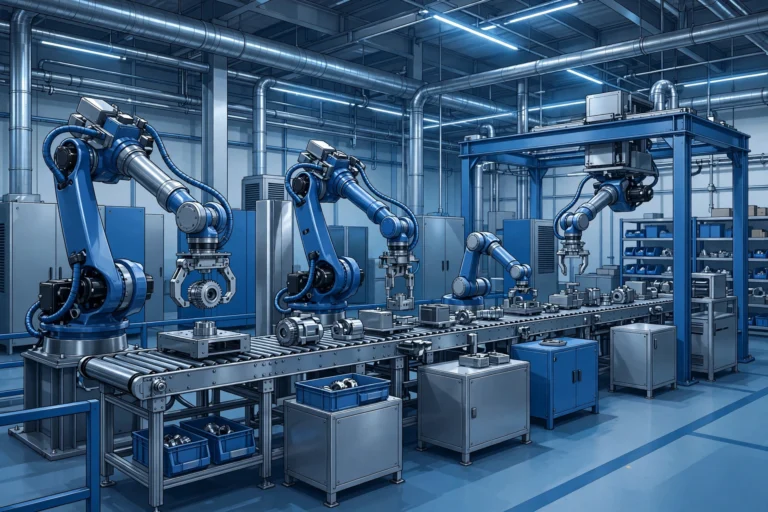
AI is leaving the screen and entering machines: autonomous robot fleets in warehouses, self-driving vehicles in factories, drones inspecting infrastructure, and humanoid robots doing physical tasks in healthcare, logistics, and energy. This is the convergence of AI and robotics, and it is why factory and warehouse technology now looks so different from office software. Our guide to IoT-enabled industrial automation explains how connected machines already run modern factories — physical AI is the next step on that road.
2. The agentic reality check
Agentic AI means software that does not just answer questions but takes multi-step actions on its own — booking, reconciling, ordering, or escalating without a human in the loop. Gartner projects that 40% of enterprise applications will feature task-specific AI agents by the end of 2026, up from under 5% a year earlier, and that 15% of day-to-day work decisions will be made autonomously by agentic AI by 2028. The reality check: Deloitte notes that many agentic projects fail because organisations automate broken processes instead of redesigning them. Only a minority of organisations have agents in production, despite far more running pilots.
3. The AI infrastructure reckoning
Running AI at scale is expensive, and the bill is now impossible to ignore. Companies are rethinking compute strategy — which models to run, where to run them, and what inference (the cost of actually using a model) really costs. Deloitte’s TMT predictions put nearly US$100 billion of global investment into sovereign AI computing in 2026, as countries and companies outside the US and China build domestic AI capacity. Deloitte also reports that tech budgets allocated to AI are projected to rise from an average of 8% to 13%.
4. The great rebuild
AI is forcing a rebuild of the technology organisation itself: team structures, governance, and workflows designed for an AI-native world. Deloitte reports that 78% of tech leaders anticipate integrating AI agents into architecture workflows within five years, and nearly 70% plan to expand their teams in response to generative AI — adding roles such as AI architects and human–AI collaboration designers rather than simply cutting headcount.
5. The AI dilemma in cybersecurity
AI is both a weapon and a shield. Attackers use it to craft convincing phishing and deepfakes; defenders use it to detect threats faster. Gartner research cited in 2026 coverage expects over 50% of enterprises to adopt AI security platforms by 2028 to manage the risks of rapid AI adoption and “shadow AI” — unsanctioned AI tools inside the company. Trust and governance, including decision governance for systems that act without asking first, is now a first-class discipline.
Comparison: the trends at a glance
| Trend | What it is | Who feels it first |
|---|---|---|
| AI goes physical | AI inside robots, drones, and machines | Manufacturing, logistics, healthcare |
| Agentic AI | Software that acts, not just answers | Every knowledge-work team |
| AI infrastructure reckoning | Cost and location of AI compute | CIOs, finance, regulated industries |
| The great rebuild | AI-native teams and workflows | IT departments, large enterprises |
| The AI dilemma | AI for attack and defence | Security teams, compliance |
| Sovereign AI and satellites | Domestic compute, space connectivity | Governments, telecoms, remote regions |
What it costs, and what you need first
Cost: Deloitte’s TMT outlook estimates the global agentic AI market at $8.5 billion in 2026, growing to $35 billion by 2030, and says as many as 75% of companies may invest in agentic AI in 2026. For an individual company, the real cost is rarely the model licence — it is integration, data cleanup, governance, and the compute bill for inference at scale.
Prerequisites: Clean, governed data; clear ownership of each automated process; and an orchestration layer so agents can work together safely. Deloitte’s adjacent “signals” to watch include edge AI, neuromorphic computing, synthetic data, AI wearables, and biometric authentication — early signals that may become dominant forces.
Risks and limits: Agents acting on bad data or unclear rules can make expensive mistakes faster than humans can catch them. Organisations that skip the redesign step — automating a broken process as-is — are the ones most likely to join the failed-pilot statistics. Regulation also matters: data-sovereignty rules are pushing some AI workloads into local, sovereign infrastructure.
Why this matters to you
If you work in IT, these trends change what skills pay: agent orchestration, AI governance, and infrastructure economics are becoming core skills, alongside the traditional ones. If you run a business, the question is no longer whether to use AI but which processes to redesign first — and what guardrails to put around systems that act on their own. If you are simply a technology user, expect more of your tools to act proactively: conversational AI for the enterprise already shows how AI assistants are becoming colleagues rather than tools, and Google’s AI Mode shows how even search is shifting from ranked links to cited answers.
Analysis: what to watch next
Analysis, not a verified fact: the most important split in 2026 may not be between companies that use AI and those that do not, but between companies that redesign work around AI and those that bolt AI onto old workflows. The first group gets compounding gains; the second gets pilot projects that never reach production. Watch three signals: whether agent projects reach production (not just pilots), whether AI security platforms become standard purchases, and whether sovereign-AI investment stays near the projected US$100 billion level. Also watch connectivity: Deloitte forecasts low-Earth-orbit satellites reaching roughly US$15 billion in annual revenues in 2026 with more than 15 million subscribers, and direct-to-device satellite investment of US$6–8 billion — a reminder that information technology trends are not only about AI.
Sources
- Deloitte — Tech Trends 2026 (official report page)
- Dataconomy — Gartner names agentic and physical AI top supply chain trends for 2026
- Inside Logistics — Gartner identifies agentic AI, physical AI among top supply chain technology trends for 2026
- ChannelLife — Deloitte forecasts AI, data centres & media shifts by 2026
Frequently asked questions
What are the emerging trends in information technology in 2026?
The leading trends are agentic AI that acts on its own, AI moving into physical machines and robots, a reckoning over AI infrastructure costs, a rebuild of IT organisations around AI, and AI’s dual role in cybersecurity. Deloitte’s Tech Trends 2026 report names these five forces, and Gartner’s 2026 trends echo the same themes of autonomy, specialization, and governance.
What is agentic AI, and why does it matter?
Agentic AI is software that carries out multi-step tasks independently, such as reconciling records or managing a workflow, rather than only answering questions. It matters because Gartner projects 40% of enterprise applications will include task-specific AI agents by the end of 2026, up from under 5% a year earlier, which would change how most office work gets done.
How much are companies spending on AI in 2026?
Deloitte’s TMT outlook estimates the global agentic AI market at $8.5 billion in 2026, rising to $35 billion by 2030, with as many as 75% of companies investing in agentic AI in 2026. Separately, Deloitte reports tech budgets allocated to AI rising from an average of 8% to 13%, and nearly US$100 billion going into sovereign AI computing.
What is physical AI?
Physical AI is the convergence of artificial intelligence with robotics and machines, so intelligence moves from screens into the physical world. Examples include autonomous robots in warehouses, self-driving vehicles in factories, and drones inspecting infrastructure in energy and logistics.
How should a business prepare for these information technology trends?
Start by redesigning one broken process before automating it, clean and govern the data agents will use, set guardrails for systems that act without human approval, and budget for inference and integration costs rather than just licences. Pilot one agentic workflow to production, measure the result, and only then scale to the next process.



One Comment
Comments are closed.